

On the night of July 17, 1918, in a basement in Yekaterinburg, Russia, the Romanov family—Tsar Nicholas II, his wife Alexandra, their five children, and four loyal servants—were awakened and told to dress quickly. They were led down to a small room and told to wait. Then, without warning, a death squad burst through the door and opened fire. The Russian Revolution had claimed its most famous victims. But in the decades that followed, rumors persisted that one member of the royal family had miraculously survived the massacre: the youngest daughter, Grand Duchess Anastasia. Her story became one of the 20th century’s most haunting mysteries—a tale of lost identity, desperate hope, and a question that would haunt investigators for nearly 90 years: Did Anastasia Romanov escape death that terrible night?
The Romanovs: A Dynasty Doomed
To understand the mystery of Anastasia, we must first understand who the Romanovs were and why they met such a brutal end.
The Romanov dynasty had ruled Russia for over 300 years, presiding over a vast empire that stretched from Europe to Asia. Tsar Nicholas II ascended to the throne in 1894, inheriting absolute power over millions of subjects. He married Princess Alexandra of Hesse, a granddaughter of Queen Victoria, and together they had five children:
- Olga (born 1895) – The eldest, serious and thoughtful
- Tatiana (born 1897) – Elegant and composed, her mother’s favorite
- Maria (born 1899) – Kind-hearted and beautiful
- Anastasia (born 1901) – The youngest daughter, mischievous and spirited
- Alexei (born 1904) – The long-awaited heir, who suffered from hemophilia
The family appeared to live a charmed existence, residing in opulent palaces and enjoying the privileges of royalty. But beneath the surface, cracks were forming in the Romanov empire.
Nicholas II was a weak and indecisive ruler. Russia’s disastrous involvement in World War I brought economic collapse, military defeats, and mass starvation. The Tsarina’s reliance on the mystic healer Grigori Rasputin (who seemed able to help young Alexei’s hemophilia) scandalized the nation. Revolutionary fervor was growing, and by 1917, the monarchy’s days were numbered.
Revolution and Captivity
In March 1917, revolution erupted. Nicholas II was forced to abdicate, ending three centuries of Romanov rule. The family was placed under house arrest, first at their palace in Tsarskoye Selo, then later moved to increasingly remote and harsh locations as different political factions fought for control of Russia.
The Bolsheviks, led by Vladimir Lenin, eventually seized power and established a communist government. They viewed the Romanovs not just as deposed royalty but as dangerous symbols of the old order that must be completely eliminated.
In April 1918, the family was transferred to Yekaterinburg in the Ural Mountains and imprisoned in a mansion that became known as the “House of Special Purpose” (Ipatiev House). Their living conditions deteriorated. They were confined to a few rooms, under constant guard, with their windows painted over so they couldn’t see out.
The family’s letters and diaries from this period reveal they remained remarkably resilient despite the circumstances. Anastasia, then 17 years old, tried to maintain her spirited sense of humor. The family drew together, supporting each other, praying, and hoping for rescue that would never come.
The Night of July 16-17, 1918
By mid-July 1918, the Bolsheviks faced a crisis. The Russian Civil War was raging, and the anti-Bolshevik White Army was advancing toward Yekaterinburg. There was a real possibility that the Whites might reach the city and liberate the Romanovs, potentially restoring the monarchy.
The Bolshevik leadership in Moscow—possibly including Lenin himself, though this remains disputed—made a decision: the Romanovs must be executed immediately.
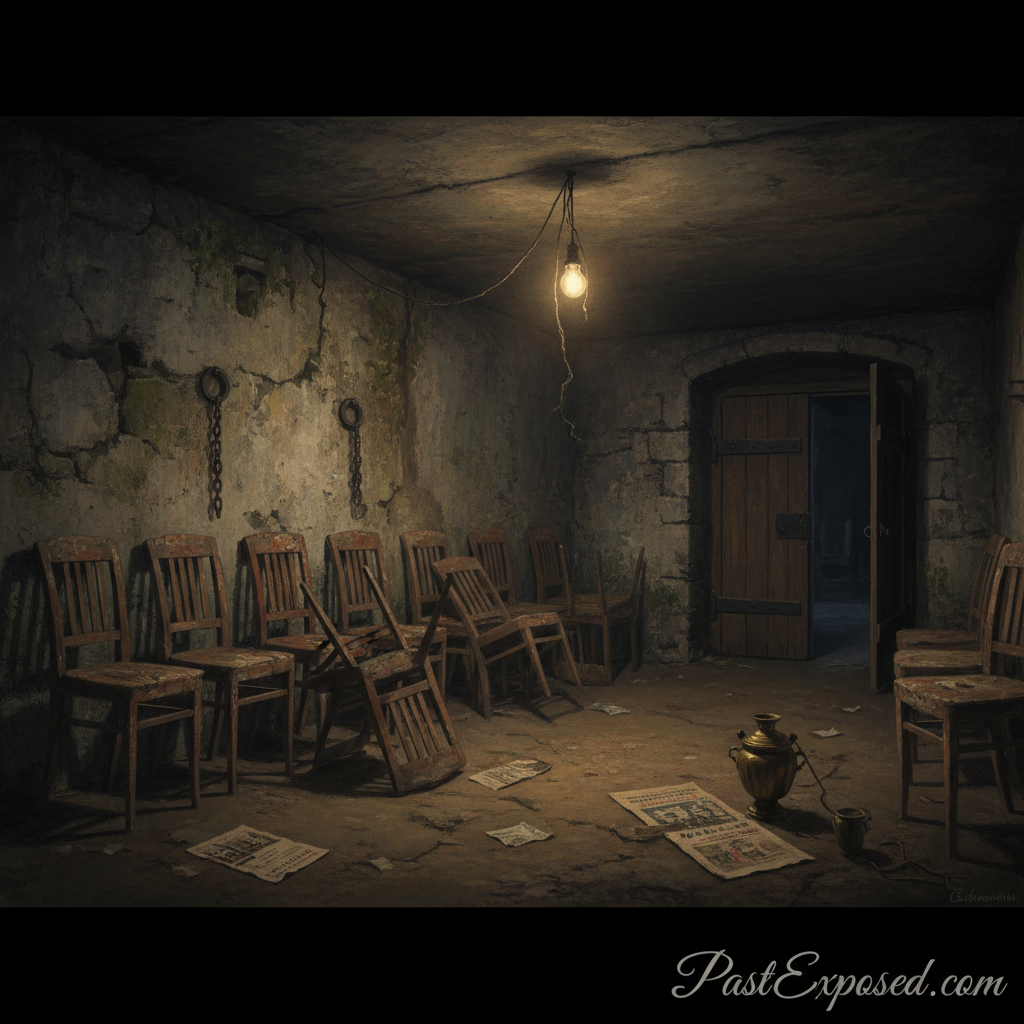
Just after midnight on July 17, 1918, the family and their remaining servants were awakened by Yakov Yurovsky, the commandant of the house. He told them that anti-Bolshevik forces were approaching and that they needed to move to the basement for their own safety.
The family dressed quickly. The girls wore specially made bodice corsets in which they had sewn diamonds, jewels, and precious stones—their portable wealth, hidden in case they ever escaped or were rescued. They had no idea these jewels would play a terrible role in what was about to happen.
Eleven people descended to the basement room: Tsar Nicholas, Tsarina Alexandra, their five children (Olga 22, Tatiana 21, Maria 19, Anastasia 17, and Alexei 13), the family physician Dr. Botkin, the Tsar’s valet, the Tsarina’s maid, and the family’s cook.
Chairs were brought for Alexandra and Alexei, who was ill and unable to stand for long periods. The others stood in a semi-circle. Nicholas held Alexei in front of him.
Yurovsky returned with the execution squad—ten men armed with revolvers. What happened next was chaos and horror.
The Execution
Yurovsky read a brief statement announcing that the Ural Executive Committee had sentenced them to death. Nicholas barely had time to say “What?” before Yurovsky raised his revolver and shot him in the head.
The other executioners opened fire. The room filled with gun smoke, screams, and the deafening sound of gunshots in the enclosed space. But something strange happened—some of the victims weren’t dying.
Bullets ricocheted off the girls’ bodies, seemingly bouncing off their chests and backs. The executioners didn’t know about the jewels sewn into the corsets, which acted like improvised body armor. The room descended into pandemonium as the wounded victims screamed and stumbled.
When the shooting stopped, several people were still alive, moaning and crying. The executioners finished the job with bayonets and the butts of rifles, a process that took another 20 minutes of horror.
Yurovsky later wrote in his memoirs that the entire execution took about 20 minutes and described it as “difficult work.” The bodies were then loaded onto a truck and taken to an abandoned mine shaft in the forest.
The Cover-Up and the Rumors Begin
The Bolsheviks initially announced only that Nicholas had been executed, claiming the family had been moved to a “secure location.” The truth about the complete massacre was kept secret for years.
The bodies were thrown down a mine shaft, but Yurovsky and his men quickly realized this wasn’t secure enough—the area might be discovered by the advancing White Army. They retrieved the bodies, attempted to destroy them with acid and fire, and eventually buried them in a hastily dug grave in the forest.
But the chaos of that night, combined with the Bolsheviks’ secrecy and the isolated location of the murders, created conditions perfect for rumors to flourish. Within months, stories began circulating that one or more of the Romanov children had survived.
When the White Army captured Yekaterinburg a few days after the murders, they conducted an investigation. They found the Ipatiev House, discovered evidence of the killings, and located the mine shaft where the bodies had initially been dumped. But no bodies were there—only personal items, pieces of clothing, and bone fragments.
The lack of bodies, combined with confused and contradictory witness testimonies, led many to believe some of the family might have escaped. And of all the Romanov children, Anastasia became the focus of the most persistent rumors.
Why Anastasia?
Several factors made Anastasia the center of survival rumors:
Her Age: At 17, she was young enough to possibly survive but old enough to potentially make her way to safety and establish a new identity.
Her Personality: Anastasia had been known for her spirit, wit, and mischievousness. She was clever and resilient—the kind of person people could imagine surviving impossible odds.
The Confusion: Some early reports (later proven false) suggested that one of the younger daughters might have survived the initial shooting.
Hope: Perhaps most importantly, people wanted to believe. The brutal murder of children was almost too terrible to accept. The idea that one might have escaped provided a small measure of redemption in an otherwise irredeemably dark story.
The Claimants: Women Who Said “I Am Anastasia”
Over the next decades, multiple women came forward claiming to be the Grand Duchess Anastasia. Most were quickly dismissed as frauds or delusional. But a few cases captured international attention.
Anna Anderson: The Most Famous Claimant
In 1920, a young woman was pulled from a canal in Berlin after an apparent suicide attempt. She refused to identify herself and was admitted to a psychiatric hospital. For two years, she remained silent about her identity, but eventually began telling doctors and fellow patients that she was Anastasia Romanov.
She claimed that she had been wounded in the execution but had been rescued by a sympathetic guard named Alexander Tchaikovsky (she even took the name Anna Tchaikovsky, later changed to Anna Anderson). She said she had been smuggled out of Russia, given birth to a child fathered by Tchaikovsky, and eventually made her way to Berlin where despair drove her to attempt suicide.
Anna Anderson’s case became a decades-long sensation that divided Romanov survivors, historians, and the public:
Evidence Supporting Her Claim:
- She had detailed knowledge of Romanov family life, court etiquette, and personal details that seemed impossible for an outsider to know
- She had physical scars consistent with bayonet wounds
- Several people who had known Anastasia believed Anna was genuine, including Anastasia’s childhood tutor and one of the Tsar’s relatives
- She bore a physical resemblance to Anastasia
- She spoke German with an accent that some believed matched Anastasia’s
Evidence Against Her Claim:
- Other Romanov relatives who had known Anastasia personally rejected her as an impostor
- She couldn’t speak Russian fluently, though Anastasia had been a native Russian speaker
- She got many factual details about the Romanov family wrong
- Private investigators determined she was likely Franziska Schanzkowska, a Polish factory worker who had gone missing around the time “Anna” appeared in Berlin
- Her fingerprints didn’t match those of Anastasia
Anna Anderson spent decades fighting legal battles for recognition as Anastasia and for access to Romanov inheritance. She never won her case in court. She moved to the United States in the 1960s, married a man named Jack Manahan, and lived in Virginia until her death in 1984.
Even after her death, her supporters insisted she was genuine. The mystery seemed destined to remain unsolved forever—until science intervened.
The DNA Revolution
In 1991, after the fall of the Soviet Union, a Russian amateur historian named Alexander Avdonin revealed that he had secretly located the burial site of the Romanov family in 1979. Working with a geologist, he had quietly dug up part of the remains but reburied them, fearing Soviet reprisals.
With the new political climate, official excavation began. In a shallow grave in the forest near Yekaterinburg, investigators found the remains of nine bodies. The bones were shattered, burned, and damaged by acid—exactly as Yurovsky had described in his accounts.
But there were only nine bodies. Two were missing. The initial analysis suggested the absent bodies were one of the daughters (either Anastasia or Maria) and Alexei.
DNA testing began, using samples from living Romanov relatives, including Prince Philip, Duke of Edinburgh (whose grandmother was the Tsarina’s sister). The results were conclusive: five of the bodies were the Tsar, Tsarina, and three of their daughters, along with the four servants.
But which three daughters? And where were the other two children?
For years, debate continued. Some Russian officials claimed Anastasia was among the discovered remains. Others argued she was one of the missing.
The Final Answer
The mystery finally ended in 2007, when amateur archaeologists discovered a second burial site about 70 meters from the first grave. This site contained the remains of two young people—a teenage boy and a young woman.
Extensive DNA testing in multiple independent laboratories confirmed these were the remains of Tsarevich Alexei and one of his sisters. Further analysis in 2009 definitively identified the sister as Grand Duchess Maria.
This meant that Anastasia’s remains were in the first grave, discovered in 1991. All eleven victims from that terrible night had been accounted for. Anastasia had not survived. She had died with her family in that basement room, killed by bullets and bayonets, her body burned and buried in an unmarked grave in the forest.
As for Anna Anderson, post-mortem DNA testing using tissue samples and hair preserved from her medical procedures conclusively proved she was not related to the Romanovs. She was indeed Franziska Schanzkowska, the missing Polish factory worker.
Whether Anna truly believed she was Anastasia, or whether she was a conscious fraud who perpetuated the deception for over six decades, remains a matter of debate.
Why Did the Legend Persist?
The mystery of Anastasia captured imaginations for nearly a century, spawning books, films, plays, and a animated movie. Why did this particular story have such power?
The Human Need for Hope: The Romanov massacre was a story of total tragedy. The idea that one family member—especially a young woman—might have survived offered a glimmer of hope in the darkness.
The Fairytale Element: A lost princess with hidden identity trying to reclaim her place is a story as old as storytelling itself. Anastasia’s story tapped into archetypal narratives deeply embedded in human culture.
Cold War Politics: During the Soviet era, the USSR had reason to keep the full truth about the Romanovs unclear. The mystery served political purposes on both sides.
The Passage of Time: The longer the mystery remained unsolved, the more it took on a life of its own, with each generation adding new layers to the legend.
The Truth About That Night
Modern forensic analysis, combined with historical documents released after the Soviet Union’s collapse, has given us a complete picture of what happened on July 16-17, 1918:
All eleven people in that basement room died. None escaped. The execution was brutal and chaotic, taking about 20 minutes because the jewels sewn into the girls’ clothing deflected some bullets, but ultimately all were killed. The bodies were taken to the forest, partially destroyed, and buried in two separate graves.
Anastasia Romanov was 17 years old when she died. According to forensic evidence, she likely survived the initial volley of gunfire (protected by her jewel-lined corset) but was killed shortly after by bayonets. She died alongside her parents, siblings, and the loyal servants who had chosen to stay with the family.
Legacy and Remembrance
In 1998, the remains from the first grave were finally laid to rest with full Orthodox Christian burial rites in the Peter and Paul Cathedral in St. Petersburg, the traditional burial place of Russian tsars. In 2015, after years of official hesitation, the remains from the second grave (Alexei and Maria) were also officially confirmed.
In 2000, the Russian Orthodox Church canonized the Romanov family as passion bearers—martyrs who faced death with Christian dignity.
Today, the Ipatiev House where the murders occurred no longer stands—it was demolished by Soviet authorities in 1977 to prevent it becoming a shrine. A church now stands on the site, the Church on the Blood, dedicated to the memory of the Romanov family.
The mystery of Anastasia is finally solved, though it took science nearly 90 years to provide definitive answers. There was no miraculous escape, no hidden identity, no lost princess waiting to be discovered. There was only a young woman, aged 17, who died terrified in a basement with her family, her body burned and hidden in the forest, her identity lost for decades. The real Anastasia was not a survivor who lived to tell her tale. She was a victim of one of the 20th century’s most brutal political murders. But perhaps there is something fitting in the fact that, for so many years, people believed she had survived. In their minds, Anastasia escaped that basement, started a new life, and lived on—because the alternative, the truth, was simply too terrible to accept. Now we know the truth. The mystery is solved. But the legend of Anastasia—the Grand Duchess who refused to die, if only in memory and hope—remains part of our collective consciousness, a reminder of a lost world, a vanished empire, and a young woman whose death became one of history’s most enduring mysteries.