
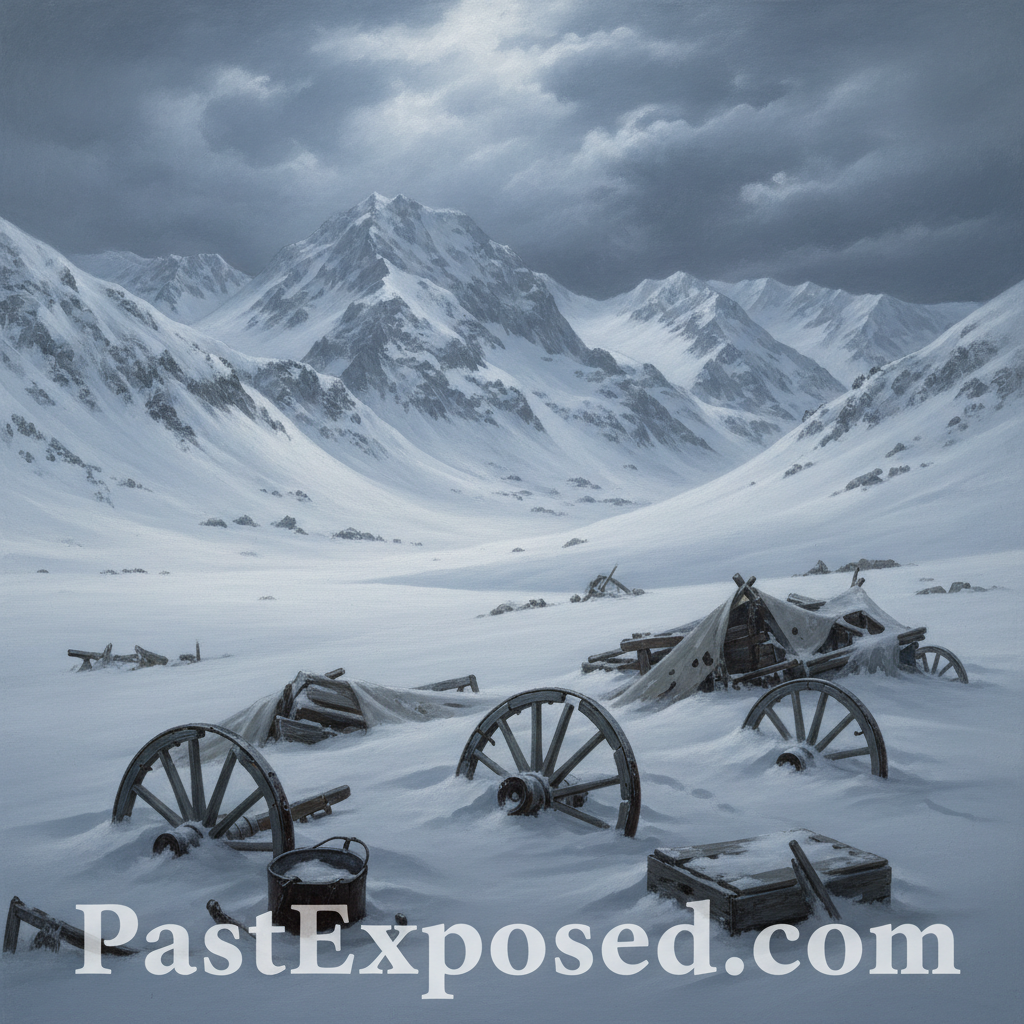
In the winter of 1846-1847, 87 pioneers seeking a better life in California found themselves trapped in the Sierra Nevada mountains, buried under snow 22 feet deep. What began as an optimistic journey toward the promise of the American West descended into one of the darkest chapters in frontier history—a five-month ordeal of starvation, madness, and unspeakable decisions that would haunt the survivors for the rest of their lives.
The Promise of California
In the spring of 1846, westward expansion was the fever dream of American families. California promised fertile land, mild weather, and boundless opportunity. The Donner and Reed families—prosperous, respectable middle-class Americans—organized a wagon train with other families from Illinois and joined thousands heading west on the California Trail.
George Donner, a 62-year-old farmer, traveled with his wife Tamsen (a former schoolteacher) and five daughters. James Reed, an Irish-born furniture manufacturer, brought his wife Margaret (who suffered from severe headaches and required constant care), his mother-in-law, and four children. These were not desperate people fleeing poverty—they were comfortable families seeking something better, equipped with well-stocked wagons, supplies, and optimism.
The journey should have taken about four months. They would be in California by early autumn, well before winter. Everything was planned, calculated, reasonable.
Then they read a book that changed everything.
Hastings’ Fatal Shortcut
Lansford Hastings, a lawyer and aspiring California land promoter, had published The Emigrants’ Guide to Oregon and California in 1845. In it, he described a new “shortcut” that would save pioneers 350-400 miles: the Hastings Cutoff, which bypassed the established route and went south of the Great Salt Lake through the Wasatch Mountains and across the salt flats.
There was one problem: Hastings had never actually traveled the route with wagons. He’d crossed it once on horseback and vastly underestimated its difficulty.
At Fort Bridger in Wyoming, the Donner Party faced a choice. Most wagon trains continued on the proven California Trail. But James Reed, an ambitious man convinced of his own judgment, persuaded the group to take Hastings’ shortcut. Several families decided to stick with the main trail. Those who followed Reed would come to envy them.
Hastings had promised to guide them personally, but when the party reached the cutoff point, they found only a note pinned to a branch: Hastings had left with an earlier group and suggested they follow his trail.
The Journey Becomes a Nightmare
The “shortcut” was a disaster from the beginning. The Wasatch Mountains required the party to literally cut a road through dense wilderness, moving only about one and a half miles per day. Wagons broke. Oxen died. Tempers flared.
On October 5, after an argument over a yoke of oxen, John Snyder struck James Reed with a whip handle. Reed stabbed Snyder in self-defense. Snyder died, and the group held a hasty trial. Though Reed claimed self-defense, the group banished him from the party, sending him ahead without weapons, food, or his family. His wife Margaret and their children remained with the wagon train.
Then came the salt flats—80 miles of blinding white nothingness that Hastings had claimed could be crossed in two days. It took six. Water was scarce. The salt dust choked men and animals. Wagons sank into the crust and had to be abandoned. Families lost everything—furniture, heirlooms, supplies carefully carried from Illinois.
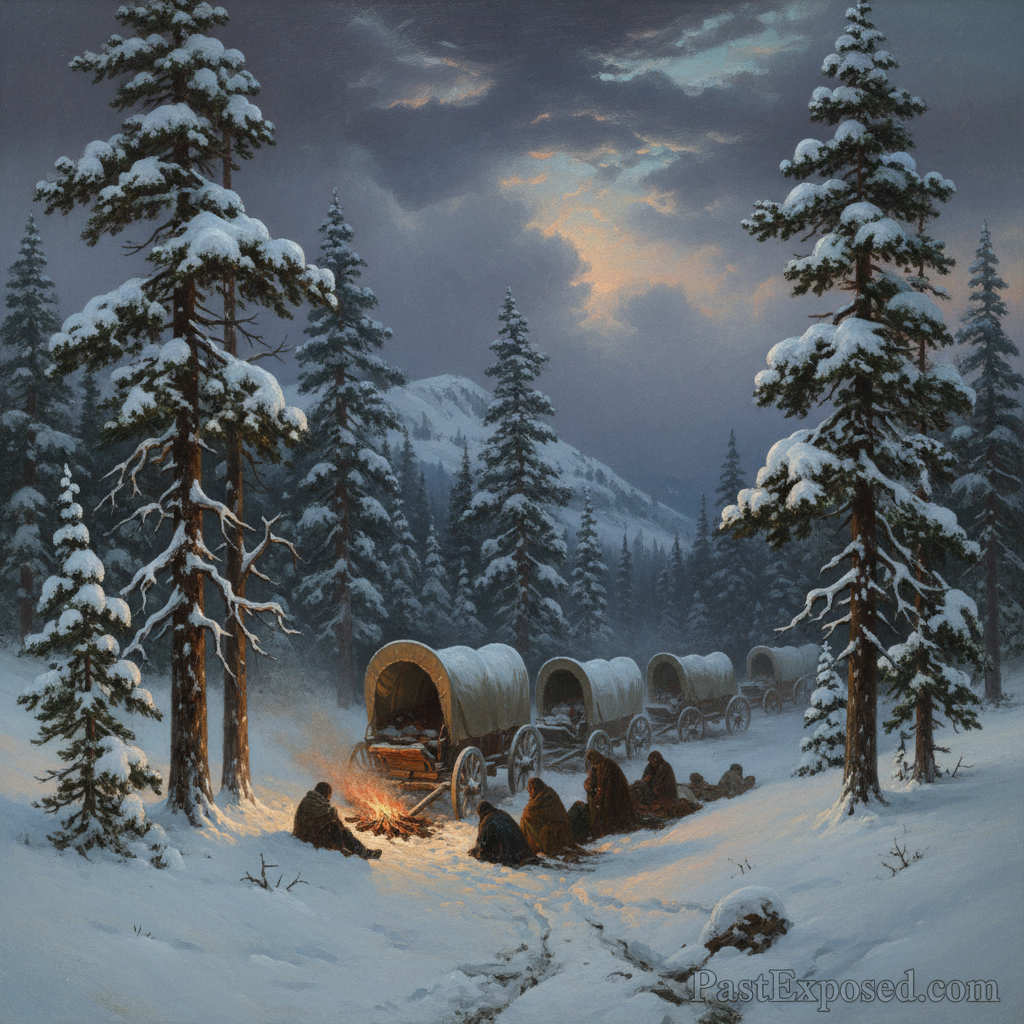
By the time they reached the Sierra Nevada foothills in late October, the party was already exhausted, short on supplies, and dangerously behind schedule. They should have been in California. Instead, they were about to enter the mountains—just as the first snow began to fall.
Trapped
On October 31, 1846, the party began their ascent into the Sierra Nevada. Light snow was falling. They pushed forward, hoping to cross the summit pass before the storms intensified.
On November 4, they camped at Truckee Lake (now Donner Lake), just three miles and 1,000 feet below the summit pass. That night, a massive storm hit. By morning, five feet of snow blanketed the ground, and the pass was impassable.
They tried again. And again. Each time, the snow drove them back. Within days, snow depths exceeded ten feet, then fifteen, then twenty. The Sierra Nevada had become a frozen prison.
The party was split between three camps: most families huddled in crude cabins near the lake, while the Donner families, whose wagons had broken down miles back, sheltered in tents at Alder Creek. These camps were six miles apart—a distance that would become almost insurmountable in the deepening snow.
Starvation Sets In
The pioneers had entered the mountains with dangerously low food supplies after the disasters of the Hastings Cutoff. Now, trapped with no game to hunt and no way forward or backward, they began to starve.
First, they slaughtered the remaining oxen and cattle, eating every edible part. When that was gone, they boiled the hides—tough, leathery strips that provided almost no nutrition but gave the illusion of eating. They scraped bones for marrow. They ate mice. They stripped trees of their bark and boiled it into a bitter, inedible mush that provided no sustenance.
Children cried constantly from hunger. Adults grew skeletal. The first deaths came in December—Baylis Williams, a hired hand, died on December 15. Then the elderly began to succumb: “Uncle Billy” Graves, Joseph Reinhardt, Augustus Spitzer. The living barely had the strength to bury the dead in the frozen ground.
In the cabins at Truckee Lake, Margaret Reed—whose husband had been banished months earlier—faced an impossible situation. She had four children ranging from 3 to 13 years old, no weapon, and no food. Her diary entries from this period are heartbreaking: “We have nothing to eat but the hides off our wagon… the children are crying for food.”
The Forlorn Hope
On December 16, fifteen of the strongest members—ten men and five women—decided to attempt an escape on improvised snowshoes made from oxbows and rawhide. They called themselves the “Forlorn Hope.”
They carried six days’ worth of rations and set out across the mountain pass in a desperate bid to reach California and bring back help. The journey should have taken six days. It would take thirty-two.
By the third day, their food was gone. They were lost in a white wilderness, unable to make more than a mile or two per day through deep snow. On the sixth night, a storm trapped them without shelter. They huddled together, trying to survive. Antonio, a young Mexican vaquero, died that night. Another man died the next morning.
Then someone spoke the unthinkable: they needed to eat the dead, or they would all die.
After anguished debate, the survivors made a pact: they would consume the flesh of those who had died, but no one would eat their own relatives. They roasted strips of human flesh over a fire, forcing themselves to chew and swallow.
But the food ran out again. And people were still dying.
On the twelfth day, some members of the group began looking at the living with desperate eyes. When two young Native American guides who had accompanied them from Nevada tried to escape, they were hunted down and shot. Their bodies were consumed.
After thirty-two days of hell, seven survivors—all five women and two men—staggered out of the mountains on January 18, 1847, and reached a California settlement. They were skeletal, frostbitten, incoherent. But they were alive.
The Relief Expeditions
News of the trapped pioneers shocked California. Four separate relief expeditions were organized between February and April 1847.
The First Relief, led by Aquilla Glover and including James Reed (who had successfully reached California alone), arrived at the lake camps on February 18. They found scenes of horror: skeletal figures barely able to stand, children with distended bellies from starvation, and the dead lying in the snow, partially consumed.
The rescuers could only carry limited food and could escort only the strongest survivors out. They had to make agonizing choices about who could attempt the journey and who was too weak to move. Some families were torn apart—children taken while parents too weak to travel remained behind.
At the Donner family camp at Alder Creek, the situation was even worse. George Donner had developed an infected hand and was near death. His wife Tamsen refused to leave him, sending their daughters with the rescuers while she stayed to care for her dying husband.
The Second Relief, which arrived in early March, found that cannibalism was now occurring openly at the camps. The survivors had consumed all the dead and were discussing lots to determine who would be killed next to feed the others.
The Third Relief expedition, arriving in mid-March, was led by William Eddy, a survivor of the Forlorn Hope. What they discovered would haunt them forever: they found Lewis Keseberg alone in a cabin, sitting beside a kettle containing human flesh and organs. Bodies of the dead had been systematically butchered. Keseberg claimed he’d only consumed those already dead, but dark rumors suggested something worse.
At the Donner camp, they found no survivors except a few children hiding in the snow. Tamsen Donner’s body was found, evidence suggesting she’d been murdered and cannibalized by Keseberg, though he denied it.
The Final Toll
Of the 87 people who entered the Sierra Nevada with the Donner Party, only 48 survived. The dead included entire families, the elderly, and the very young. The survivors were physically destroyed—many suffered permanent effects from frostbite, losing fingers and toes. Psychologically, they were shattered.
The survivors faced not just relief but judgment. California newspapers published sensational accounts of cannibalism. Some survivors, particularly Lewis Keseberg, were socially shunned for the rest of their lives. Others, like the Reed family, tried to rebuild and move forward, but the trauma never left them.
The Survivors’ Burden
Those who lived carried impossible guilt. Virginia Reed, just 13 when rescued, wrote to her cousin: “Never take no cutoffs and hurry along as fast as you can.” That simple advice, written in a child’s hand, encapsulated the tragedy—a cautionary tale written in blood and snow.
James Reed, whose decision to take the Hastings Cutoff had contributed to the disaster, became successful in California but was haunted by the deaths. Margaret Reed, who had saved her children through sheer determination during months of starvation, lived with the memories of watching other mothers’ children die.
The Donner Party survivors rarely spoke publicly about what happened. Some changed their names. Some moved far away and never mentioned their past. The shame of survival—and the things done to survive—was a burden many carried in silence.
The Questions That Remain
The Donner Party tragedy raises profound questions that echo through history: At what point does survival trump morality? When does the human desire to live override our humanity itself? Could anyone judge the choices made by people who watched their children starve?
Forensic analysis of the camps, conducted in the 1980s and 2000s, confirmed cannibalism occurred but couldn’t determine the full extent or specific details. Bone fragments show cut marks consistent with butchering. But many questions remain unanswered, deliberately buried by survivors who took their darkest secrets to the grave.
The Legacy
Today, Donner Memorial State Park sits on the site of the lake camp. A monument there is exactly 22 feet high—the depth of the snow that buried the cabins. Visitors stand at its base, trying to imagine being trapped beneath that weight of winter.
The tragedy changed westward expansion. After 1847, emigrants avoided the Hastings Cutoff entirely. The established California Trail, though longer, became the standard route. Hastings himself, whose promotional literature had contributed to the disaster, never apologized and continued promoting western settlement until his death in 1870.
The Donner Party tragedy stands as one of the darkest moments in American frontier history—a stark reminder that the westward expansion celebrated in American mythology came at a terrible cost. For 87 people seeking the American Dream in California, the journey became a frozen nightmare that tested the absolute limits of human endurance and morality. The survivors’ descendants still live in California today, carrying a complex legacy: pride in their ancestors’ survival, but also the shadow of the unspeakable things done in desperation. The snow has long since melted from the Sierra Nevada passes. The cabins have crumbled to nothing. But the story remains frozen in history, a warning etched in suffering about the price of bad decisions, bad luck, and the thin line between civilization and savagery when survival itself becomes the only law.