
In 1941, Nazi soldiers dismantled and looted one of the world’s most spectacular treasures—a room made entirely of amber, gold, and precious mirrors, valued today at over $500 million. The Amber Room, dubbed the “Eighth Wonder of the World,” vanished during World War II and has never been recovered. For over 80 years, treasure hunters, historians, and governments have searched for it, following clues from Nazi bunkers to sunken ships, from hidden mines to secret vaults. Was it destroyed in the bombing of Königsberg? Hidden in a network of underground tunnels? Or does it still wait, intact and glittering, in some forgotten chamber? This is the story of history’s greatest art heist and the obsessive hunt for a treasure that refuses to be found.
The Creation of a Wonder
The Amber Room was born from the ambition of Prussian kings and the skill of master craftsmen. In 1701, King Frederick I of Prussia commissioned the construction of an extraordinary chamber in his Charlottenburg Palace in Berlin. The design called for wall panels made entirely of amber—not the small pieces found in jewelry, but massive panels of the fossilized resin, backed by gold leaf and decorated with mirrors and Venetian mosaics.
The project was staggering in scope. Amber, formed from ancient tree resin fossilized over millions of years, is rare, fragile, and difficult to work with. The artisans, led by German baroque sculptor Andreas Schlüter and Danish amber craftsman Gottfried Wolfram, spent a decade creating the panels. Over six tons of amber were used—the equivalent of 100,000 individual pieces, all carefully selected, carved, and assembled.
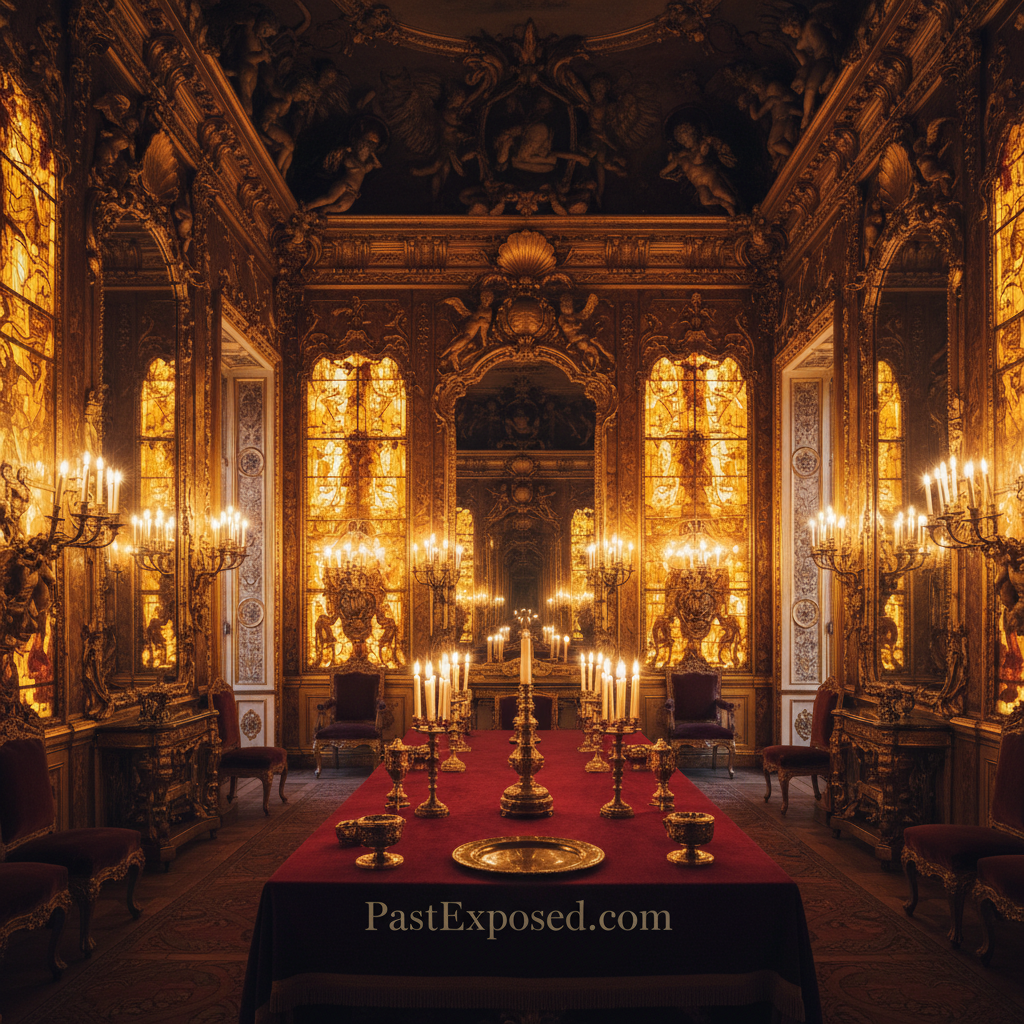
The result was breathtaking: walls that glowed with warm, honey-colored light, creating an effect unlike anything in the world. When candlelight illuminated the room, the amber panels seemed to come alive, their depths shifting from golden yellow to deep orange, creating what witnesses described as “the feeling of being inside a jewel.”
A Gift Between Empires
In 1716, the Amber Room’s fate changed when Prussian King Frederick William I, son of its creator, gave the chamber to Russian Tsar Peter the Great. The gift cemented an alliance between Prussia and Russia against Sweden. It was an extraordinary gesture—the equivalent of giving away a national treasure.
The Amber Room was carefully disassembled, crated, and transported to St. Petersburg, Russia’s capital. Initially, it was installed in the Winter Palace, but in 1755, Empress Elizabeth ordered it moved to the Catherine Palace in Tsarskoye Selo, about 25 kilometers south of St. Petersburg.
At the Catherine Palace, the room underwent a massive expansion. Italian architect Francesco Bartolomeo Rastrelli redesigned the chamber to fit a larger space, adding additional amber panels and decorative elements. Russian craftsmen spent years completing the work, incorporating precious stones, gold, and intricate carvings.
By the time it was finished, the Amber Room covered more than 55 square meters of wall space. It contained amber panels weighing six tons, 450 kilograms of gold leaf, and numerous precious and semi-precious stones. The walls featured intricate mosaics, mirrors that multiplied the amber’s glow, and ornate carvings depicting mythological scenes and heraldic symbols.
For nearly 200 years, the Amber Room served as a private meditation chamber for Russian tsars and tsarinas, a reception room for important guests, and a symbol of Imperial Russia’s wealth and power. Visitors described it in awed terms, calling it the “Eighth Wonder of the World.”
Operation Barbarossa: The Nazi Invasion
On June 22, 1941, Nazi Germany launched Operation Barbarossa, the massive invasion of the Soviet Union. The German army swept across the western Soviet territories with terrifying speed. By September, they were approaching Leningrad (formerly St. Petersburg).
As the Germans advanced, Soviet curators at the Catherine Palace worked desperately to save the treasures. They removed paintings, sculptures, and furniture, crating them for evacuation to safer locations deep in the Soviet interior. But the Amber Room presented a unique problem.
Amber is extremely fragile. The panels had been in place for nearly 200 years, carefully maintained but never designed to be repeatedly moved. The amber had dried and become brittle with age. Any attempt to remove the panels risked shattering them into thousands of irreparable pieces.
The curators tried anyway. They attempted to remove the first panels, but the amber began to crumble. Facing an impossible choice, they decided to leave the Amber Room in place and hide it. They covered the walls with wallpaper and thin cotton sheets, hoping the Germans wouldn’t discover what lay beneath.
It was a futile hope. The German army included special art looting units, specifically tasked with identifying and confiscating cultural treasures. These units, operating under orders from Nazi leadership, had extensive catalogs of valuable artworks and artifacts in the territories they planned to conquer.
The Theft: 36 Hours to Dismantle a Wonder
When German forces captured Tsarskoye Selo in mid-September 1941, soldiers of the Nazi Army Group North quickly discovered the Amber Room. They tore away the makeshift coverings and called in experts.
What happened next was carried out with methodical efficiency. The Germans brought in the Königsberg Castle Museum director, Dr. Alfred Rohde, an expert on amber who had previously studied the room. Rohde supervised a team of soldiers and specialists who worked for 36 hours straight to dismantle the Amber Room.
The panels were carefully removed, wrapped, and packed into 27 crates. The work was done with surprising care—the Nazis weren’t simply looting treasure to melt down; they intended to preserve and display it. In Hitler’s twisted vision, these “Germanic” artworks (created by German craftsmen, even if owned by Russia) were being “repatriated” to their proper place in the Greater German Reich.
By October 1941, the 27 crates had been transported to Königsberg (now Kaliningrad, Russia), a German city on the Baltic Sea. There, the Amber Room was reinstalled in Königsberg Castle, where it was put on display in the castle museum. For nearly three years, the stolen room was exhibited to German visitors as a triumph of Nazi art acquisition.
The Bombing and the Mystery Begins
By 1944, the tide of war had turned. The Soviet Red Army was pushing west, reclaiming occupied territories and advancing toward Germany itself. Nazi officials began evacuating their looted treasures, moving them away from the advancing Soviet forces.
In August 1944, as Soviet forces approached Königsberg, Dr. Rohde received orders to dismantle the Amber Room once again. According to some accounts, he supervised its dismantling and packing. According to others, he tried to evacuate it but ran out of time. What happened next is where history becomes mystery.
Some witnesses claimed the amber panels were packed into crates and hidden in the castle’s basement. Others reported seeing the crates loaded onto trucks and driven away. Still others said the room was left in place because moving it was too risky.
In August 1944, British Royal Air Force bombers attacked Königsberg in massive air raids. The city was devastated. Königsberg Castle was hit repeatedly and burned for days. When the Soviets finally captured the ruined city in April 1945, the castle was a smoke-blackened shell.
Soviet investigators immediately searched for the Amber Room. They found nothing. No panels, no crates, no fragments. Dr. Alfred Rohde, who would have known the room’s fate, had died in December 1945 under mysterious circumstances—some said from typhus, others suggested suicide or possibly Soviet interrogation.
The Amber Room had vanished.
The Search: 80 Years of Dead Ends
In the decades since 1945, the hunt for the Amber Room has generated countless theories, expeditions, and disappointed treasure hunters:
Theory 1: Destroyed in the Königsberg Fire
The most prosaic explanation is that the Amber Room was still in Königsberg Castle when it burned in August 1944. Amber is organic and combustible—a fierce enough fire could have consumed the panels entirely, leaving no trace. This theory is supported by the fact that no credible sighting or fragment has ever been confirmed.
However, many experts find this unlikely. Why would Nazi officials, who had successfully moved the room twice before, leave it in place as their territory was being overrun? And why has no fragment ever been found, even in the castle ruins?
Theory 2: Hidden in Underground Bunkers
Germany in the final years of WWII built extensive underground complexes—bunkers, tunnels, and storage facilities where they hid looted art, gold, and weapons. Some researchers believe the Amber Room was moved to one of these facilities:
- Steinort Manor: Located in former East Prussia, this estate had extensive cellars and a nearby bunker system. Several expeditions have searched there, finding some war relics but no Amber Room.
- The Mamerki Bunker Complex: A massive underground facility in Poland, once Hitler’s eastern headquarters. Ground-penetrating radar has detected anomalies, but excavations have found nothing conclusive.
- The Deutschneudorf Tunnels: A network of mine tunnels near the Czech border where Nazis hid other stolen art. Searches in the 1990s and 2000s turned up nothing.
Theory 3: Sunk in a U-Boat or Ship
Some believe the Amber Room was loaded onto a ship or U-boat attempting to evacuate treasures from Königsberg before the Soviet advance. Several German vessels were sunk in the Baltic Sea in early 1945. The most famous candidate is the Wilhelm Gustloff, a German transport ship sunk by a Soviet submarine in January 1945 with the loss of over 9,000 lives—history’s deadliest maritime disaster.
However, the Gustloff was evacuating refugees, not cargo, and there’s no evidence the Amber Room was aboard. Other ships have been investigated, but none have yielded the treasure.
Theory 4: Deliberately Destroyed
A darker theory suggests the Amber Room was intentionally destroyed by the Nazis themselves—either to prevent it from falling back into Soviet hands, or destroyed by mistake when SS troops demolished evidence of looting as they retreated.
Theory 5: Hidden in Plain Sight
Some researchers speculate that the Amber Room—or pieces of it—survived and were secretly acquired by private collectors. Amber panels could have been disassembled and sold off individually, making them nearly impossible to trace. In this scenario, fragments might be hidden in private collections, with owners afraid to reveal them for fear of prosecution.
The Daring Reconstruction
In 1979, the Soviet government made a bold decision: if the original Amber Room couldn’t be found, they would recreate it. A team of Russian craftsmen, led by master restorer Alexander Kedrinsky, began the painstaking process of reconstructing the room from photographs, drawings, and the few surviving documents.
The project took 23 years and cost approximately $11 million. Craftsmen had to relearn forgotten amber-working techniques. They sourced amber from the same Baltic Sea regions that had supplied the original. Each panel had to be individually crafted, carved, and fitted with the same precision as the 18th-century originals.
In 2003, the reconstructed Amber Room was unveiled at the Catherine Palace, completed just in time for St. Petersburg’s 300th anniversary. Russian President Vladimir Putin and German Chancellor Gerhard Schröder attended the opening ceremony—a symbol of reconciliation between their nations.
The reconstruction is breathtaking, a faithful recreation of the lost original. But it’s also a reminder: the real Amber Room, with its centuries of history and its unique, irreplaceable amber, is still missing.
Recent Discoveries and False Hopes
The search continues into the 21st century, often fueled by tantalizing but ultimately disappointing discoveries:
1997: German police recovered a single mosaic panel stolen from the Amber Room, found in the possession of a German family whose father had been a soldier stationed in Königsberg. This confirmed that at least pieces of the room had survived, reigniting hope that more might still exist.
2008: British investigative journalists claimed to have found evidence that the Amber Room was hidden in a mine near Deutschkatharinenberg, Germany. Excavations found nothing.
2017: Polish divers claimed to have discovered a German ship sunk in the Baltic Sea that might contain the Amber Room. After investigation, it was determined to be a different vessel with no art treasures.
2020: Treasure hunters using ground-penetrating radar claimed to have found a hidden chamber beneath Ksiaz Castle in Poland that could contain the Amber Room. As of 2024, no confirmation has been provided.
The Fate of Those Who Knew
Many of the people who could have answered the mystery are dead, and several died under suspicious circumstances:
- Dr. Alfred Rohde (museum director who supervised the Amber Room) – died December 1945, possibly from typhus, possibly from Soviet interrogation
- Lieutenant Georg Stein (German officer who allegedly knew the hiding place) – reportedly killed by Soviet agents in the 1980s before he could reveal the location
- Various treasure hunters and investigators – Several people searching for the Amber Room have died in accidents or under mysterious circumstances, fueling conspiracy theories about “curses” or deliberate silencing
The Value: More Than Money
If the Amber Room still exists, its value is almost impossible to calculate. Experts estimate its monetary worth at $500 million or more—but its cultural and historical value is immeasurable. It represents:
- The pinnacle of amber craftsmanship—nothing like it has been created before or since
- A symbol of Russo-German cultural exchange before the wars tore Europe apart
- One of the world’s most spectacular examples of Baroque artistry
- The ultimate unsolved mystery of art looting in World War II
Why It Matters
The Amber Room’s story is more than a treasure hunt. It’s a reminder of what war destroys—not just lives, but culture, beauty, and irreplaceable pieces of human achievement. The Nazis looted an estimated 600,000 artworks during WWII. Some were recovered, some destroyed, and thousands remain missing.
The Amber Room is the most famous of these losses, a symbol of all the art and beauty that vanished into the chaos of war. Finding it wouldn’t just solve a mystery—it would represent a small victory of preservation over destruction, of culture over barbarism.
Somewhere, perhaps in a forgotten bunker or at the bottom of the Baltic Sea, six tons of amber, gold, and precious stones might still exist—waiting to be discovered, or perhaps lost forever in the rubble of history. Every few years, another searcher claims to have found the Amber Room’s location. Every few years, hope rises and falls again. Will it ever be found? Or is it, like so much else from that terrible war, simply gone—consumed by fire, scattered across private collections, or buried so deep that it will never see light again? The Amber Room reminds us that some mysteries may never be solved, some treasures never recovered, some wonders lost forever to time and tragedy. But the search continues, driven by the hope that somewhere, somehow, the Eighth Wonder of the World is waiting to be brought back into the light—a golden ghost of a room that once glowed like captured sunlight, now hidden in darkness, waiting for the world to find it once more.