
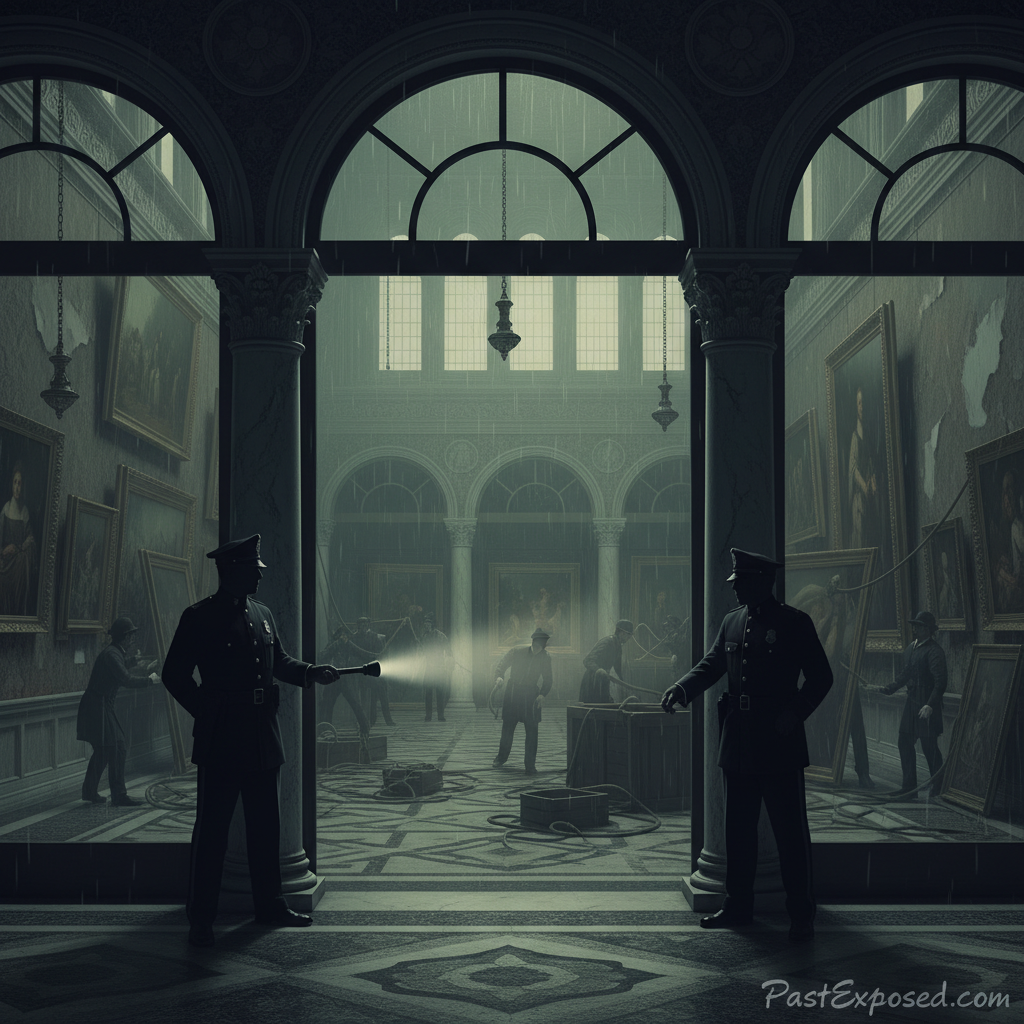
Just after midnight on March 18, 1990, two men dressed as Boston police officers knocked on the side door of the Isabella Stewart Gardner Museum. Within 81 minutes, they had executed the largest unsolved art theft in history—stealing 13 priceless masterpieces worth over $500 million, including works by Rembrandt, Vermeer, and Degas. Thirty-five years later, despite a $10 million reward, countless investigations, and thousands of leads, not a single piece has been recovered. The empty frames still hang on the museum walls—silent witnesses to one of the most audacious crimes of the 20th century.
St. Patrick’s Day, 1990: The Night Everything Changed
The Isabella Stewart Gardner Museum in Boston is not your typical art museum. Built in 1903 to resemble a 15th-century Venetian palace, it houses the personal collection of Isabella Stewart Gardner, an eccentric art collector who specified in her will that nothing in the museum could ever be moved, changed, or loaned out. Every painting, every sculpture, every piece of furniture must remain exactly where she placed it—or the entire collection would be given away to another institution.
This unusual stipulation would have tragic consequences.
On the night of March 17-18, 1990—the early morning hours after St. Patrick’s Day celebrations—two security guards were on duty: 23-year-old Rick Abath and an assistant. At 1:24 AM, just as the city was winding down from the holiday festivities, the museum’s intercom buzzed.
Two men in Boston Police uniforms stood at the side entrance. They told the guard through the intercom that they were responding to a disturbance call and needed to be let in to investigate.
This was the first mistake—and it would be catastrophic. Museum policy explicitly prohibited guards from opening the doors for anyone after hours. But Rick Abath, perhaps intimidated by the police uniforms or caught off guard after a quiet shift, buzzed them in.
81 Minutes of Perfect Execution
Once inside, the “police officers” immediately announced they had a warrant for Rick Abath’s arrest. They asked if anyone else was in the building. Abath called his partner over. Within moments, both guards were handcuffed.
One of the thieves said: “Gentlemen, this is a robbery. Don’t give us any problems, and you won’t get hurt.”
The guards were taken to the museum’s basement, handcuffed to pipes, and their heads wrapped in duct tape. Throughout the ordeal, one of the thieves kept asking the guards: “You’re not going to give us any problems, are you?” Both guards, terrified, assured him they wouldn’t.
The thieves then systematically disabled the museum’s security system—or rather, they tried to. They ripped the security recording tapes from the system, taking the evidence of their entry and movements. But they either didn’t know about or couldn’t disable the motion detectors, which continued recording their movements throughout the museum—creating a valuable timeline for investigators.
For the next 81 minutes, the thieves moved through the museum with what investigators would later describe as a curious combination of expertise and randomness.
What They Took: A Puzzling Selection
The thieves stole 13 pieces of art:
From the Dutch Room:
- “The Concert” by Johannes Vermeer (c. 1664)—one of only 34 known Vermeer paintings in existence, now the single most valuable stolen painting in the world, estimated at over $200 million
- “The Storm on the Sea of Galilee” by Rembrandt (1633)—Rembrandt’s only known seascape
- “A Lady and Gentleman in Black” by Rembrandt (1633)
- A Rembrandt self-portrait etching
- A Chinese bronze beaker (Ku) from the Shang Dynasty (12th-11th century BCE)
From the Short Gallery:
- Five drawings by Edgar Degas
- A bronze eagle finial that topped a Napoleonic flag
From another location:
- “Chez Tortoni” by Édouard Manet (c. 1878-1880)
The motion detectors revealed the thieves spent most of their time in the Dutch Room—returning there multiple times. They also made two trips to the Short Gallery on the museum’s second floor. Curiously, they spent very little time in rooms containing some of the museum’s most valuable works, including Titian’s masterpiece “The Rape of Europa,” worth at least $200 million, which they completely ignored.
The Curious Behavior
The thieves’ behavior was strange—suggesting either they were working from a very specific shopping list provided by a buyer, or they weren’t as knowledgeable as initially thought.
In the Dutch Room, they cut “The Storm on the Sea of Galilee” and “A Lady and Gentleman in Black” from their frames using a blade. But when they tried to remove a third Rembrandt painting, “Portrait of the Artist as a Young Man,” they apparently damaged it in the attempt and left it behind, still in its frame but knocked off the wall.
They took a Rembrandt self-portrait etching—valuable, but worth far less than the paintings. They grabbed a Chinese bronze beaker that wasn’t particularly rare or valuable by museum standards.
They took five Degas sketches—not his most significant works. And they grabbed a finial (decorative ornament) from atop a Napoleonic flag—a curious choice that has baffled investigators. Why take a flag ornament? Some theories suggest it was taken as “proof” for a buyer that the theft had been successful.
Most puzzling: they ignored countless masterpieces worth tens or hundreds of millions of dollars. The Titian alone would have dwarfed the value of several pieces they stole. Michelangelo, Botticelli, Raphael—all ignored.
The Escape
At approximately 2:45 AM, the motion detectors recorded the thieves’ final movements. They left through the same side door they had entered, loading the stolen artworks into their vehicle.
The security guards remained handcuffed in the basement until the day shift arrived around 8:00 AM. By then, the thieves and the art were long gone.
The guards were immediately suspects—particularly Rick Abath, who had let the thieves in. But despite intensive investigation, no evidence ever linked either guard to the crime. Polygraph tests were inconclusive. No financial windfalls appeared in their lives. Most investigators eventually concluded they were simply victims of their own inexperience and poor judgment.
The Investigation: Decades of Dead Ends
The FBI launched what would become one of the longest and most expensive art theft investigations in history. Early theories focused on organized crime, particularly Boston’s notorious Irish and Italian mobs.
The Organized Crime Theory: In 2013, the FBI announced they believed they knew the identities of the thieves—members of a criminal organization with ties to New England and the mid-Atlantic states. The FBI suggested the thieves were likely deceased, but they believed the art might still be recoverable. However, they refused to name the suspects publicly, and no arrests were ever made.
The Bobby Donati Connection: Bobby Donati, a Boston mobster, was killed in 1991—just over a year after the heist. Some investigators believe Donati may have been involved in the theft and was murdered in a gang dispute. However, no concrete evidence has ever linked him to the crime.
The Myles Connor Theory: Myles Connor Jr., a notorious art thief and rock musician, was in prison on the night of the heist—giving him an airtight alibi. However, some investigators suspect he may have planned the robbery and had others execute it. Connor has consistently denied involvement but has hinted he knows where some of the art might be. He has never provided actionable information.
The International Buyer Theory: Many experts believe the theft was commissioned by a private collector—someone wealthy enough to pay for the heist and willing to keep stolen masterpieces hidden. Such “vanity thefts” are rare but not unknown in the art world. However, no credible leads have ever pointed to a specific buyer.
Why Haven’t the Paintings Surfaced?
This is perhaps the greatest mystery of all. Thirty-five years have passed, yet not a single piece has been recovered or credibly offered for sale on the black market.
Several theories attempt to explain this:
Theory 1: Destroyed
The most tragic possibility is that the paintings were damaged or destroyed shortly after the theft. The thieves’ rough handling—cutting canvases from frames, rolling them up—could have caused irreparable damage. If the paintings were damaged and deemed unsellable, they may have been discarded or burned.
Theory 2: Hidden by Someone Who Died
If the thieves or the person who commissioned the theft died without revealing the location, the art could be hidden somewhere, unknown to anyone living. Storage units, hidden rooms, buried containers—all have been proposed as possible hiding places.
Theory 3: In a Private Collection
A wealthy, unscrupulous collector could be keeping the paintings in a private vault, viewing them in secret. Such a person would never be able to display them publicly or sell them through legitimate channels, but for some collectors, mere ownership is enough.
Theory 4: Used as Criminal Currency
Stolen art is sometimes used as collateral in criminal enterprises—traded among criminals, used to secure loans, or held as leverage. The paintings could be circulating in the underworld, moving from one criminal organization to another.
The Empty Frames
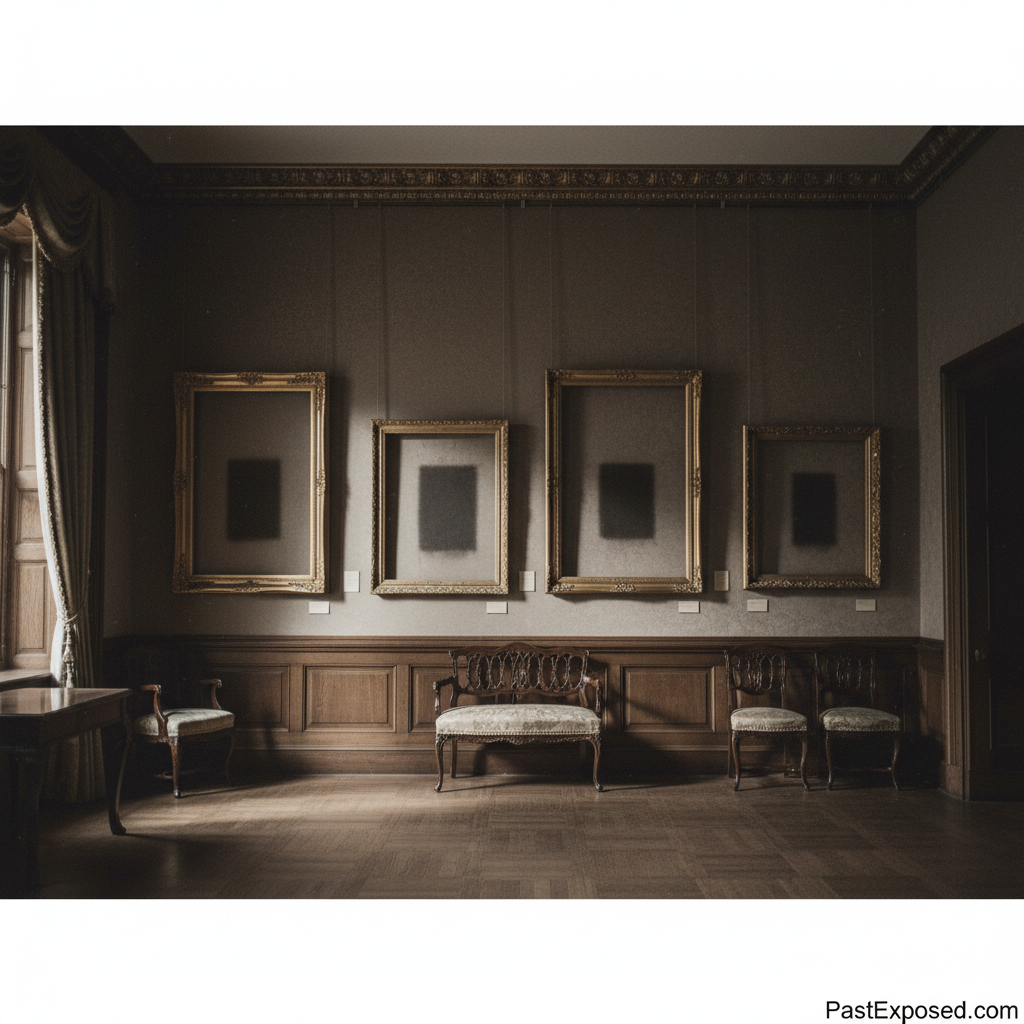
In accordance with Isabella Stewart Gardner’s will, the museum cannot change the arrangement of artwork. So the empty frames remain on the walls—placeholder ghosts marking where the stolen masterpieces once hung.
Visitors to the Dutch Room can see the dark rectangles where paintings once protected the wallpaper from fading. The empty frames of Rembrandt and Vermeer hang in silent accusation. It’s both haunting and strangely moving—a memorial to loss, a reminder of absence.
The museum has stated that if the paintings are ever recovered, they will be returned to these exact spots, fulfilling Gardner’s wishes and completing the collection once more.
The $10 Million Reward
The museum offers a $10 million reward for information leading to the recovery of the stolen artworks in good condition. It’s one of the largest rewards ever offered for stolen property.
Yet despite this astronomical sum, and despite immunity offered to anyone with information (except the actual thieves), no credible tips have led to recovery.
Over the years, countless false leads have poured in. Con artists have attempted to sell fake information. Psychics have offered visions. Well-meaning amateur sleuths have proposed elaborate theories. But the paintings remain missing.
What Would They Be Worth Today?
In 1990, the stolen collection was valued at approximately $200 million. Today, conservative estimates place the value at over $500 million, with some experts suggesting it could be worth $600 million or more.
The Vermeer alone—one of the rarest paintings in existence—could command $250-300 million at auction if it could ever be legally sold. But of course, it can’t. The paintings are too famous, too well-documented, too hot to ever sell through legitimate channels.
This is the paradox of high-profile art theft: the more valuable and famous the piece, the harder it is to sell. These paintings can never be auctioned, never displayed publicly, never legitimately owned. They are priceless and worthless at the same time.
Recent Developments
In 2023, the FBI renewed its public appeals for information, emphasizing that the case remains active and that they believe the art could still be recovered. They’ve explored connections to organized crime in Connecticut and Philadelphia, investigated tips about paintings being moved to Ireland and Europe, and followed leads across multiple continents.
In 2024, new attention focused on possible connections to Corsican organized crime and potential hiding places in rural New England, but none of these leads have borne fruit.
The museum continues to hold the frames empty, waiting—waiting for the day when Rembrandt and Vermeer might come home.
Could It Happen Today?
Modern museum security has evolved dramatically since 1990. Motion sensors are now backed up by multiple camera systems, biometric access controls, and sophisticated alarm networks. Guards receive far more training. Policies about opening doors after hours are strictly enforced.
Yet security experts warn that determined, well-planned thieves can still succeed. In 2020, thieves stole jewels worth $1 billion from Dresden’s Green Vault museum in Germany, demonstrating that even in the 21st century, brazen museum heists remain possible.
The Gardner Museum has significantly upgraded its security since 1990, but it will never be able to change Isabella Stewart Gardner’s fundamental requirement: the art must remain displayed as she arranged it, in a building that was never designed as a fortress.
The Human Cost
Beyond the monetary value and the loss to art history, the heist has had profound human impacts. Rick Abath, the guard who let the thieves in, has lived under a cloud of suspicion for over three decades, despite never being charged. He has spoken publicly about the guilt and second-guessing that has followed him throughout his life.
Museum curators, art historians, and investigators have devoted entire careers to trying to recover the stolen works. Some have retired without seeing resolution. Some have died with the mystery unsolved.
And somewhere, possibly, someone knows where the paintings are. Perhaps they’re dying to tell someone, burdened by the secret. Or perhaps they don’t care at all.
The Isabella Stewart Gardner Museum heist stands as one of the most audacious and frustrating unsolved crimes in American history. Thirteen masterpieces vanished in 81 minutes and have remained hidden for 35 years. Are they hanging in a secret vault, admired by a criminal millionaire? Are they rolled up in a storage container in some forgotten location? Were they destroyed decades ago, their beauty lost forever? We may never know. But in a dusty Dutch Room in Boston, empty frames still hang on faded walls, patient as gravestones, waiting for the day—perhaps decades from now, perhaps never—when Rembrandt’s stormy sea might return to the museum where it belongs. Until then, the greatest art heist in history remains unsolved, a perfect crime that robbed the world not just of priceless paintings, but of the very possibility of seeing them. The thieves stole more than art that night. They stole the future—every person who will never stand before Vermeer’s Concert, every student who will never study Rembrandt’s brushwork, every soul who might have been moved by beauty that now exists only in photographs and memories. That is the true crime, and it compounds with every passing day.