

On the evening of March 31, 1922, something unspeakable happened at a remote Bavarian farmstead called Hinterkaifeck. Six people—an entire family and their maid—were brutally murdered with a mattock in what would become one of Germany’s most disturbing unsolved crimes. But the horror didn’t end with the killings. Evidence suggests the murderer remained in the house for days afterward, feeding the cattle, eating meals in the kitchen, and sleeping in the family’s beds while the bodies lay undiscovered. When investigators finally arrived, they found a crime scene so bizarre and so chilling that over a century later, despite advances in forensic science and multiple investigations, no one has been able to definitively say who killed the Gruber family—or why.
The Farm at the Edge of the Woods
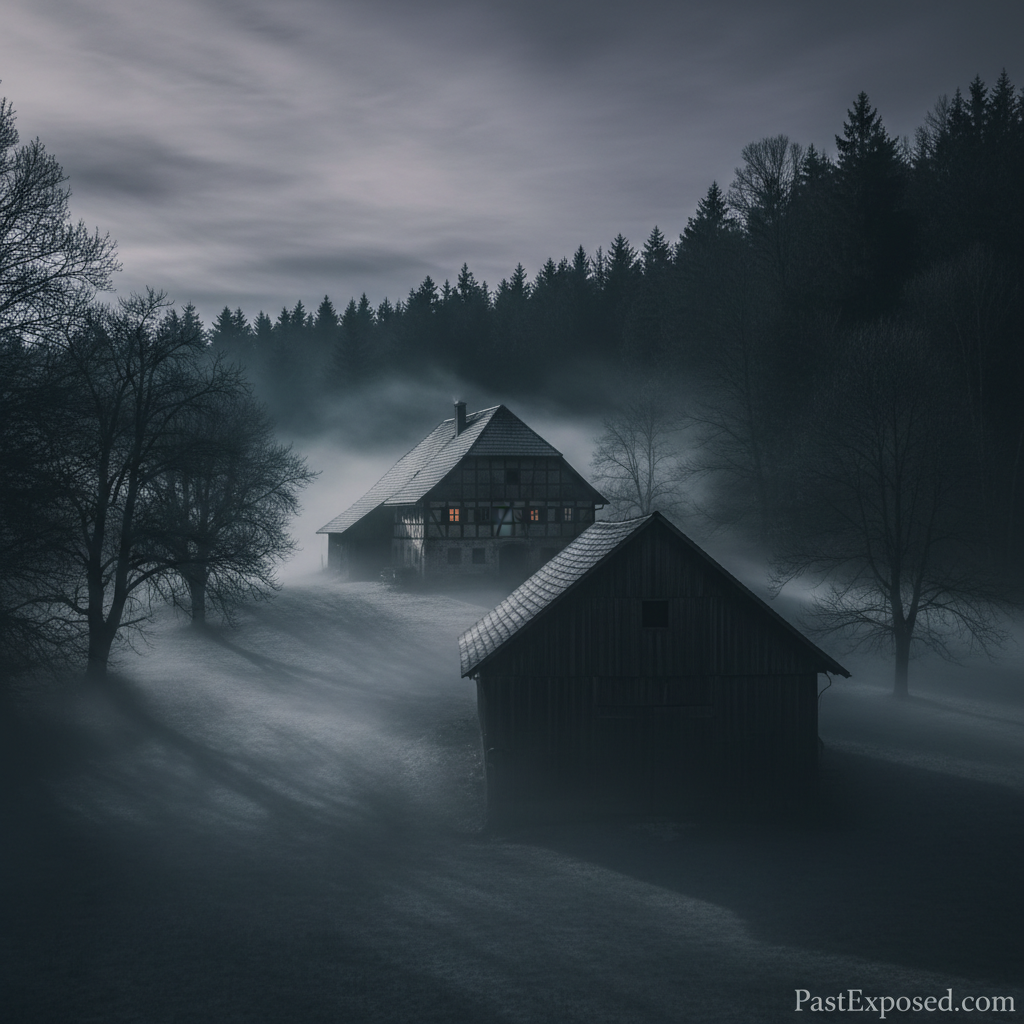
Hinterkaifeck was not a village or town, but a single isolated farmstead located about 70 kilometers north of Munich, in the Bavarian region of Germany. The name itself is telling: “Hinter” means “behind” and “Kaifeck” was a nearby hamlet. The farm sat behind Kaifeck—remote, surrounded by forests, accessible only by narrow rural paths.
In 1922, the farm was home to six people:
- Andreas Gruber (63) – The patriarch, a widower who ran the farm
- Cäzilia Gruber (72) – Andreas’s elderly mother
- Viktoria Gabriel (35) – Andreas’s widowed daughter, who had returned to live on the farm with her children
- Cäzilia Gabriel (7) – Viktoria’s daughter, called “Cilli”
- Josef Gabriel (2) – Viktoria’s young son
- Maria Baumgartner (44) – The family’s maid, who had just started working there on March 31, her first and last day
Viktoria’s husband, Karl Gabriel, had been reported killed in World War I in 1914, though his body was never found. Rumors persisted in the area that Karl was still alive, that his death had been faked, and that he might someday return. It was one of many whispered secrets surrounding the Gruber family.
The Strange Events Before the Murders
In the days leading up to March 31, Andreas Gruber had confided in neighbors about several deeply unsettling incidents at the farm:
Footprints in the Snow: Six months earlier, in the autumn of 1921, Andreas had discovered footprints in the snow leading from the forest to the farm—but no footprints leading back out. Someone had approached the house and either remained hidden somewhere on the property or had somehow left without leaving tracks. Andreas searched the farm and forest but found no one.
Strange Noises in the Attic: In the weeks before the murders, the family heard unexplained sounds coming from the attic—footsteps, creaking floorboards, movements when no one should have been up there. Andreas investigated multiple times but found nothing.
The Newspaper: A few days before the murders, Andreas found an unfamiliar newspaper on the property that no one in the family had purchased or brought home. How had it gotten there?
Keys Missing: One of the house keys disappeared. The family couldn’t find it anywhere.
The Previous Maid: Perhaps most tellingly, the family’s previous maid had quit six months earlier, in September 1921, claiming the farmhouse was haunted. She told people in the village she heard strange noises and felt an evil presence. She refused to return, even for better wages.
Despite these ominous signs, Andreas didn’t report any of it to the police. He was a proud, stubborn man who distrusted authorities and preferred to handle his own affairs. It was a decision that would cost him and his family their lives.
March 31, 1922: The Last Day
Friday, March 31, 1922, began as an ordinary day at Hinterkaifeck. Seven-year-old Cäzilia attended school in the nearby village of Gröbern, a short walk from the farm. She seemed her normal self, giving no indication anything was wrong at home.
That same day, Maria Baumgartner arrived at Hinterkaifeck to begin her new position as the family’s maid, replacing the woman who had quit six months earlier claiming the house was haunted. Maria, a former servant at a monastery in Ingolstadt, was described as devout and hardworking. She had no way of knowing she was walking into a nightmare.
At some point that evening—investigators later estimated between 7 PM and midnight—the murders began.
The Killings
Based on the crime scene evidence and autopsies, investigators pieced together a horrifying sequence of events:
The killer apparently lured the family members one by one to the barn. Andreas Gruber was struck from behind with a mattock (a farming tool similar to a pickaxe) while tending to the livestock. Viktoria was next, followed by young Cäzilia, who had accompanied her mother and grandfather to the barn for evening chores.
The force of the blows was tremendous. Skulls were fractured. The victims would have died quickly—except for young Cäzilia. The autopsy revealed that the little girl had survived the initial attack and lay dying in the barn for hours afterward. Investigators found clumps of her own hair torn from her scalp, which she had pulled out in her agony before death finally came.
After murdering the three in the barn, the killer crossed the yard to the main house. There, he found Cäzilia Gruber (the grandmother), two-year-old Josef, and Maria Baumgartner, who had been at the farm for only a few hours. All three were bludgeoned to death in their beds. The violence was extreme; the walls were spattered with blood.
And then, the killer did something almost unprecedented in criminal history: he stayed.
The Killer Who Remained
For several days after the murders, someone was living at Hinterkaifeck. The evidence is undeniable:
- The farm animals were fed and watered regularly during the days after the murders
- Smoke was seen rising from the farmhouse chimney on multiple occasions
- Food had been eaten from the kitchen—bread was baked, meals were prepared and consumed
- On Sunday, April 2, a neighbor noticed someone moving around the property
- The family dog, normally alert and protective, had been locked in the barn and eventually stopped barking
Who was this person? Was it the killer, calmly remaining at the scene of the crime? Was it someone who discovered the bodies but didn’t report them? Or was it someone else entirely—perhaps an accomplice, or even multiple people?
The thought of someone going about domestic routines—feeding animals, cooking food, warming themselves by the fire—while six corpses lay cooling in the barn and bedrooms is almost incomprehensible. What kind of mind could do this?
The Discovery
The Gruber family’s absence was noticed fairly quickly by neighbors and villagers, but in rural Bavaria in 1922, it wasn’t unusual for a farm family to keep to themselves for a few days. Seven-year-old Cäzilia’s absence from school on Monday and Tuesday raised some concern, but not immediate alarm.
Finally, on Tuesday, April 4—four days after the murders—neighbors and the postman, concerned by the family’s continued absence and the eerie silence from the farm, decided to investigate. When they entered the property, they made the gruesome discovery.
The bodies of Andreas, Viktoria, and young Cäzilia were found in the barn, partially covered with hay and straw. In the house, the three others—grandmother Cäzilia, little Josef, and Maria Baumgartner—were found in their blood-soaked beds.
The crime scene was a charnel house. The brutality of the attacks, the violation of a family home, and the unsettling evidence that someone had remained on the property after the killings sent shockwaves through Bavaria and eventually all of Germany.
The Investigation Begins
The Munich police immediately dispatched investigators to Hinterkaifeck, including some of their most experienced detectives. The crime scene was photographed extensively—unusual for 1922 and demonstrating the seriousness with which authorities treated the case.
The autopsies revealed several important details:
- All victims had been killed with the same weapon—a mattock that was found at the farm
- The killer had struck with tremendous force, suggesting physical strength
- Young Cäzilia had survived for hours, tearing at her own hair in her death agony
- The grandmother had been partially decapitated by the violence of the blows
- Little Josef had been smothered with his own pillow after being struck
Investigators interviewed over 100 people, including family members, neighbors, traveling workers, and anyone who had been in the area around March 31. They developed numerous theories and investigated multiple suspects, but no arrest was ever made.
The Suspects: A Gallery of Possibilities
Over the decades, various suspects have been proposed, each with circumstantial evidence but none with conclusive proof:
1. Lorenz Schlittenbauer
Schlittenbauer was a neighbor and one of the men who discovered the bodies. He was also rumored to be the biological father of Viktoria’s younger son, Josef. According to village gossip, Schlittenbauer and Viktoria had an affair while her husband Karl was away at war.
Suspicious facts about Schlittenbauer:
- He had allegedly refused to pay child support for Josef
- Viktoria had reportedly threatened to take him to court
- His behavior when discovering the bodies was odd—he went directly to the barn and uncovered the bodies before anyone else, almost as if he knew where they were
- He later obtained guardianship of the surviving Gruber property rights
However, witnesses placed Schlittenbauer at a village festival on the night of the murders, giving him an alibi—though some historians question the reliability of those alibis.
2. Karl Gabriel (The Dead Husband Who Wasn’t Dead?)
Viktoria’s husband Karl had been declared killed in World War I, but his body was never found or identified. Rumors persisted that Karl had deserted, faked his death, and was living under an assumed identity somewhere. Some theorized he returned to Hinterkaifeck and, enraged by discovering his wife’s affair and illegitimate child, murdered the entire family.
This theory would explain:
- The familiarity with the farm layout
- The possible motive of jealous rage
- Why the killer stayed afterward—perhaps searching for something or trying to decide what to do next
However, no evidence ever surfaced that Karl was alive, and investigators found no trace of him.
3. A Traveling Worker or Vagrant
Bavaria in 1922 was still recovering from World War I and dealing with significant social upheaval. Transient workers, displaced veterans, and homeless wanderers were common. Some investigators theorized that a vagrant or criminal had been hiding on the property (explaining the footprints and noises), was discovered by the family, and killed them to avoid identification.
This theory doesn’t explain why the killer would stay at the farm afterward, though desperation for food and shelter during difficult times might provide a motive.
4. Someone From Andreas Gruber’s Past
Andreas was known to be argumentative and difficult. He had several disputes with neighbors over property lines and money. Investigators looked into whether someone from his past had sought revenge, but no strong candidate emerged.
5. The Incest Theory and the Previous Maid
Dark rumors circulated that Andreas had been engaging in an incestuous relationship with his daughter Viktoria, and that little Josef (whose paternity was disputed) was actually Andreas’s son, not Karl Gabriel’s or Schlittenbauer’s. According to this theory, Maria Baumgartner, the new maid, discovered evidence of this on her first day and was killed to keep her silent, with the family members eliminated as well.
This theory is largely speculative and relies heavily on village gossip rather than evidence. However, it would explain why the previous maid had left so abruptly—perhaps she had discovered something disturbing.
The Failed Clairvoyant
Such was the desperation to solve the case that Munich police took an unusual step: they consulted a clairvoyant. The police sent the severed heads of the victims (which had been removed during autopsy and preserved) to Munich so they could be examined by this “psychic detective.”
The clairvoyant provided no useful information. The heads were never returned to the bodies and were reportedly lost or destroyed during World War II when Munich was bombed, removing any possibility of modern DNA or forensic analysis.
Why It Remains Unsolved
Several factors contributed to the case remaining unsolved:
- Remote Location: The isolated farm meant there were no nearby witnesses
- Time Delay: Four days passed before the bodies were discovered, allowing evidence to degrade and the crime scene to be disturbed
- Limited Forensics: 1922 forensic science was primitive compared to today. No fingerprints were lifted, no blood typing was done, no crime scene preservation protocols existed
- Social Factors: The tight-knit rural community meant people were reluctant to share information that might implicate neighbors or family members
- Missing Evidence: The victims’ heads being lost meant modern DNA analysis became impossible
- World War II: Police files were scattered or destroyed during the war, losing potentially crucial documentation
Modern Investigations
The Hinterkaifeck murders have never been officially closed. In 2007, students from the Fürstenfeldbruck Police Academy conducted a cold case review using modern criminal profiling techniques. Their conclusion? The murders were most likely committed by someone familiar with the farm and family—probably Lorenz Schlittenbauer or possibly Karl Gabriel if he was still alive.
However, without physical evidence to test with modern DNA technology, and with all witnesses and suspects long dead, the case can never be conclusively solved.
The Farm’s Grim End
After the murders, Hinterkaifeck stood empty and abandoned. No one wanted to live in the house where six people had been so brutally murdered. Locals reported the farm was haunted, hearing strange noises and seeing unexplained lights.
In 1923, just a year after the murders, the farmstead was demolished. The owners wanted to erase the site of such horror. The land was plowed and eventually absorbed into neighboring farms. Today, nothing remains of Hinterkaifeck except a small memorial stone in a field, marking the approximate location where the farmhouse once stood.
Cultural Impact
The Hinterkaifeck murders have become one of Germany’s most famous cold cases, inspiring:
- Numerous books and documentaries in German and international media
- The case is studied in German criminology courses as an example of early 20th-century police investigation
- It has influenced horror fiction and films, including the trope of the “killer who stays in the house”
- Multiple German crime shows and podcasts have featured the case
- It remains a subject of ongoing historical and criminological research
The Enduring Questions
Who killed the Gruber family and their maid? What was the motive—revenge, jealousy, madness, or simply the wrong place at the wrong time? And perhaps most chillingly: who stayed in that house for days after the murders, living among the dead, eating their food, sleeping in their beds, tending their animals?
Was it a neighbor covering his tracks? A husband returned from the dead? A vagrant who had been hiding on the property? Or someone else entirely, whose identity and motive died with them?
Over a century has passed since that terrible night in March 1922. Everyone who lived at Hinterkaifeck is long dead. Everyone who investigated the crime has passed away. The farmhouse itself has been erased from the earth. Yet the mystery persists, as haunting today as it was when neighbors first discovered those six bodies in the barn and bedrooms of that remote Bavarian farm. The fields where Hinterkaifeck once stood are peaceful now, growing crops in the Bavarian sunshine. But on quiet evenings, when shadows lengthen and the forest darkens, it’s hard not to imagine what happened there—six people murdered with brutal efficiency, and a killer who stayed behind, living in the house of the dead, waiting. For what? We’ll never know. The farmhouse kept its secrets, and when it was demolished, those secrets were buried in the earth of Bavaria, as silent and cold as the victims themselves. The only sound that remains is the echo of a question asked across a century: Who killed the family at Hinterkaifeck? And why?