
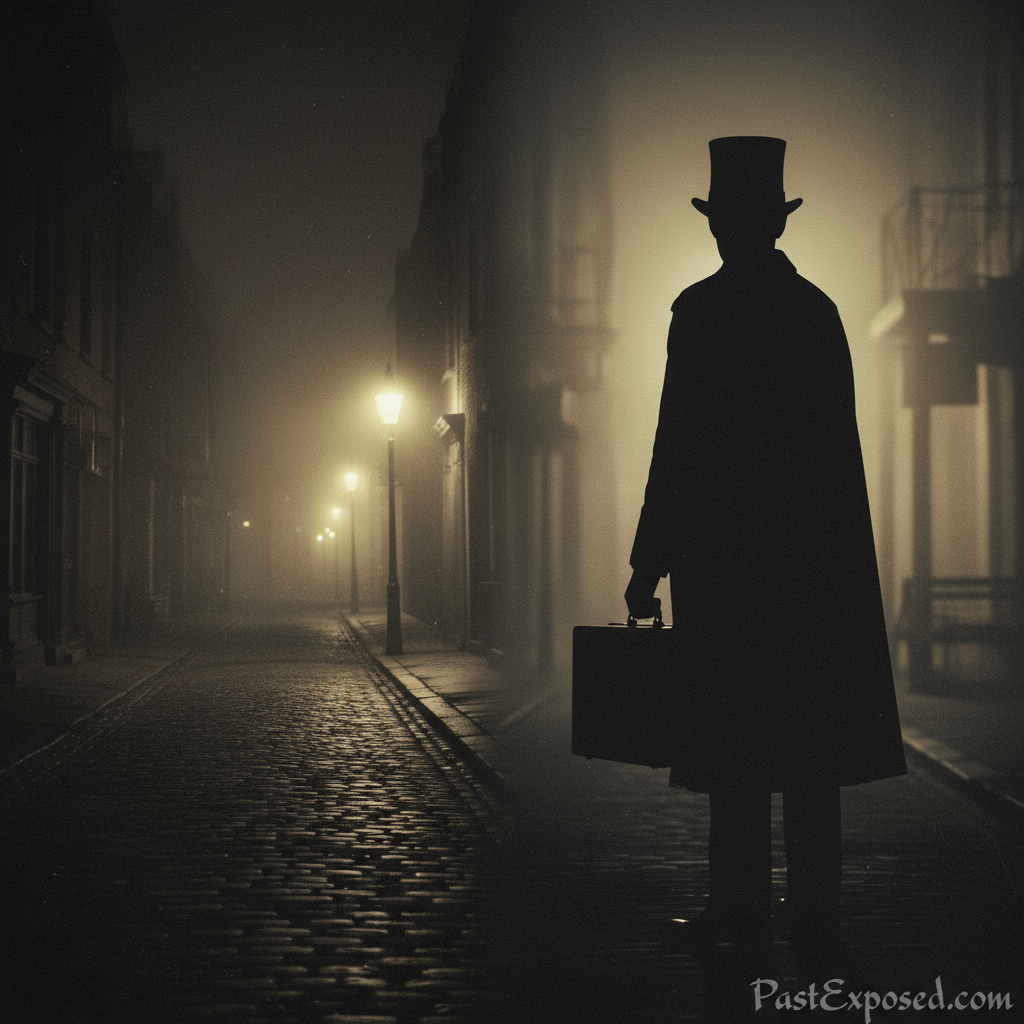
In the autumn of 1888, the fog-shrouded streets of London’s Whitechapel district became a hunting ground for history’s most infamous serial killer. Five women—all poor, all vulnerable—were brutally murdered in a manner so savage that it shocked Victorian England to its core. The killer sent taunting letters to police, signed with a name that would echo through history: Jack the Ripper. Then, as mysteriously as the murders began, they stopped. The killer was never caught, never identified, never brought to justice. Over 135 years later, despite countless investigations, theories, and suspects, the identity of Jack the Ripper remains one of criminology’s greatest unsolved mysteries.
Whitechapel: A Portrait of Desperation
To understand the Ripper murders, one must first understand Whitechapel in 1888. This East London district was a place of crushing poverty, overcrowding, and despair. Tens of thousands lived crammed into filthy tenements and doss houses (cheap lodging houses where a bed cost fourpence a night). Unemployment was rampant. Disease was common. Hope was scarce.
Many women, unable to earn enough through legitimate work like sewing or cleaning, turned to prostitution to survive. These “unfortunate women,” as they were called, walked the dark streets at night, looking for clients who would pay them enough for a bed or a meal. They were vulnerable, desperate, and invisible to respectable society—perfect victims for a predator.
The police force of the time was ill-equipped to handle serial murder. Forensic science was in its infancy. There were no fingerprint databases, no DNA testing, no psychological profiling. Detectives relied on witness testimony, physical evidence, and luck—and in the Ripper case, all three would fail them.
The Five Canonical Victims
While there is debate about how many victims Jack the Ripper actually claimed, five murders are universally attributed to him—the so-called “canonical five.” Each killing was more brutal than the last, demonstrating a progression in the killer’s confidence and savagery.
Mary Ann Nichols – August 31, 1888
Mary Ann “Polly” Nichols, 43 years old, was found in Buck’s Row at 3:40 AM, her throat cut so deeply that she was nearly decapitated. Her abdomen had been slashed open. She had been killed where she lay, in the street, and the murderer had disappeared into the night without being seen.
At first, police thought it might be an isolated incident. They were tragically wrong.
Annie Chapman – September 8, 1888
Just over a week later, 47-year-old Annie Chapman was discovered in the backyard of 29 Hanbury Street. Her throat had been cut, and her abdomen had been opened with surgical precision. Organs had been removed and taken by the killer. The murder had occurred in the early morning hours, in a location where the killer could have been discovered at any moment.
The brutality and the surgical skill demonstrated in the mutilations led some to speculate that the killer had medical knowledge. Panic began to spread through Whitechapel.
Elizabeth Stride – September 30, 1888
Elizabeth Stride, 44, was found in Dutfield’s Yard with her throat cut but without the abdominal mutilations characteristic of the other victims. Many experts believe the killer was interrupted—possibly by the arrival of a cart driver—and fled before he could complete his work.
If this theory is correct, it explains what happened next.
Catherine Eddowes – September 30, 1888 (same night)
Less than an hour after Stride’s body was discovered, Catherine Eddowes, 46, was found in Mitre Square. This murder was the most savage yet. Her throat was cut, her face mutilated beyond recognition, her abdomen opened, and organs removed. The killer had taken her left kidney and part of her uterus.
Two murders in one night—one possibly interrupted, the second completed with horrifying efficiency—demonstrated that the killer was growing bolder, more confident, and seemingly unstoppable.
Mary Jane Kelly – November 9, 1888
The final canonical victim was 25-year-old Mary Jane Kelly, the youngest of the five. Unlike the others, she was killed indoors, in her small rented room at 13 Miller’s Court. This gave the killer time, privacy, and freedom to unleash the full extent of his depravity.
When police broke down the door, they found a scene of unimaginable horror. Kelly had been systematically dismembered. Her face had been slashed beyond recognition. Organs had been removed and arranged around the room. The crime scene photographs (which still exist) are so disturbing that many researchers refuse to view them.
The level of mutilation in Kelly’s murder was so extreme that some experts believe the killer knew her personally, suggesting a personal motive. Others argue it simply represented the logical endpoint of his escalating violence, now that he had time and privacy to indulge his fantasies fully.
After Mary Jane Kelly, the canonical murders stopped. Jack the Ripper vanished as mysteriously as he had appeared.
The Letters: Taunting the Police
During the murder spree, London’s Central News Agency and police received hundreds of letters claiming to be from the killer. Most were obvious hoaxes, written by attention-seekers or journalists trying to sell newspapers. But a few letters have been taken more seriously by investigators.
The most famous is the “Dear Boss” letter, received on September 27, 1888, which was the first to use the name “Jack the Ripper.” The writer taunted police, promised more murders, and displayed knowledge that seemed to match the crimes. However, many experts now believe even this letter was a hoax, possibly written by a journalist.
More disturbing was the “From Hell” letter, received by George Lusk, chairman of the Whitechapel Vigilance Committee, on October 16, 1888. The letter was accompanied by half of a human kidney, which the writer claimed was taken from Catherine Eddowes. Medical examination confirmed the kidney was human and had been preserved in spirits, consistent with having been removed from Eddowes about three weeks earlier.
The “From Hell” letter is considered by many researchers to be the only genuine communication from the killer, though debate continues.
Why Did the Murders Stop?
One of the great mysteries of the Ripper case is why the murders ended as abruptly as they began. Several theories have been proposed:
Death: The killer may have died from illness, accident, or suicide shortly after the final murder. This would explain why someone so active suddenly stopped.
Imprisonment: The killer may have been arrested and imprisoned for another crime, preventing him from killing again. Victorian prison records are incomplete, making this difficult to verify.
Institutionalization: Mental illness was poorly understood in 1888. The killer may have been committed to an asylum, either voluntarily or involuntarily, and died there without his crimes being connected.
Emigration: The killer may have left England, either fleeing justice or simply moving on. Some theories suggest he continued killing elsewhere, perhaps in America.
Satisfaction: Perhaps the Kelly murder, the most extreme and prolonged, satisfied whatever dark urge drove him, and he simply stopped. This is considered unlikely by modern criminal psychologists, who note that serial killers rarely stop voluntarily.
The Suspects: An Gallery of Possibilities
Over 135 years, literally hundreds of suspects have been proposed. Some were seriously investigated by Victorian police. Others are modern theories based on re-examination of evidence. Here are some of the most prominent:
Montague John Druitt
A barrister and schoolteacher who committed suicide in December 1888, shortly after the Kelly murder. Melville Macnaghten, a senior policeman who joined Scotland Yard after the murders, named Druitt as the top suspect in a confidential memo. However, Druitt had a solid alibi for at least one of the murders, and there’s no concrete evidence connecting him to the crimes. His main “qualification” as a suspect seems to be that he committed suicide around the time the murders stopped.
Aaron Kosminski
A Polish Jewish immigrant and barber who lived in Whitechapel and was later committed to an asylum. Kosminski was named as a suspect by multiple police officials, including Sir Robert Anderson, who claimed in his memoirs that the Ripper’s identity was “definitely ascertained” and that the killer was a low-class Polish Jew. In 2014, a forensic investigation claimed to have DNA evidence linking Kosminski to the crimes through a shawl allegedly found at one of the murder scenes. However, the shawl’s provenance is questionable, and the DNA evidence has been widely criticized by experts as inconclusive.
Michael Ostrog
A Russian-born con artist and thief who was named alongside Druitt and Kosminski in Macnaghten’s memo. Ostrog was known to be violent and had a history of posing as a doctor. However, research has shown he was likely in prison in France during the murders, eliminating him as a suspect.
Prince Albert Victor
Queen Victoria’s grandson and heir presumptive to the throne was named as a suspect in various conspiracy theories, most notably in the 1970s. These theories suggest the murders were part of a royal cover-up, with government officials helping to hide the prince’s involvement. However, royal family records show Prince Albert Victor was not in London during several of the murders, and there’s no credible evidence supporting these theories. Most historians dismiss them as sensationalized fiction.
Sir William Gull
Queen Victoria’s personal physician was suggested as a suspect in various conspiracy theories, often tied to the Prince Albert Victor theories. The most elaborate version claims Gull killed the women to cover up the prince’s scandalous relationship with a Catholic shop girl. However, Gull was elderly and had suffered a stroke before the murders, making him an unlikely candidate for the physically demanding crimes. Like the prince theories, most historians reject Gull as a serious suspect.
Francis Tumblety
An Irish-American quack doctor who was in London during the murders and was arrested for gross indecency in November 1888. He fled to America before trial, and Scotland Yard sent officers to investigate him there. Tumblety had a documented hatred of women and collected preserved female organs in jars. While an intriguing suspect, there’s no definitive evidence linking him to the murders.
Joseph Barnett
Mary Jane Kelly’s former boyfriend, who had argued with her days before her murder. Some theorists suggest Barnett killed the earlier victims to frighten Kelly off the streets, then killed her in a rage when she wouldn’t give up prostitution. While an interesting psychological theory, there’s little evidence to support it beyond circumstantial speculation.
George Chapman (Severin Klosowski)
A Polish immigrant who was a convicted poisoner, executed in 1903 for murdering three women. Inspector Frederick Abberline, who led the Ripper investigation, believed Chapman was Jack the Ripper. However, Chapman’s method (poison) was radically different from the Ripper’s violent attacks, making him an unlikely match according to modern criminal psychology.
Modern Investigations and Technology
The Jack the Ripper case has been subject to numerous modern reinvestigations using advanced forensic techniques:
DNA Analysis: Several attempts have been made to extract DNA from letters and physical evidence allegedly connected to the crimes. Results have been inconclusive and controversial, with many samples contaminated by over a century of handling.
Geographic Profiling: Modern criminal profilers have analyzed the locations of the murders to create a likely area where the killer lived. The results suggest the Ripper lived in the heart of Whitechapel, within a few hundred yards of the murder sites.
Psychological Profiling: FBI profilers and criminal psychologists have created profiles of the killer, suggesting he was likely a local man, probably aged 25-35, possibly employed in a trade that gave him access to sharp knives (butcher, barber, surgeon), and almost certainly someone who appeared normal and non-threatening to his victims.
Digital Reconstructions: Computer analysis of witness descriptions has attempted to create composite images of possible suspects seen near the murder sites. However, the witnesses were often drunk, terrified, or viewing suspects in poor lighting, making their accounts unreliable.
Why the Case Endures
The Jack the Ripper murders have maintained their grip on public imagination for over a century. Why? Several factors contribute to the case’s enduring fascination:
The Perfect Storm of Mystery: An unknown killer, brutal crimes, taunting letters, and a complete disappearance create a puzzle that begs to be solved.
The Victorian Setting: Foggy gaslit streets, horse-drawn carriages, and the contrast between Victorian propriety and Whitechapel’s squalor create an atmospheric backdrop that feels almost fictional.
The Victims Were Human: Unlike many historical mysteries involving abstract events, the Ripper case involves real women with real lives, making it deeply human and tragic.
The Investigation Was Public: The crimes occurred during the early age of mass media. Newspapers covered every development, creating a public investigation that drew millions into the mystery.
The Case Is Unsolved: Unlike many historical mysteries that have been definitively solved, the Ripper’s identity remains unknown, allowing each generation to apply new theories and techniques.
The Victims Deserve Remembrance
In all the fascination with Jack the Ripper’s identity, it’s easy to forget the real tragedy: five women were brutally murdered, their lives cut short by violence. They weren’t just victims in a historical puzzle—they were people.
Mary Ann Nichols had five children. Annie Chapman was estranged from her family and lived in poverty. Elizabeth Stride had survived an earlier traumatic event when the ship she was on sank. Catherine Eddowes used the alias “Mary Ann Kelly,” possibly to avoid creditors. Mary Jane Kelly was young, with her whole life ahead of her.
These women lived in a society that had failed them, that offered them few options for survival, and that ultimately could not protect them from a killer who saw them as objects rather than human beings. Their stories deserve to be remembered alongside the mystery of their killer.
Will We Ever Know?
The honest answer is: probably not. Too much time has passed. Too much evidence has been lost, contaminated, or destroyed. The witnesses are long dead. The police files have been picked over by researchers for over a century, and no smoking gun has emerged.
Various researchers periodically claim to have “solved” the case, usually by promoting a particular suspect with circumstantial evidence. But without a confession, a definitive physical link, or a contemporary document clearly identifying the killer, any solution remains speculation.
The identity of Jack the Ripper will almost certainly remain one of history’s permanent mysteries—a Victorian puzzle that defeated the best investigators of its time and continues to elude modern forensic science.
On foggy nights in London, tour guides still lead groups through the streets of Whitechapel, pointing out the locations where five women met their terrible ends at the hands of a killer whose name became synonymous with evil. Jack the Ripper has become a legend, a boogeyman, a symbol of terror that transcends the actual crimes. But somewhere, in some forgotten record or unmarked grave, the truth lies buried. Perhaps it’s a name in a Victorian ledger, an institutionalized patient, a suicide whose death went unnoticed, or a murderer who took his terrible secret to the grave. The identity of Jack the Ripper died with him, and 135 years later, the monster remains faceless—preserved in history not as a man, but as a phantom, a question mark, an unsolved mystery that will haunt us forever. The fog has long since lifted from Victorian London’s streets, but the shadow of the Ripper remains, cast across more than a century, a darkness that will never fully retreat into the light.