
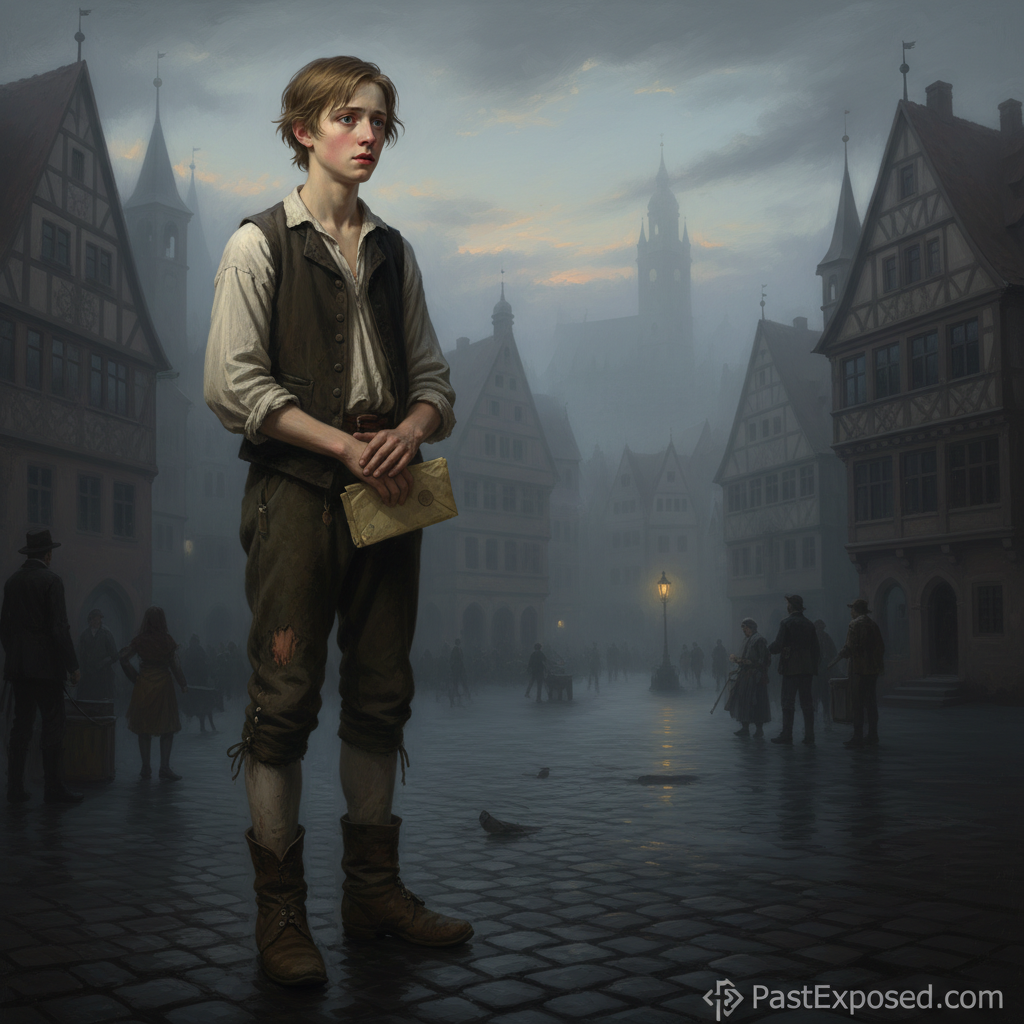
On Whit Monday, May 26, 1828, a strange teenage boy stumbled into Unschlittplatz square in Nuremberg, Germany. He could barely walk, mumbled incoherently, and clutched two letters in his trembling hands. He seemed to know only one sentence: “I want to be a cavalryman, as my father was.” Thus began one of history’s most haunting mysteries—a case that would captivate Europe, inspire countless theories, and end in murder.
The Arrival
The boy appeared to be about sixteen years old, dressed in tattered peasant clothing and worn boots that appeared never to have been walked in. His skin was pale, as if he had never seen sunlight. His feet were soft and blistered from the short walk into town. Everything about him suggested a life spent entirely indoors, locked away from the world.
Local shoemaker Georg Weichmann encountered the boy first, finding him unable to communicate beyond repeating a single phrase. The authorities were summoned, and the boy was taken to a police station where he was given paper and pen—to everyone’s astonishment, he carefully wrote one name: Kaspar Hauser.
The two letters he carried offered more questions than answers. The first, allegedly from his mother, claimed she was a poor servant girl and that the boy’s father—a cavalryman—was dead. The second, supposedly from a laborer who had raised him, stated that the boy had been kept in his house since 1812 and had never been allowed to “take a single step out of my house.”
But handwriting analysis would later reveal a disturbing truth: both letters were written by the same person, in a crude attempt to disguise the handwriting. Someone had orchestrated this boy’s arrival, but why?
A Child Raised in Darkness
As Kaspar slowly learned to speak more German, he told an extraordinary and horrifying story. For as long as he could remember—perhaps his entire life—he had been confined to a dark cell measuring approximately two meters long, one meter wide, and one and a half meters high. He slept on a straw bed with a wooden horse as his only toy. He had never seen another human being clearly, never heard a voice, never walked, never seen sunlight.
Food and water appeared mysteriously—he would wake to find bread and water beside him. Occasionally, the water tasted bitter, and he would fall into a deep sleep. When he awoke, his straw had been changed and his hair and nails cut by unseen hands. He had no concept of day or night, no understanding of the outside world, no knowledge of his own identity.
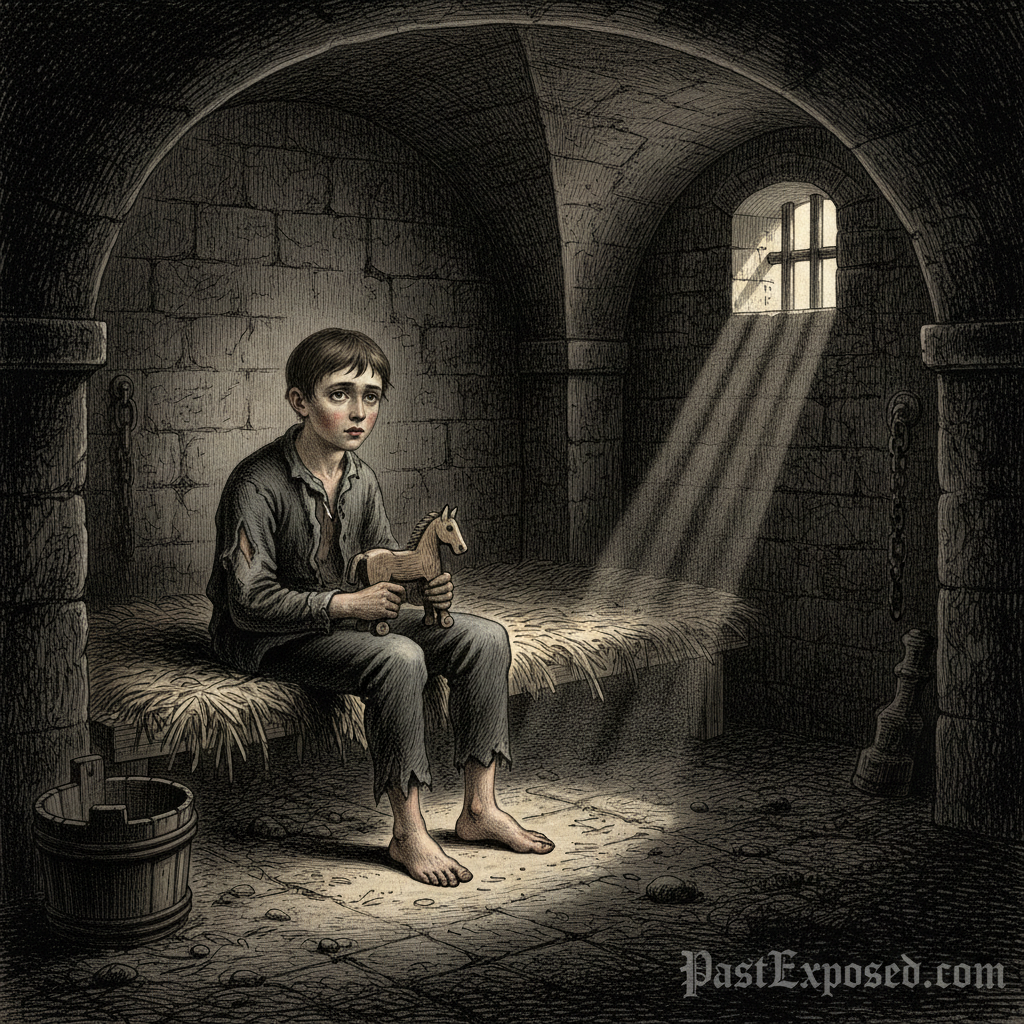
Then, days before his appearance in Nuremberg, his mysterious captor finally revealed himself—but always standing behind the boy, never allowing himself to be clearly seen. This man taught Kaspar to stand, to walk a few steps, and to say the single sentence that would be his introduction to the world. Then the man brought him to Nuremberg and abandoned him there.
The Medical Evidence
Physicians who examined Kaspar found his story physiologically credible. His eyes were extremely sensitive to light, and he could reportedly see better in darkness than in daylight. His sense of smell was abnormally acute—he could distinguish plants and flowers by scent from considerable distances. His hearing was similarly enhanced. These were the senses of someone who had lived in near-total darkness, whose survival had depended on senses other than sight.
His legs were weak, his gait unsteady. His skin showed the pallor of someone who had never been exposed to the sun. His diet had clearly been limited—he initially refused all food except bread and water, becoming violently ill when offered meat or beer.
Most tellingly, he showed a complete lack of social understanding. He had no concept of depth perception, thinking he could touch distant church towers. He showed no understanding of relationships, time, or social hierarchy. He was, in every way, a blank slate—a human being who had been deliberately kept from experiencing life.
The Investigation and Wild Theories
Word of the mysterious foundling spread across Europe. Who was this boy? Why had he been imprisoned? And most intriguingly—was he someone important?
The most sensational theory emerged quickly: Kaspar Hauser was the hereditary prince of Baden, stolen from his cradle as an infant and replaced with a dying baby. The motive? To alter the succession and keep power within a different branch of the royal family. Proponents pointed to Kaspar’s refined features, his quick intelligence once educated, and his noble bearing. Some claimed to see a resemblance to the Baden royal family.
The dates aligned disturbingly well. The Crown Prince of Baden’s son had died mysteriously in 1812 at just a few weeks old—the same year Kaspar claimed his imprisonment began. The baby’s death had been sudden and suspicious, the body shown only briefly to the grief-stricken mother before being quickly buried.
If true, it would mean that the ruling Grand Duke of Baden was a usurper, and Kaspar was the rightful heir to one of Germany’s significant states. The implications were politically explosive.
Education and Celebrity
Kaspar was placed in the care of local schoolmaster Friedrich Daumer, who undertook the remarkable task of educating this teenage boy who had the knowledge of an infant. Kaspar proved an eager student, learning to read and write with astonishing speed. He showed particular aptitude for drawing and developed a love of poetry.
He became a celebrity, a curiosity that drew visitors from across Europe. Lord Stanhope, a British nobleman, became particularly interested in the case, eventually becoming Kaspar’s legal guardian. But Stanhope’s interest would later be questioned—was he a benefactor or part of the conspiracy to keep Kaspar’s true identity hidden?
As Kaspar’s education progressed, he began to remember fragments from his imprisonment—or thought he did. He recalled glimpses of coats of arms, of fine clothing, of details that suggested his captor had been a nobleman. But these memories were vague, unreliable, possibly the confabulations of a traumatized mind trying to make sense of the senseless.
The First Attack
On October 17, 1829, Kaspar was found bleeding in Daumer’s cellar, a deep wound across his forehead. He claimed a hooded man had attacked him, striking him with a blade. But there were inconsistencies in his story. Some suspected he had wounded himself for attention. Others believed it was a genuine assassination attempt—someone trying to silence him before he could remember too much.
The attack changed everything. Public opinion began to turn. Some now viewed Kaspar as a fraud, an attention-seeker, perhaps even a criminal. Lord Stanhope grew distant, eventually abandoning his guardianship. Kaspar was moved from household to household, no longer a celebrated mystery but a burden, a problem no one wanted.
The Final Attack
On December 14, 1833, Kaspar came home to his current guardian, schoolmaster Johann Georg Meyer, with a deep stab wound in his chest. He claimed that a stranger had lured him to Ansbach Court Garden with the promise of revealing information about his mother. There, the man had stabbed him and handed him a small purse.
Inside the purse was a penciled note, written in mirror writing: “Hauser will be able to tell you quite precisely how I look and from where I am. To save Hauser the effort, I want to tell you myself from where I come. I come from from the Bavarian border on the river by the name of… M L Ö.”
The note was bizarre, the mirror writing strange, the message cryptic. Was it evidence of a conspiracy? Or had Kaspar, desperate and destitute, staged the attack himself?
The wound was fatal. Kaspar Hauser died three days later, on December 17, 1833, at the age of approximately 21. His last words were: “I didn’t do it myself.”
The Investigation and Controversy
Authorities concluded that Kaspar had stabbed himself, staging an attack to regain public sympathy and support. They pointed to inconsistencies in his account, the suspicious nature of the note, and the angle of the wound. The case was closed as a self-inflicted injury resulting in accidental death.
But many refused to accept this conclusion. How could someone stab themselves so deeply, walk home, and maintain the story until death? Why would he do so when he had nothing to gain? The wound had penetrated his pericardium—could someone truly inflict such an injury on themselves?
Others believed the attack was genuine, that Kaspar had finally been silenced by those who feared what he might remember or reveal. His death conveniently ended all questions about his identity and any potential claims to the Baden throne.
The Scientific Evidence
In the 1990s and early 2000s, scientists conducted DNA tests on blood samples and hair believed to be from Kaspar Hauser, comparing them to living descendants of the Baden royal family. The results were… inconclusive. Some tests suggested no relationship; others were too degraded to provide reliable results. The samples themselves might have been contaminated or mislabeled over the decades.
The mystery remained unsolved, now joined by questions about the reliability of the physical evidence itself.
The Truth Lost to Time
What actually happened to Kaspar Hauser? The theories remain as numerous as they are contradictory:
The Royal Conspiracy: He was the true heir to Baden, kidnapped and imprisoned to clear the path for his uncle’s line to inherit. His murder was ordered when he became a threat to the usurpers.
The Fraud: He was a clever con artist, possibly coached by someone, who invented the story of imprisonment to gain sympathy and financial support. The attacks were self-inflicted to maintain the deception.
The Victim: He was the illegitimate son of someone important—perhaps royalty, perhaps not—whose very existence was an embarrassment. He was hidden away and eventually killed when hiding him became too difficult.
The Military Connection: Some researchers suggest his father actually was a cavalryman, and Kaspar was hidden due to complicated family circumstances we can no longer reconstruct.
The Legacy
Kaspar Hauser’s grave in Ansbach bears an inscription that captures the essential mystery: “Here lies Kaspar Hauser, riddle of his time. His birth was unknown, his death mysterious.”
His case has inspired countless books, plays, films, and psychological studies. The term “Kaspar Hauser syndrome” is sometimes used in psychology to describe the developmental effects of extreme social isolation. Whether prince or pauper, victim or fraud, his story remains one of history’s most compelling unsolved mysteries.
A boy emerged from darkness into a world he had never known, spoke words that might have revealed a scandal that could topple thrones, and died with his secrets intact. Was he murdered to protect a dynasty? Did he take his own life in despair? Or was the truth something else entirely—something we can no longer imagine because the evidence has been lost to time? In the end, perhaps the only certainty is this: Kaspar Hauser lived, suffered, and died, and the truth died with him. The boy from nowhere returned to nowhere, leaving behind only questions that echo across two centuries.