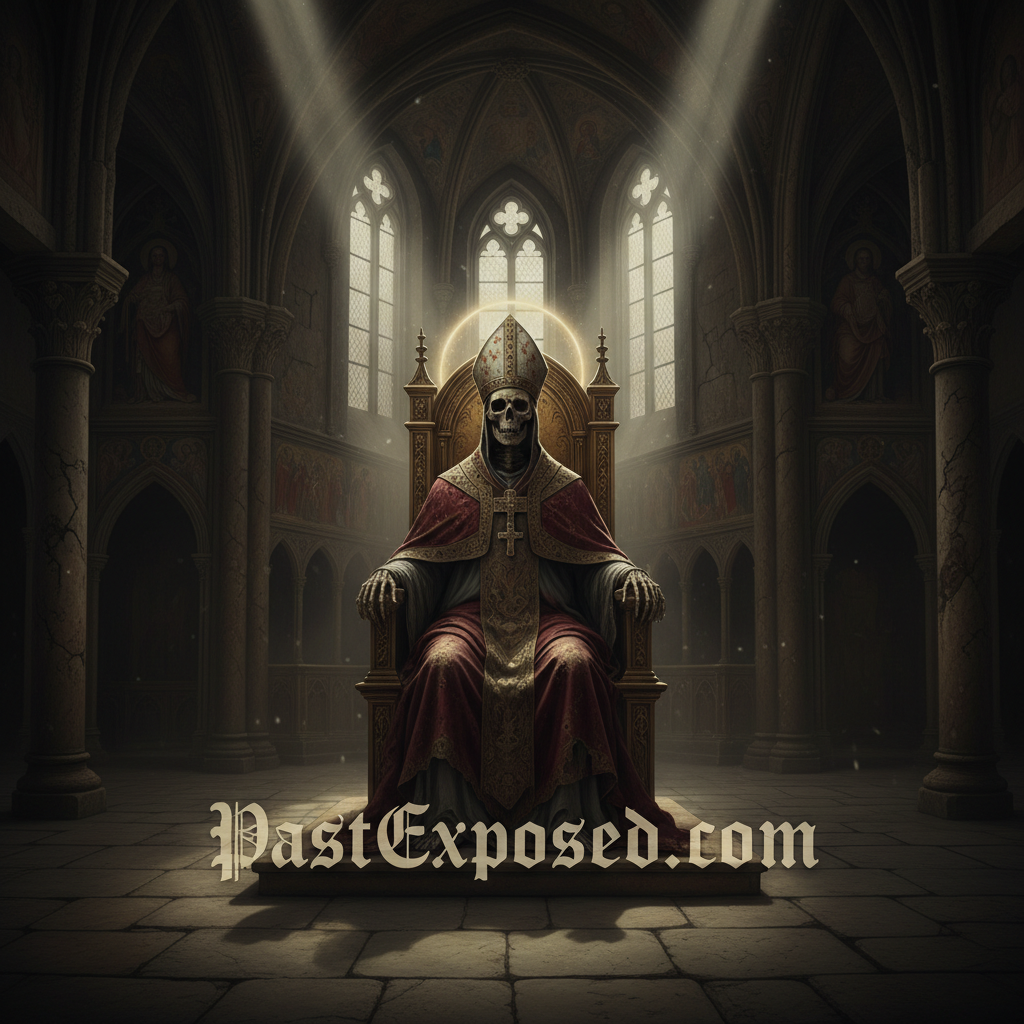
In January 897 AD, in the heart of the Vatican, one of the most grotesque spectacles in religious history unfolded. Pope Stephen VI ordered his predecessor’s rotting corpse exhumed, dressed in papal vestments, propped up on a throne, and put on trial for crimes against the Church. This macabre event, known as the Cadaver Synod, would trigger a cascade of violence, revenge, and chaos that nearly destroyed the papacy itself. It remains one of history’s darkest and most bizarre episodes—a moment when power, madness, and religious fervor collided in the most horrifying way imaginable.
The Dark Age of the Papacy
To understand the Cadaver Synod, we must first understand the world that spawned it. The late 9th century marked what historians call the “Saeculum Obscurum”—the Dark Age of the papacy. The Western Roman Empire had long since collapsed, and Europe was fractured into warring kingdoms and rival factions.
The papal throne, rather than being a sacred office above earthly politics, had become a prize fought over by powerful Roman families. Popes were made and unmade by political intrigue, bribery, and violence. The average papal reign during this period lasted less than four years, and many popes died under suspicious circumstances.
Into this chaos stepped three men whose fates would become forever intertwined: Pope Formosus, Pope Boniface VI, and Pope Stephen VI.
Formosus: The Ambitious Cardinal
Formosus was born around 816 AD and rose through the Church hierarchy to become Cardinal Bishop of Porto. His name, ironically, means “handsome” or “well-formed” in Latin—a stark contrast to the desecration his body would later suffer.
Formosus was a skilled diplomat and a powerful figure in church politics. He served as a papal legate to Bulgaria, where he successfully converted Khan Boris I to Christianity. However, his ambition and political maneuvering made him many enemies in Rome.
In 872, Formosus was accused of conspiring to become pope and of “aspiring to the Bulgarian throne.” Pope John VIII excommunicated him and forced him into exile. For years, Formosus wandered Europe, a cardinal without a home.
But political fortunes change quickly. After John VIII’s death (he was poisoned and then clubbed to death—the first pope to be assassinated), Formosus gradually rehabilitated his reputation. When Pope Marinus I became pope in 882, he restored Formosus to his position as Bishop of Porto.
In October 891, at approximately 75 years old, Formosus himself was elected pope. His five-year reign would be marked by constant political struggle.
A Pontificate of Conflict
Pope Formosus found himself caught between the competing interests of powerful families and kingdoms. Italy was in chaos, with various factions fighting for control. The Carolingian Empire was fragmenting, and local strongmen were carving out territories.
Formosus made a fateful decision: he invited Arnulf of Carinthia, the King of East Francia, to invade Italy and claim the imperial crown. This was a direct challenge to Lambert of Spoleto and his mother, Agiltrude, who controlled much of central Italy and believed Lambert should be emperor.
Arnulf invaded Italy in 894 and 896, defeating Lambert’s forces. Formosus crowned Arnulf as Holy Roman Emperor in February 896. It seemed Formosus had won his political gamble.
But fate intervened. Arnulf suffered a stroke and was forced to return to Germany, leaving Italy to Lambert and Agiltrude. Formosus’s protector was gone, and his enemies controlled Rome.
On April 4, 896, Pope Formosus died. The official cause was never recorded, though given the political climate, poison was suspected. He was buried with full honors in St. Peter’s Basilica.
His nightmare was only beginning.
The Succession of Madness
After Formosus’s death, Pope Boniface VI was elected—but died of gout just 15 days later. Then came Pope Stephen VI (sometimes numbered as Stephen VII in historical records).
Stephen VI was a creature of the Spoleto faction—the same family Formosus had worked against. Lambert of Spoleto and his mother Agiltrude had effectively installed Stephen as pope specifically to exact revenge on their dead enemy.
What Stephen did next would shock even the violence-hardened citizens of medieval Rome.
The Trial Begins
In January 897, nine months after Formosus’s death, Pope Stephen VI ordered the body of his predecessor exhumed from its tomb in St. Peter’s Basilica.
Imagine the scene: grave-diggers descending into the papal crypt, breaking open the stone sarcophagus, and removing the decomposing remains of Pope Formosus. The corpse—reduced to bones, rotting flesh, and the tattered remnants of burial vestments—was hauled up to the surface.
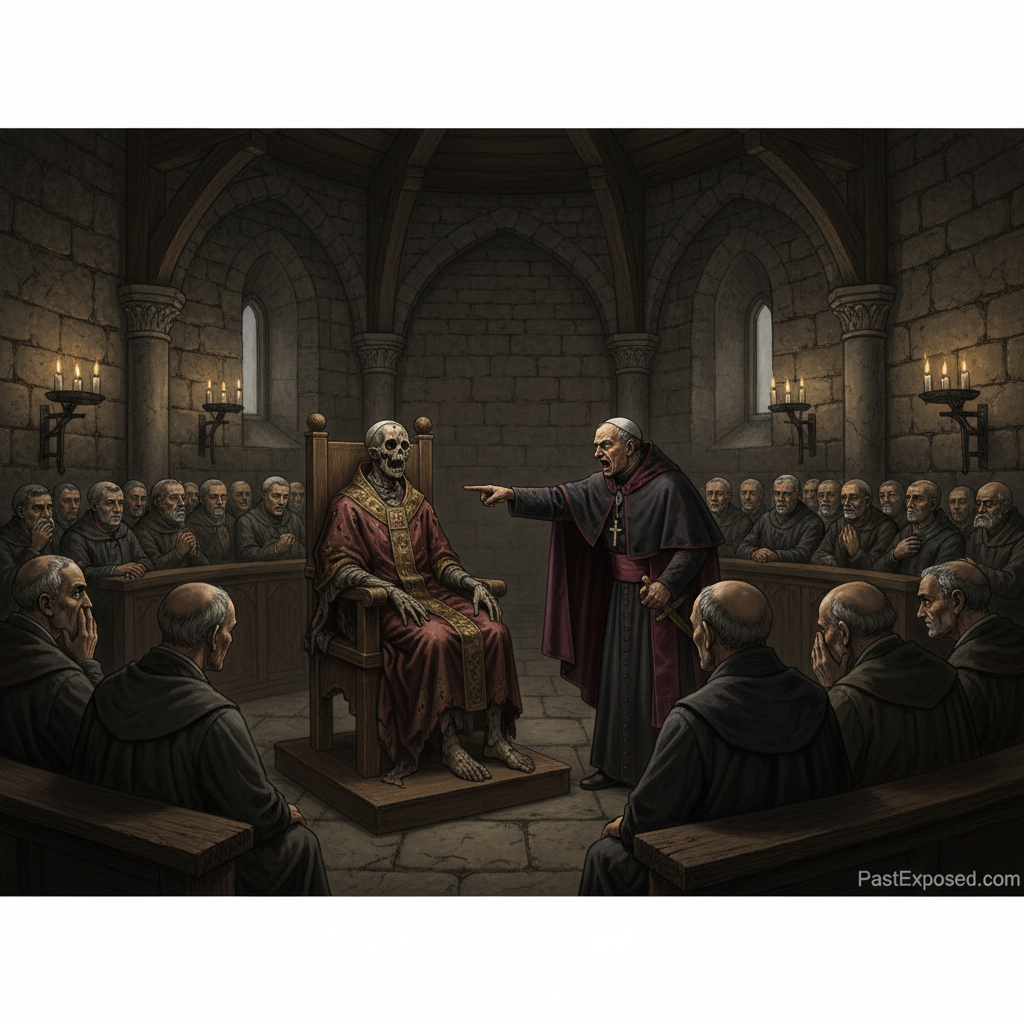
On Stephen’s orders, the corpse was re-dressed in full papal regalia: the sacred vestments, the papal pallium, the symbols of the office Formosus had held. The body was then carried into the papal council chamber and seated upon a throne.
What followed was a trial unlike any before or since.
Pope Stephen VI convened a full ecclesiastical council, known as a synod. The charges against the corpse of Formosus were threefold:
1. Perjury: Formosus had violated his oath by accepting the papacy while still serving as Bishop of Porto, contrary to Church law that forbade bishops from transferring sees.
2. Illegitimate elevation: Formosus’s election as pope was invalid because he had previously been excommunicated.
3. Political crimes: His actions in crowning Arnulf and opposing Lambert constituted treason against the rightful rulers of Italy.
The synod played out like a grotesque theater. Pope Stephen VI served as both prosecutor and judge. The corpse of Formosus, propped up on the throne, could not speak in its own defense. Instead, a deacon was appointed to stand behind the body and answer on behalf of the deceased—essentially providing a voice for the dead pope.
Historical accounts describe Stephen VI as screaming at the corpse, hurling accusations and insults, demanding answers from the rotting remains. The assembled bishops and clergy—many terrified of crossing the unstable pope—sat in horrified silence as Stephen interrogated the dead.
“Why did you usurp the Apostolic See?” Stephen reportedly shrieked at the corpse. “What ambition drove you to such sacrilege?”
The deacon, trembling, provided weak defenses that Stephen immediately shouted down.
The Verdict
The outcome was never in doubt. The corpse was found guilty on all charges.
Pope Stephen VI declared all of Formosus’s acts as pope null and void. Every priest he had ordained was retroactively stripped of their office. Every decree he had issued was nullified. It was as if his entire papacy had never existed.
But Stephen’s revenge didn’t end there.
The papal vestments were torn from the corpse. The three fingers of Formosus’s right hand—the ones used to give blessings—were hacked off with a sword. This was both symbolic and practical: without these fingers, he could never again bless in the Catholic tradition.
The mutilated corpse was then dragged through the streets of Rome. Citizens watched in horror and confusion as the remains of a former pope were paraded like a criminal through the city.
Finally, the body was thrown into the Tiber River—the ultimate dishonor. In Catholic theology, proper burial was essential for salvation. By casting Formosus into the river, Stephen was damning his predecessor’s soul for eternity.
The Monk and the Miracle
But the story didn’t end in the Tiber’s waters. According to contemporary accounts, a hermit monk living on the riverbank retrieved the body from the water. He recognized the papal vestments (or what remained of them) and gave Formosus a secret Christian burial.
Soon, stories began to circulate among the Roman people. Some claimed they saw visions of Formosus. Others reported miracles occurring at his new burial site. The mood in Rome began to shift.
The people who had watched in shocked silence as a corpse was put on trial began to ask questions: Had Stephen VI gone mad? Was this blasphemy? What kind of pope puts a dead man on trial?
The Earthquake and the Backlash
Then, in August 897, just months after the Cadaver Synod, a powerful earthquake struck Rome. The Basilica of St. John Lateran—the cathedral church of Rome and the pope’s official seat—partially collapsed.
Medieval people saw divine significance in natural disasters. The earthquake was interpreted as God’s judgment against Stephen VI for his desecration of Formosus’s corpse. The whispers of divine displeasure became shouts of outrage.
A faction of clergy and Roman citizens rose up against Stephen. He was arrested, stripped of his papal vestments—much as he had stripped Formosus—and thrown into prison.
In August or September of 897, Stephen VI was strangled to death in his cell. His reign had lasted less than eighteen months.
The Rehabilitation
The chaos didn’t end with Stephen’s death. Italy descended into a cycle of revenge and counter-revenge that would define papal politics for decades.
Stephen’s successor, Pope Theodore II, reigned for only 20 days before dying (likely poisoned). But in those three weeks, he managed to order the re-interment of Formosus’s remains in St. Peter’s Basilica with full honors.
Pope John IX, who followed shortly after, convened a synod that formally annulled the Cadaver Synod. Formosus’s acts as pope were reinstated as valid. The clergy he had ordained were recognized again. His reputation was officially restored.
John IX went further, declaring that future trials of deceased persons were forbidden. Never again, the Church decreed, should a corpse be put on trial.
But the damage was done. The Cadaver Synod had exposed the papacy as a corrupt, violent institution controlled by political factions rather than divine will. Trust in the Church hierarchy was shattered.
The Cycle Continues
The story has one final, darkly ironic twist. In 904 AD, Pope Sergius III—a supporter of the original Cadaver Synod—became pope. One of his first acts was to overturn the rehabilitation of Formosus and declare the Cadaver Synod valid again.
Formosus’s body was reportedly exhumed once more, beheaded, and thrown back into the Tiber River. The corpse had now been tried, rehabilitated, and condemned again—all while thoroughly deceased.
Sergius III would go on to become one of the most corrupt popes in history, fathering an illegitimate son (who would later become Pope John XI) with Marozia, a powerful Roman noblewoman. This began the so-called “Rule of the Harlots,” a period when the papacy was controlled by Marozia and her family.
Why Did It Happen?
Modern historians have struggled to fully explain the Cadaver Synod. Several factors seem to have converged:
Political Revenge: The Spoleto family wanted to utterly destroy Formosus’s legacy and justify their own claim to power. By proving Formosus was an illegitimate pope, they could argue that all his acts—including crowning Arnulf—were invalid.
Legal Precedent: Medieval canon law was obsessed with legitimacy and succession. If Formosus’s papacy could be declared void, it would have enormous implications for Church law and politics.
Mental Illness: Contemporary accounts suggest Stephen VI may have been genuinely unstable. His behavior during the trial—screaming at a corpse—indicates possible psychosis or mania.
Theological Justification: Some scholars have argued that putting a corpse on trial wasn’t seen as completely bizarre by medieval standards. If the soul survived death and would face divine judgment, perhaps earthly judgment of the dead wasn’t entirely illogical.
Warning to Others: The spectacle served as a brutal warning to any clergy who might oppose the Spoleto faction. If they would do this to a dead pope, what would they do to living enemies?
The Historical Impact
The Cadaver Synod marked the absolute nadir of papal authority in the medieval period. The image of a dead pope, rotting on a throne while being screamed at by his successor, became a symbol of Church corruption that would echo through the centuries.
Protestant reformers in the 16th century would point to the Cadaver Synod as evidence of Catholic Church depravity. Voltaire and other Enlightenment thinkers used it as ammunition against religious authority. Even today, it remains a go-to example when discussing the darkest moments of institutional Christianity.
The event also influenced Church law. Canon law was reformed to prevent any repetition of such a grotesque trial. The concept that the dead could be legally tried was formally rejected—though this didn’t stop occasional violations in later centuries.
Was It Real?
Some modern scholars have questioned whether the Cadaver Synod happened exactly as described, or at all. The primary sources are limited and sometimes contradictory. Some argue the story was exaggerated by later writers to discredit the medieval papacy.
However, the preponderance of evidence suggests the event did occur, though perhaps not with all the theatrical details later accounts added. Multiple contemporary chroniclers mention it, and the political circumstances make it plausible. The exhumation and trial of Formosus’s corpse appears in official Church records from the period.
What may be exaggerated are some of the more dramatic details—the extent of Stephen’s raving, the exact condition of the corpse, and so on. Medieval chroniclers were not above embellishing for dramatic effect.
But the core facts—that a pope exhumed his predecessor, put the corpse on trial, found it guilty, mutilated it, and threw it in the river—these appear to be historically accurate.
The Bodies of Power
The Cadaver Synod forces us to confront uncomfortable questions about power, legitimacy, and the uses of the dead. Throughout history, corpses have been powerful political symbols. From Lenin’s preserved body in Red Square to the exhibition of criminals’ bodies as warnings, the dead have been instrumentalized by the living for political purposes.
But the Cadaver Synod went further: it granted the dead legal agency, only to strip it away. It was simultaneously an acknowledgment that Formosus’s actions as pope mattered enough to prosecute, and a denial that he had any legitimate authority.
This paradox—treating the dead as both powerless object and responsible subject—reveals the desperate illogic of ninth-century papal politics.
A Cautionary Tale
Today, Formosus rests in St. Peter’s Basilica, his tomb unmarked and unremarkable among the dozens of papal burials. Few visitors know his story or the indignities his corpse suffered.
The Cadaver Synod chamber is long gone, destroyed and rebuilt many times over the centuries. No physical trace of the trial remains except fragmentary historical accounts and the enduring shock the story provokes.
The Cadaver Synod stands as one of history’s most macabre moments—a perfect storm of political revenge, religious fervor, and possible madness that produced a spectacle so bizarre it still disturbs us more than a millennium later. It reminds us that even the most sacred institutions can be corrupted, that power unchecked can produce monstrosity, and that the dead, silent and unable to defend themselves, remain forever vulnerable to the judgments of the living. In a medieval Roman courtroom, a corpse sat on a throne, accused of crimes it could no longer answer for, while a pope screamed at rotting flesh and bone. And in that grotesque theater, we see reflected the darkest capacities of human nature—our ability to desecrate, to seek revenge beyond death itself, and to turn even the sacred into an instrument of political brutality. The Cadaver Synod was not just the trial of Pope Formosus—it was the trial of the papacy itself. And in the end, both were found guilty.