

On a cold November morning in 1970, a man hiking through Norway’s “Death Valley”—a remote, desolate area near Bergen—stumbled upon a sight that would haunt investigators for decades. Partially hidden among the rocks lay the charred remains of a woman. She had been burned beyond recognition, surrounded by sleeping pills, bottles of gasoline, and the scattered remnants of her belongings. But this was no simple suicide or accident. The labels had been meticulously removed from her clothing. Her fingerprints had been sanded off. She carried multiple wigs, fake identities, and coded notes. For over fifty years, the Isdal Woman has remained one of Europe’s most baffling cold cases—a mystery that blurs the line between spy thriller and tragedy.
The Discovery in Death Valley
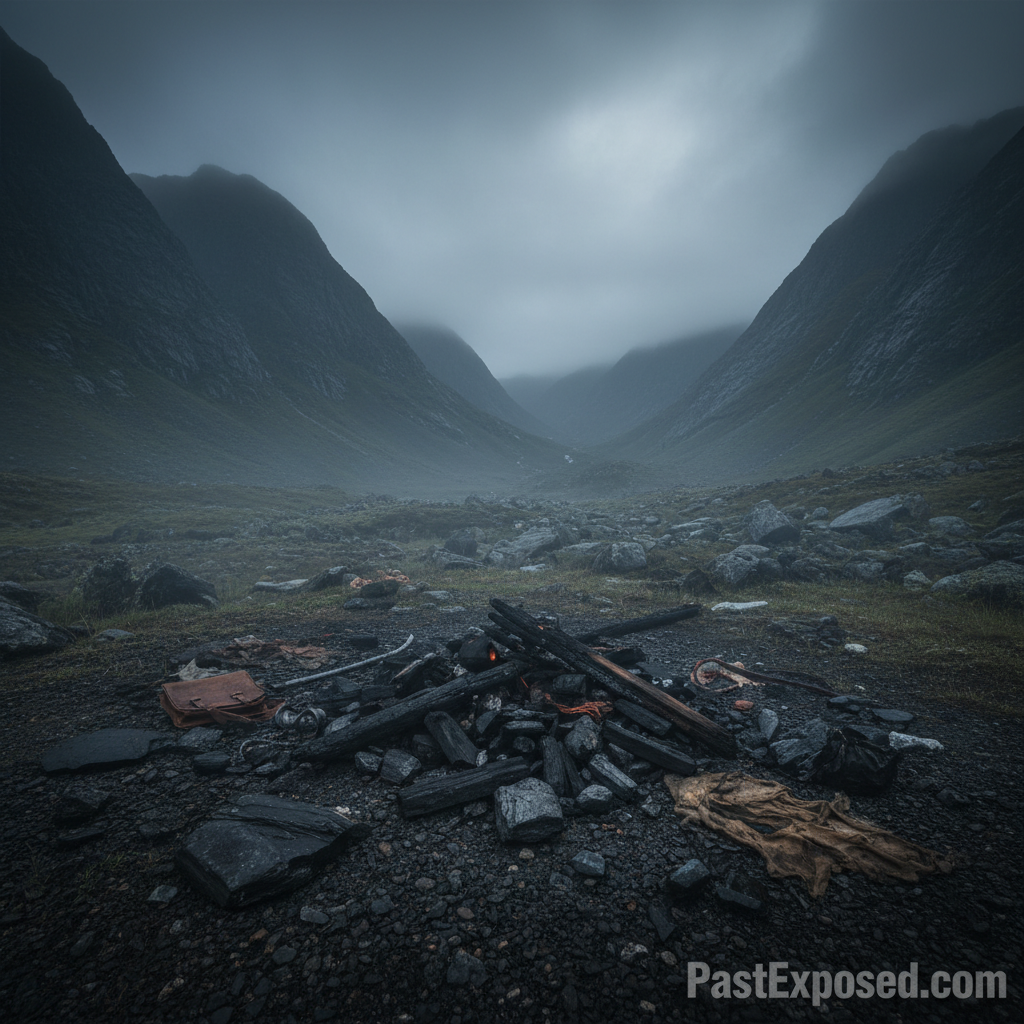
November 29, 1970. Bergen, Norway. A region known for its stunning fjords, colorful wooden houses, and—ironically—a valley called Isdalen, which translates to “Ice Valley” or “Death Valley.” The name comes from its perpetually cold, shadowed terrain where the sun rarely reaches.
A local professor out for a walk discovered what he initially thought was a discarded mannequin among the rocks. Upon closer inspection, the horrifying truth became clear: it was the badly burned body of a woman, positioned in a way that suggested she had been kneeling when she died.
The scene was immediately bizarre. The woman’s body was severely charred, her face unrecognizable. Nearby lay:
- Two plastic bottles that had contained gasoline (petrol)
- Over a dozen Fenemal sleeping pills (a powerful sedative) scattered around the body
- Partially burned foreign banknotes
- A partially melted watch stopped at 12:32
- The remnants of burned clothing and personal items
Most disturbingly, all identifying labels had been removed from her clothing. Brand names, size tags, manufacturer marks—everything that might trace the origin of her garments had been carefully cut away.
The Woman With No Name
The autopsy revealed even more mysteries. The woman was approximately 30-40 years old, about 164 cm tall, with dark brown hair (though multiple wigs would later be found). The cause of death was determined to be a combination of carbon monoxide poisoning and the ingestion of approximately 50-70 sleeping pills—a lethal dose.
Her neck showed bruising consistent with manual strangulation, though this was inconclusive. The pathologist noted that the positioning of the body and the burn patterns were unusual for a suicide. Most people who self-immolate do not remain kneeling in place; survival instinct causes them to move, to try to escape the flames.
Even more mysterious: her fingerprints appeared to have been deliberately sanded or burned off, making identification through fingerprint databases impossible.
Dental records showed extensive dental work using materials and techniques common in several European countries, but the work was too generic to pinpoint a specific dentist or region.
Isotope analysis of her teeth (conducted decades later with modern technology) suggested she had lived in various regions of Europe during her youth, possibly Central or Eastern Europe, but had also spent significant time in other areas.
The Suitcases: A Trail of False Identities
Police investigations revealed that the woman had checked into a Bergen hotel just days before her death, using a false name. This led investigators to discover something extraordinary: the woman had been traveling throughout Norway and other Scandinavian countries for months under multiple false identities.
Two suitcases belonging to her were found stored at Bergen’s railway station. Their contents were astounding:
- Multiple wigs of different styles and colors
- Several sets of clothing, all with labels removed
- Foreign currency from various countries
- Prescription glasses with non-prescription lenses (disguise glasses)
- A coded diary/notebook with entries that appeared to be written in cipher
- Numerous fake identification documents under different names
- A spoon with what appeared to be melted silver residue
Police identified at least nine different aliases the woman had used during her travels. The names were variations like:
- Fenella Lorch
- Alexia Zarna-Merchez
- Vera Jarle
- Claudia Tielt
She had stayed at various hotels across Norway, always paying in cash, always giving false addresses that investigators later discovered didn’t exist. Hotel staff remembered her as polite but odd—she would request room changes frequently, seemed nervous, and was seen with various men at different times.
The Coded Diary
One of the most intriguing pieces of evidence was a small diary found in the woman’s belongings. The entries were written in a code consisting of combinations of letters and numbers. Cryptographers and intelligence experts examined the diary but could not definitively crack the code.
Some entries appeared to correlate with her travel itinerary—dates and locations she had visited—but written in cipher. Why would someone encode a simple travel log unless the destinations themselves held significance?
Other entries seemed to reference meetings or appointments, but the meaning remained obscure. The diary suggested meticulous planning and a level of operational security consistent with espionage tradecraft.
The Spy Theory: Cold War Intrigue
1970 was the height of the Cold War. Norway, as a NATO member with a border near the Soviet Union, was a hotbed of intelligence activity. Both Western and Eastern Bloc intelligence services operated extensively in Scandinavia.
Investigators and intelligence analysts began to suspect the Isdal Woman was a spy—possibly an agent who had been compromised or was in the process of fleeing when something went wrong.
Evidence supporting the spy theory:
- Multiple identities: The false passports and systematic use of aliases are classic intelligence tradecraft
- Coded communications: The encrypted diary suggests she was concealing information
- Travel patterns: Her movements matched locations of strategic interest during the Cold War, including military installations
- Destroyed identification: Removing labels and fingerprints suggests operational security protocols
- Suspicious contacts: Hotel staff reported seeing her with different men, possibly handlers or contacts
- Cash payments: Always paying cash and providing false addresses to avoid paper trails
- Disguises: The wigs and fake glasses indicate efforts to alter appearance
Some intelligence analysts speculated she might have been:
- An East German (Stasi) or Soviet (KGB) agent
- A Western intelligence operative who was compromised
- A double agent caught between competing intelligence services
- An intelligence courier carrying sensitive information
The Murder Theory: Did Someone Kill Her?
While Norwegian police officially ruled the death a probable suicide, many aspects of the case suggest foul play:
- Bruising on the neck: Suggestive of strangulation
- Unusual positioning: The kneeling posture is inconsistent with voluntary self-immolation
- Amount of pills: Taking 50-70 sleeping pills would have rendered her unconscious before she could set herself on fire
- Location: Death Valley is an unusual place to choose for suicide—remote, difficult to access, cold, and desolate
- Gastric contents: Analysis showed she had eaten a substantial meal shortly before death, unusual for someone planning suicide
The murder scenario suggests:
- The woman was forced to ingest sleeping pills or was drugged
- She was strangled or rendered unconscious
- Her body was positioned and set on fire to destroy evidence
- The killer(s) staged it to look like suicide
But if it was murder, who killed her? And why?
Potential Scenarios
Scenario 1: Spy Gone Wrong
The woman was an intelligence operative who was discovered or betrayed. Her own service (or a rival service) eliminated her to prevent compromise or because she knew too much. The elaborate cover-up and destruction of evidence point to professional intelligence work.
Scenario 2: Defector Eliminated
She was attempting to defect from an Eastern Bloc intelligence service and was tracked down and executed before she could reveal what she knew to Western authorities.
Scenario 3: Tragic Suicide
The woman, perhaps suffering from mental illness or trapped in an impossible situation (possibly related to espionage), chose to end her life. She destroyed her identity because she wanted to disappear completely, to leave no trace. The coded diary and aliases were related to her work, but her death was her own choice.
Scenario 4: Criminal Activity
Perhaps she wasn’t a spy at all, but involved in criminal activities—smuggling, fraud, or organized crime—that required false identities. Her death could have been an execution by criminal associates.
The Police Investigation
Norwegian police conducted an extensive investigation, but it was hampered by several factors:
- The remote location meant evidence may have been contaminated or lost
- The Cold War context meant intelligence services were unwilling to share information
- The destroyed fingerprints and lack of dental matches made identification nearly impossible with 1970s technology
- Witnesses provided conflicting descriptions of the woman and the men seen with her
Interpol was contacted, but no missing persons reports matched the Isdal Woman. Her photograph, facial reconstruction, and details were circulated throughout Europe—no one came forward to identify her.
The case was eventually filed away as unsolved, though it was never officially closed.
Modern Investigations: DNA and New Technology
In 2016, nearly fifty years after the discovery, Norwegian authorities reopened the case using modern forensic technology.
Key developments:
- DNA analysis: Genetic material was extracted from the woman’s remains, but with no match in any database, it provided no immediate identification
- Isotope analysis: Study of stable isotopes in her teeth suggested she had lived in several regions of Europe during her life, possibly including Germany, France, and areas of Eastern Europe
- Digital facial reconstruction: Using modern techniques, forensic artists created updated images of what she might have looked like
- Genealogical DNA databases: Investigators hoped consumer genealogy databases might eventually provide leads, though privacy laws and the passage of time complicate this approach
A BBC podcast and NRK (Norwegian Broadcasting) documentary brought renewed international attention to the case, generating thousands of tips, though none led to definitive identification.
Who Was She?
Over fifty years later, the Isdal Woman remains unidentified. Every attempt to discover who she was has failed. She succeeded in erasing her identity so thoroughly that even modern science struggles to reveal her secrets.
Was she a spy caught in the deadly games of Cold War intelligence? A tragic woman fleeing an unbearable past? A criminal on the run? Or something else entirely?
Theories have proliferated:
- Some believe she was an East German Stasi operative
- Others suggest she was a West German intelligence agent
- Some think she was Israeli Mossad
- A few propose she was a Soviet KGB officer
- Others believe she was simply a deeply troubled woman with no connection to espionage
The Men in the Shadows
One of the most frustrating aspects of the case is that multiple witnesses reported seeing the woman with various men—at hotels, restaurants, and on trains. Some of these men were described in detail, and police even created composite sketches.
Yet none of these men ever came forward. Not one. Despite extensive publicity, widespread media coverage, and international appeals, the men who were seen with the Isdal Woman in the days and weeks before her death remained silent.
Their silence speaks volumes. Were they intelligence agents who couldn’t reveal themselves? Criminals? Innocent men who feared being implicated? Or were they involved in her death?
The Cemetery in Bergen
Unable to identify her, authorities buried the Isdal Woman in a cemetery in Bergen. Her gravestone reads simply “Isdal Woman” with the date of her discovery.
For years, flowers appeared on her grave—anonymous bouquets left by unknown mourners. Who were they? People moved by her tragic story? Or perhaps someone who knew her, unable to speak publicly but unwilling to let her lie forgotten?
In 2017, the grave was exhumed as part of the renewed investigation, and additional forensic samples were taken. She was then reburied.
The Unsolved Puzzle
What makes the Isdal Woman case so compelling is not just the mystery of her identity, but the mystery of her entire existence. She was someone who deliberately erased herself from the world—someone who lived in shadows, used fake names, and moved between countries like a ghost.
And then, in a desolate valley in Norway, she burned away the last traces of who she was.
Today, Death Valley is still there, cold and isolated, nestled among Bergen’s mountains. Hikers occasionally visit the spot where the Isdal Woman died, marked now by a small memorial. The rocks where her body was found have long since been washed by rain and snow, but the questions remain: Who was she? Why was she in Norway? Was she murdered, or did she choose to die? And why, after more than fifty years, has no one—not family, not friends, not former employers—come forward to claim her? Perhaps someone, somewhere, knows the truth. Perhaps they’re still alive, still silent, still keeping the Isdal Woman’s secrets locked away. Or perhaps the truth died with her on that cold November day, burned to ash along with her identity, leaving behind only questions, coded diary entries, and a nameless grave in a Norwegian cemetery. In Death Valley, the stones keep their secrets. And so, it seems, will the woman who died among them.