
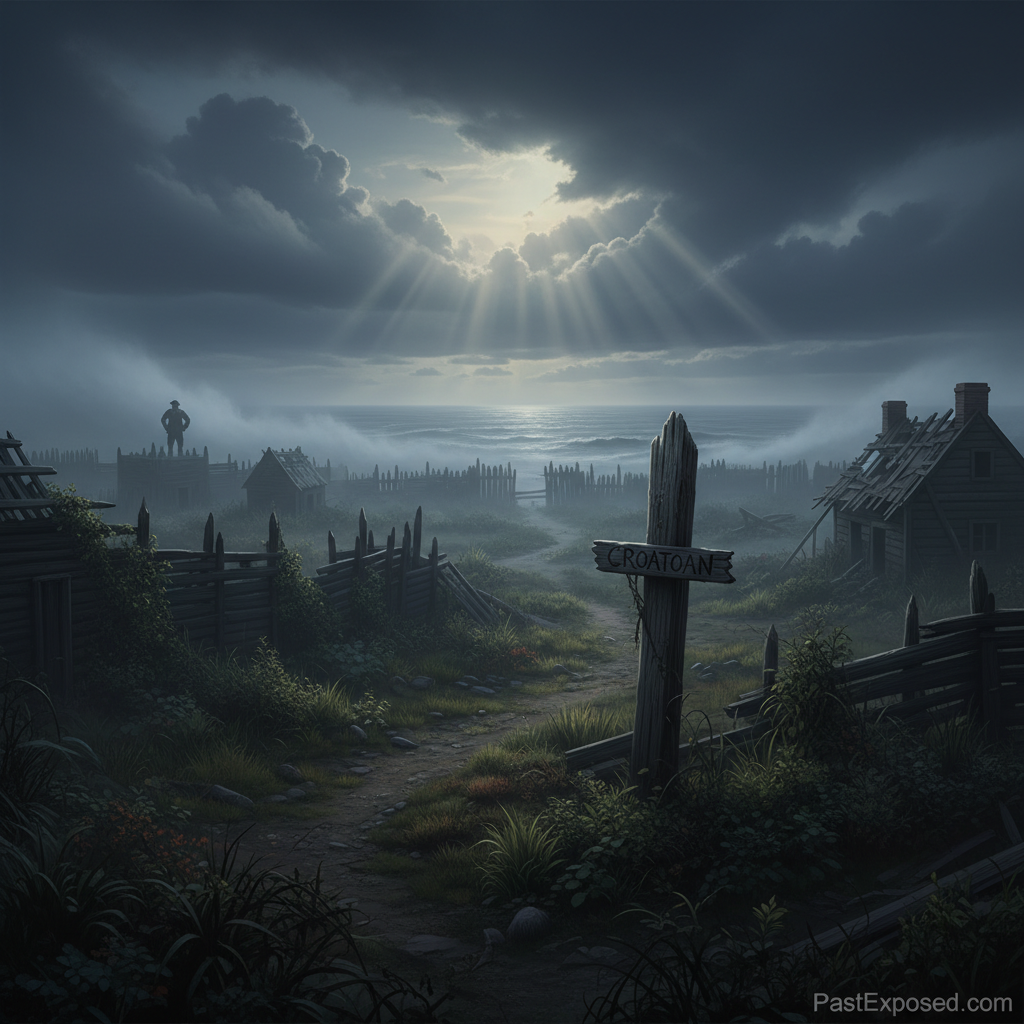
In 1587, 117 English settlers arrived on Roanoke Island off the coast of present-day North Carolina, determined to establish the first permanent English colony in the New World. Three years later, when supply ships finally returned, they found the settlement completely abandoned. Houses stood empty. Belongings were left behind. There were no bodies, no signs of struggle, no graves. The only clue was a single word carved into a wooden post: “CROATOAN.” What happened to the Lost Colony remains America’s oldest unsolved mystery—a disappearance so complete and so baffling that over 400 years later, we still have no definitive answer.
The Dream of Empire
To understand the Lost Colony, we must first understand the ambitions that brought those settlers to a remote island thousands of miles from home. In the late 16th century, England was determined to challenge Spain’s dominance of the New World. Queen Elizabeth I granted her favorite courtier, Sir Walter Raleigh, a charter to explore and colonize lands in North America.
Raleigh had already sponsored two previous expeditions to the region the English called “Virginia” (named in honor of Elizabeth, the “Virgin Queen”). The first, in 1584, brought back glowing reports of fertile land and friendly natives. The second, in 1585, established a military outpost on Roanoke Island but ended in failure when the colonists, running low on supplies and in conflict with local tribes, abandoned the settlement and returned to England with Sir Francis Drake in 1586.
But Raleigh was not discouraged. The third attempt would be different. This time, instead of soldiers, he would send families—men, women, and children committed to building permanent homes. They would be led by John White, an artist and cartographer who had been on the 1585 expedition and maintained good relationships with some of the indigenous peoples.
The Settlers Arrive
On May 8, 1587, a fleet of three ships carrying approximately 117 colonists departed from Portsmouth, England. The group included 91 men, 17 women, and 9 children. Unlike the previous military expedition, these were families seeking a new life: craftsmen, farmers, gentlemen, servants, and their loved ones.
Among them was John White’s pregnant daughter, Eleanor Dare, and her husband Ananias Dare. The colonists carried with them everything needed to establish a self-sufficient settlement: tools, seeds, livestock, weapons, and supplies to last until they could harvest their first crops and establish trade.
The fleet arrived at Roanoke Island on July 22, 1587. Governor White had actually intended to use Roanoke only as a brief stop before continuing north to the Chesapeake Bay, where a more suitable site had been chosen. However, the fleet’s commander, Simon Fernandes, refused to take the colonists any further. Whether this was due to the lateness of the season, conflicts with White, or a desire to return to privateering, we’ll never know. The colonists were stranded on Roanoke.
The island was not uninhabited. The remains of the 1585 fort still stood, though overgrown and damaged. More ominously, one skeleton was found at the site—a man killed by the local natives during the conflicts of the previous expedition. It was an unsettling welcome.
A Birth and a Murder
Despite the challenging circumstances, the colonists set to work rebuilding structures and establishing their settlement. On August 18, 1587, Eleanor Dare gave birth to a daughter—the first English child born in the Americas. They named her Virginia Dare, and her birth was seen as a hopeful symbol of the colony’s future.
But darker events soon cast shadows over this joy. Relations with the local Croatoan tribe (who had been friendly during the 1585 expedition) remained good, but other tribes were hostile. On July 28, just days after the colonists’ arrival, one of the settlers, George Howe, was killed by hostile natives while catching crabs alone in shallow water. His body was found with sixteen arrow wounds and his skull crushed.
The murder increased tensions and highlighted the colony’s vulnerability. White and his advisors attempted to negotiate with the local tribes through their Croatoan allies, but a disastrous raid on the wrong village—the colonists attacked friendly natives by mistake—only worsened relations.
White’s Fateful Departure
As summer turned to fall, it became clear the colony was in trouble. Supplies were running low. The late planting season meant crops wouldn’t be ready before winter. Relations with most local tribes were hostile. The colonists needed help from England—food, supplies, and more settlers.
On August 27, 1587, the colonists held a council and made a desperate decision: Governor White would return to England to seek aid and supplies. It was an agonizing choice for White, who would be leaving behind his daughter Eleanor, his son-in-law Ananias, and his infant granddaughter Virginia.
Before departing, White and the colonists agreed on a plan. If they were forced to abandon Roanoke, they would carve the name of their destination into a prominent tree or post. If they left under distress or danger, they would add a Maltese cross above the name. This agreed-upon signal would tell White where to find them when he returned.
White sailed for England in late August 1587, expecting to return within months with fresh supplies. He had no way of knowing he wouldn’t see Roanoke Island again for three years.
Trapped in England
What should have been a brief trip became a nightmare of delays. White arrived in England in November 1587 to find the nation in crisis. Spain was preparing the massive naval force that would become known as the Spanish Armada, planning a full-scale invasion of England. Queen Elizabeth issued orders that no ships could leave English ports—every vessel was needed for national defense.
White desperately tried to secure permission to return to his colony. He managed to get two small ships in April 1588, but the captains, more interested in privateering (attacking Spanish ships) than resupply missions, engaged in ship-to-ship combat, sustained damage, and were forced to return to England. The colony’s supplies remained undelivered.
Then came the epic sea battle with the Spanish Armada in the summer of 1588. England’s victory secured the nation but did nothing to help the stranded colonists. Throughout 1589 and into 1590, White petitioned, begged, and pleaded for ships to return to Roanoke. He was stonewalled at every turn.
Finally, in March 1590, White secured passage on a privateering expedition led by Captain John Watts. The ships would stop at Roanoke, but only briefly—the primary mission was raiding Spanish ships and settlements. It was far from ideal, but it was White’s only option.
The Return: August 18, 1590
On August 15, 1590, after months at sea, White’s ships arrived off the coast of Roanoke Island. As they approached, they saw smoke rising from the island and their hopes surged—surely it was a signal fire from the colonists. But when they investigated the next day, they found only a forest fire, burning unattended.
Rough seas delayed landing until August 18—exactly three years to the day after Virginia Dare’s birth. White’s written account of what happened next remains one of the most haunting documents in American history.
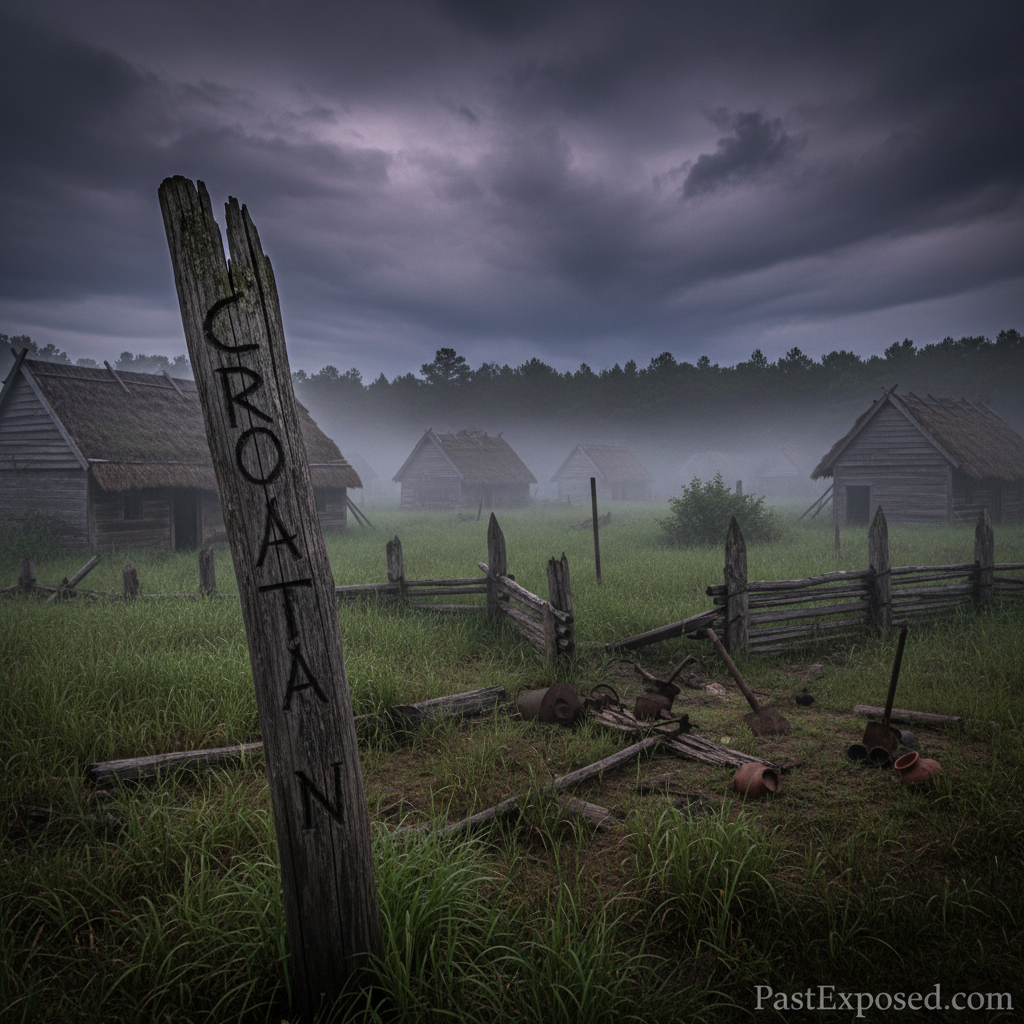
As the boats approached the northern end of Roanoke Island, the men saw carved letters on trees. Drawing closer to the settlement site, they found the houses had been taken down and a strong palisade (defensive wall) had been built around the area. On one of the posts at the entrance, carved in “fair capital letters,” was the word:
CROATOAN
There was no Maltese cross—meaning, according to their pre-arranged signal, the colonists had not left under duress. On a nearby tree, White found the letters “CRO” carved into the bark.
White entered the settlement area, his heart pounding with a mixture of hope and dread. The houses were gone, dismantled deliberately, with the timber apparently taken. There were no bodies. No graves. No signs of violence or struggle.
But White did find evidence of a hasty departure. Iron bars and heavy artillery pieces had been buried but were now exposed, thrown about by those who had dug them up. Personal belongings—his own possessions, books, maps, pictures, and armor—were found scattered and damaged, ruined by weather and torn up by “savages” (likely looters after the colonists departed).
Most heartbreaking for White: three of his personal trunks had been broken open, their contents ruined by rain. His books were torn. His maps and drawings—years of work—were spoiled. His armor was rusty and unusable.
The Search Cut Short
The word “CROATOAN” seemed to provide an answer. The Croatoan were a friendly tribe who lived on what is now Hatteras Island, about 50 miles south of Roanoke. White had friends among them, including Manteo, a Croatoan man who had traveled to England with earlier expeditions and converted to Christianity. It made sense that the colonists, facing difficulties, would relocate to Croatoan territory where they might find allies and assistance.
White was eager to sail immediately to Croatoan Island. But fate had other plans. A massive storm struck the coast. One of the ships lost anchors and was nearly driven aground. The decision was made to head for the Caribbean to resupply and overwinter, then return in the spring to search Croatoan.
The ships never returned. Captain Watts had his privateering agenda, and White had no authority to force the issue. The expedition eventually returned to England in October 1590. John White, now an old man, his daughter, son-in-law, and granddaughter lost, never made another voyage to America.
In his final written account, White expressed his resignation to God’s will, but his anguish is palpable even across the centuries: “And with committing the relief of my discomfortable company the planters in Virginia, to the merciful help of the Almighty, whom I most humbly beseech to help and comfort them, according to his most holy will and their good desire.”
The Theories: What Happened?
For over 400 years, historians, archaeologists, and amateur sleuths have proposed dozens of theories about the fate of the Lost Colony. The evidence is fragmentary, contradictory, and open to multiple interpretations:
Theory 1: Integration with the Croatoan Tribe
The most likely scenario: The colonists relocated to Croatoan Island (modern Hatteras Island) and integrated with the friendly Croatoan tribe. The carved message supports this. Later English explorers in the 1600s reported meeting Native Americans in the region with gray eyes and who claimed their ancestors “could talk in a book”—possible references to literacy from English colonists.
Archaeological excavations on Hatteras Island have uncovered a ring with a lion design (possibly belonging to one of the colonists), European artifacts from the correct time period, and evidence of a mixed English-Native settlement.
The colonists’ English identity may have simply dissolved over generations as they intermarried with the Croatoan, adopted Native ways, and their children grew up in an indigenous culture. By the time the next English settlers arrived at Jamestown in 1607—seventeen years later—the original colonists would have been elderly or dead, their descendants fully integrated into tribal life.
Theory 2: Massacre by Hostile Tribes
Some historians believe the colonists were killed by hostile tribes—either the Secotan or Powhatan confederacy. The Jamestown colonists, arriving in 1607, heard rumors from Chief Powhatan about a massacre of white settlers at a place matching Roanoke’s location. Powhatan allegedly showed English weapons he claimed came from slaughtered colonists.
However, no mass grave has ever been found, and the carved “CROATOAN” message without a distress cross argues against a sudden violent attack.
Theory 3: Multiple Dispersal
A newer theory suggests the colony split into multiple groups. Some may have gone to Croatoan. Others may have traveled inland, attempting to reach the copper mines of the Chesapeake Bay region (mentioned in earlier explorations). Still others might have tried to sail away in a boat and perished at sea.
This would explain conflicting reports from later English explorers who heard tales of white people living among various tribes in different locations. Archaeological site “Site X,” located about 50 miles inland from Roanoke, has yielded English artifacts from the right time period, suggesting at least some colonists traveled west.
Theory 4: Drought and Starvation
Modern tree-ring analysis has revealed that the years 1587-1589 included the worst drought in the region in 800 years. The colonists arrived at precisely the wrong time. Crops would have failed. Game would have been scarce. Fresh water would have been limited.
Facing starvation on Roanoke, the colonists may have dispersed in small groups, seeking aid from any tribes willing to help. Some may have survived by integrating into native communities. Others likely died from disease, hunger, or violence as desperate English settlers and stressed Native populations clashed over scarce resources.
Theory 5: Spanish Attack
Spain, viewing any English presence in the Americas as a threat, had intelligence about the Roanoke colony. Spanish documents from the period show they were aware of the settlement’s location and discussed eliminating it. Some researchers believe a Spanish raid from St. Augustine, Florida, may have destroyed the colony.
However, Spanish records are meticulous about such operations, and no document confirming an attack on Roanoke has been found. The “CROATOAN” carving also doesn’t fit this scenario unless it was left before a Spanish attack, and the colonists never reached their intended destination.
Modern Investigations
The search for the Lost Colony continues into the 21st century, now aided by technologies John White couldn’t have imagined:
Archaeological Excavations: Multiple sites have yielded artifacts that may be connected to the Lost Colony, including European items found in Native American contexts on Hatteras Island and at inland Site X.
Ground-Penetrating Radar: Used to search for buried structures or mass graves without excavation.
DNA Analysis: Attempts have been made to trace genetic connections between modern populations and the colonists. The Lumbee tribe of North Carolina has long claimed descent from the Lost Colony, and some members have surnames matching colonists (Dare, Cooper, etc.). DNA studies have been inconclusive but ongoing.
Documentary Research: Scholars continue to scour English, Spanish, and other European archives for any overlooked mention of the colony’s fate.
The Dare Stones: An Elaborate Hoax
In 1937, a tourist in North Carolina found a stone carved with a message purportedly from Eleanor Dare, explaining that the colonists had moved inland, were attacked by natives, and that she had survived to 1591. Over the next few years, 47 more “Dare stones” appeared, each supposedly continuing Eleanor’s story.
Scholars and the public were initially excited, but investigations revealed the stones were almost certainly forgeries. The finder had advertised for more stones and offered rewards, incentivizing their “discovery.” The language and details in the carvings contained suspicious anachronisms and errors. By 1941, academic consensus deemed them hoaxes, though the identity of the forger(s) was never definitively proven.
The first stone remains controversial, with a small minority of researchers arguing it might be genuine even if the subsequent stones were fakes copying its style.
Virginia Dare: An American Legend
Virginia Dare, the first English child born in the Americas, has become a figure of American mythology despite having lived only a few weeks or months before vanishing with the colony. Her story has been romanticized in countless poems, novels, and artworks.
Some Native American legends speak of a white deer that appeared in the region around the time of the colony—later romanticized by 19th-century writers into the story that Virginia Dare was transformed into a white doe by a jealous witch. While these tales are almost certainly later inventions, they demonstrate how the Lost Colony mystery has captured American imagination.
Virginia Dare’s name graces counties, streets, bridges, and even a variety of wine. She has become a symbol—of lost potential, of American origins, and of the ultimate fate of those 117 souls who vanished into history.
John White’s Final Years
John White, the governor who left his family behind, lived his final years in Ireland, having retired from exploration. His last known document is dated 1593. He is believed to have died around 1593-1606, but the exact date and circumstances are unknown.
White left behind a collection of remarkable watercolors documenting Native American life, flora, and fauna of the Roanoke region—images that remain among our best visual records of indigenous peoples of that era. But he also left behind a legacy of loss, having been unable to return to his family when they needed him most.
Did he blame himself? His writings suggest a man struggling with guilt, responsibility, and powerlessness. He had been forced by circumstances beyond his control to abandon his colony, and forced by those same circumstances to stay away while they faced unknown fates.
The Legacy of the Lost Colony
The Lost Colony of Roanoke holds a unique place in American consciousness. Unlike later successful colonies, its failure and mystery have made it more famous than most successes. The question “What happened to them?” has inspired countless books, television shows, plays, and investigations.
The mystery also serves as a reminder of how fragile early colonial ventures were. The margin between survival and disaster was razor-thin. A few months’ delay in resupply, a drought, conflicts with indigenous peoples, disease—any of these could doom an entire settlement.
Today, Fort Raleigh National Historic Site on Roanoke Island commemorates the Lost Colony. Each summer since 1937, the outdoor drama “The Lost Colony” has been performed, telling the story to new generations. The show has been seen by over 4 million people, making it one of the longest-running outdoor theatrical productions in America.
Will We Ever Know?
The most honest answer is: probably not with absolute certainty. Too much time has passed. Too much evidence has been destroyed by time, weather, and development. The physical remains of 117 people scattered across possibly multiple locations and integrated into Native American communities 400+ years ago are nearly impossible to definitively identify.
What we can say with reasonable confidence is that the colonists almost certainly did not simply vanish. They went somewhere. Most likely, groups of colonists relocated to different areas—some to Croatoan Island, some inland, perhaps others elsewhere. Over time, they would have died, been killed, or been absorbed into indigenous communities.
Their descendants may walk among us today, their genetic legacy preserved in families who have no idea they carry the blood of Eleanor Dare or Virginia’s namesake or any of the other souls who stepped off those ships in 1587.
In the end, the Lost Colony of Roanoke reminds us that history is full of unanswered questions—threads that lead nowhere, lives that leave only the faintest traces, mysteries that remain mysteries no matter how much we wish to solve them. One hundred and seventeen people vanished, leaving behind only a word carved into wood: CROATOAN. Was it a destination? A warning? A goodbye? We may never know. But that single word echoes across four centuries, a whisper from the past that refuses to be silenced, a mystery that refuses to be solved, and a reminder that sometimes history keeps its secrets forever. John White died not knowing what became of his daughter, his granddaughter, or any of his people. We, too, may have to accept that some answers remain forever lost in the mists of time—vanished, like the colony itself, leaving behind only questions, speculation, and a name carved into history: The Lost Colony of Roanoke.