

On the evening of October 21, 1978, 20-year-old pilot Frederick Valentich took off from Melbourne’s Moorabbin Airport in a small Cessna 182L aircraft, bound for King Island across the Bass Strait. His flight should have taken about an hour. Instead, at 7:12 PM, Valentich radioed air traffic control in Melbourne with an urgent message: an unidentified aircraft was flying above him. For the next six minutes, the increasingly panicked pilot described a strange metallic craft with bright green lights that was “orbiting” his plane. Then, at 7:12 PM, Valentich’s transmission abruptly ended with the sound of metallic scraping. Neither Frederick Valentich nor his aircraft were ever seen again. What happened in the skies over Bass Strait that night remains one of aviation’s most baffling unsolved mysteries—and one of the most credible UFO encounters on record.
The Young Pilot
Frederick Valentich was a 20-year-old pilot from Melbourne, Australia, passionate about aviation from childhood. By 1978, he had logged 150 hours of flight time and was working toward his commercial pilot’s license. Friends and family described him as dedicated, responsible, and safety-conscious—not someone prone to panic or hallucination.
Fred was also deeply interested in UFOs. He had read books on the subject, discussed sightings with friends, and had reportedly told his father that he feared a UFO encounter. Some skeptics would later use this interest to suggest he staged his own disappearance or succumbed to wishful thinking. But his interest also meant he was familiar with various aerial phenomena and less likely to misidentify conventional aircraft.
On October 21, 1978, Valentich filed a flight plan for a routine training flight from Melbourne to King Island, a small landmass in the Bass Strait between mainland Australia and Tasmania. He planned to pick up crayfish from King Island and return the same evening. It was a clear night with good visibility—ideal flying conditions.
The Flight
At 6:19 PM, Valentich departed Moorabbin Airport in VH-DSJ, a Cessna 182L, a reliable single-engine aircraft commonly used for training flights. The weather was excellent: scattered clouds at 5,000 feet, light winds, and visibility of more than 10 miles. It was almost a full moon.
For the first 50 minutes, the flight was completely routine. Valentich maintained contact with Melbourne Flight Service as he flew southwest over the Bass Strait, the notoriously treacherous body of water known for unpredictable weather and strong currents.
At 7:06 PM, as Valentich approached Cape Otway on the Victorian coast—about halfway to King Island—everything changed.
The Transmission
The following is the actual transcript of the radio conversation between Frederick Valentich (DSJ) and Melbourne Flight Service (FS). This is one of the most extraordinary documents in aviation history:
19:06:14 DSJ: Melbourne, this is Delta Sierra Juliet. Is there any known traffic below five thousand?
FS: Delta Sierra Juliet, no known traffic.
DSJ: Delta Sierra Juliet, I am, seems to be a large aircraft below five thousand.
19:06:44 FS: Delta Sierra Juliet, what type of aircraft is it?
DSJ: Delta Sierra Juliet, I cannot affirm, it is four bright, it seems to me like landing lights.
19:07 FS: Delta Sierra Juliet.
19:07:31 DSJ: Melbourne, this is Delta Sierra Juliet, the aircraft has just passed over me at least a thousand feet above.
FS: Delta Sierra Juliet, roger, and it is a large aircraft, confirmed?
DSJ: Er—unknown, due to the speed it’s traveling, is there any air force aircraft in the vicinity?
FS: Delta Sierra Juliet, no known aircraft in the vicinity.
19:08:18 DSJ: Melbourne, it’s approaching now from due east towards me.
FS: Delta Sierra Juliet.
19:08:41 DSJ: (Open microphone for two seconds.)
19:08:48 DSJ: Delta Sierra Juliet, it seems to me that he’s playing some sort of game, he’s flying over me two, three times at speeds I could not identify.
19:09 FS: Delta Sierra Juliet, roger, what is your actual level?
DSJ: My level is four and a half thousand, four five zero zero.
FS: Delta Sierra Juliet, and you confirm you cannot identify the aircraft?
DSJ: Affirmative.
FS: Delta Sierra Juliet, roger, stand by.
19:09:27 DSJ: Melbourne, Delta Sierra Juliet, it’s not an aircraft it is (open microphone for two seconds).
19:09:42 FS: Delta Sierra Juliet, can you describe the—er—aircraft?
DSJ: Delta Sierra Juliet, as it’s flying past it’s a long shape (open microphone for three seconds) cannot identify more than it has such speed (open microphone for three seconds). It’s before me right now Melbourne.
19:10 FS: Delta Sierra Juliet, roger and how large would the—er—object be?
19:10:19 DSJ: Delta Sierra Juliet, Melbourne, it seems like it’s chasing me. What I’m doing right now is orbiting and the thing is just orbiting on top of me also. It’s got a green light and sort of metallic like, it’s all shiny on the outside.
FS: Delta Sierra Juliet
19:10:46 DSJ: Delta Sierra Juliet (open microphone for five seconds) It’s just vanished.
FS: Delta Sierra Juliet
19:11 DSJ: Melbourne, would you know what kind of aircraft I’ve got? Is it a military aircraft?
FS: Delta Sierra Juliet, Confirm the—er—aircraft just vanished.
DSJ: Say again.
FS: Delta Sierra Juliet, is the aircraft still with you?
DSJ: Delta Sierra Juliet; it’s (open microphone for two seconds) now approaching from the southwest.
FS: Delta Sierra Juliet
19:11:50 DSJ: Delta Sierra Juliet, the engine is rough-idling. I’ve got it set at twenty three twenty-four and the thing is coughing.
FS: Delta Sierra Juliet, roger, what are your intentions?
DSJ: My intentions are, ah, to go to King Island, ah, Melbourne. That strange aircraft is hovering on top of me again (open microphone for two seconds). It is hovering and it’s not an aircraft.
FS: Delta Sierra Juliet.
19:12:28 DSJ: Delta Sierra Juliet. Melbourne (open microphone for seventeen seconds).
19:12:49 (End of transmission.)
That seventeen-second open microphone period at the end has been analyzed countless times. It contains a strange metallic scraping or grinding sound that has never been explained. Then—silence.
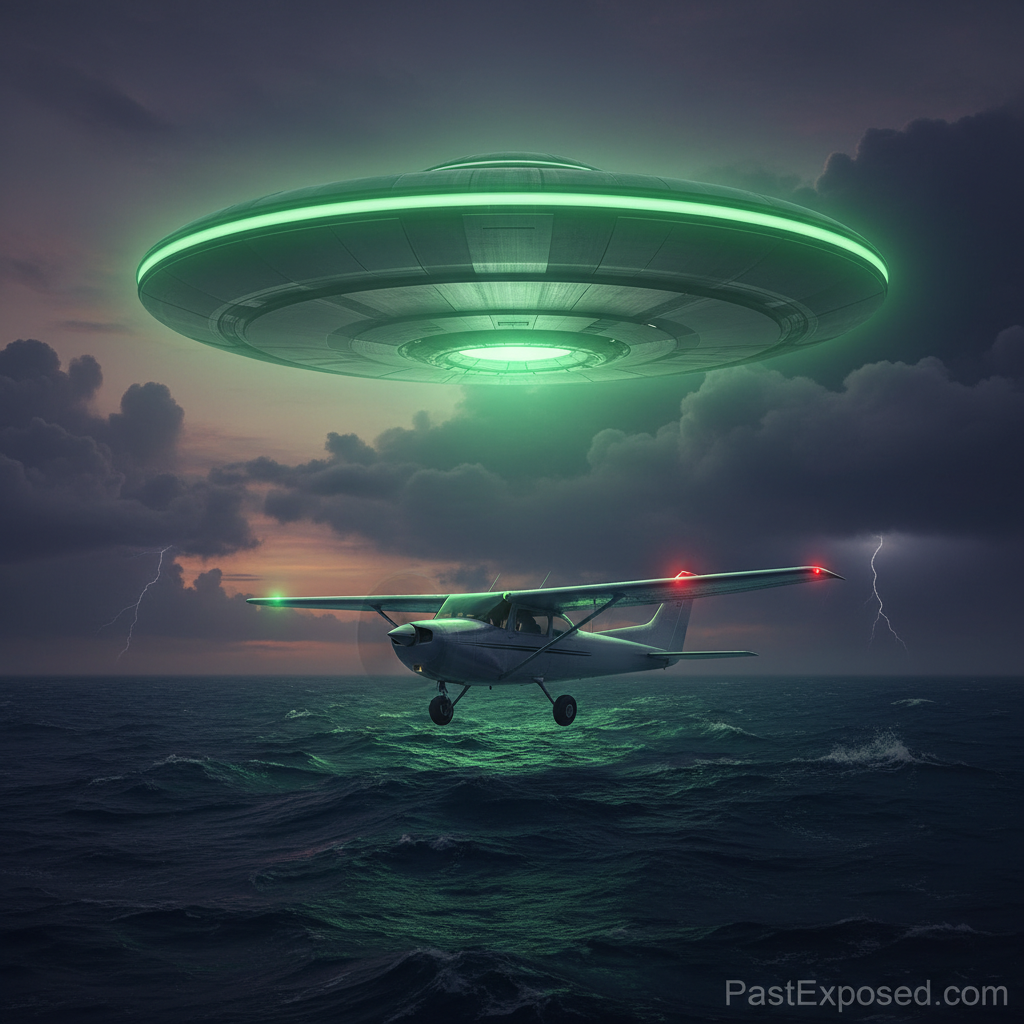
Melbourne Flight Service immediately tried to re-establish contact. Silence. They continued trying for the next 17 minutes. No response. Valentich and his aircraft had vanished.
The Search
A massive search and rescue operation was launched at first light on October 22. The Australian Royal Air Force, Navy vessels, civilian aircraft, and even fishing boats scoured the Bass Strait for any sign of Valentich or his aircraft.
The search covered 1,000 square miles of ocean. They found nothing. No wreckage. No oil slick. No debris. No life raft. No body. Not a single trace of the Cessna or its pilot.
Over the following days and weeks, the search area was expanded. Beaches along the coast were examined for debris that might have washed ashore. Nothing.
The Cessna 182L is a tough, reliable aircraft. If it had crashed into the sea, there should have been floating debris—seat cushions, panels, fuel tanks, personal items. But the Bass Strait yielded nothing.
After four days of intensive searching, the operation was officially called off. Frederick Valentich was presumed dead, though no body was ever recovered. The aircraft was never found.
The Investigation
The Australian Department of Transport conducted an official investigation into the disappearance. Their findings, released in 1982 (four years after the incident), were frustratingly inconclusive:
“The reason for the disappearance of the aircraft has not been determined.”
The investigation found:
- No evidence of any other aircraft in the area at the time
- No radar returns showing any unusual objects
- No military aircraft, balloons, or other conventional objects that could explain Valentich’s sighting
- No meteorological phenomena (such as unusual cloud formations or atmospheric conditions) that could account for what he described
- No evidence of aircraft malfunction before the disappearance
- No evidence Valentich was suicidal or had staged his disappearance
Investigators noted that Valentich was flying at night over water—a challenging environment even for experienced pilots. However, the weather was good, he was an adequately trained pilot for the conditions, and nothing in the radio transmission suggested he was lost or disoriented until the very end.
The investigation acknowledged the UFO report but offered no explanation for it. Officials essentially threw their hands up: something happened to Frederick Valentich, but we don’t know what.
Theories
Theory 1: Disorientation and Crash
Skeptics suggest Valentich became disoriented while flying over water at night—a well-documented phenomenon called spatial disorientation. In this state, pilots can lose their sense of up and down, accidentally flying inverted or into the water while believing they’re climbing.
The “UFO” he saw could have been his own aircraft lights reflecting off clouds or water, other aircraft in the distance, or stars and planets he misidentified due to disorientation. His increasingly panicked state suggests confusion. The engine trouble could have been real mechanical failure or simply his perception while disoriented.
Eventually, this theory suggests, he crashed into the Bass Strait. The wreckage sank in deep water and was never found.
Problems with this theory: Valentich’s transmissions were coherent and specific. He described a structured object with lights, shape, and deliberate movement. His account was detailed and consistent. Spatial disorientation typically causes confused, contradictory reports, not the systematic description Valentich provided. Also, he was flying in excellent visibility conditions that make disorientation less likely.
Theory 2: Suicide or Staged Disappearance
Some investigators suggested Valentich might have staged his disappearance, either to start a new life or as an elaborate suicide made to look like a UFO abduction.
The evidence for this: He had a deep interest in UFOs, which could have inspired the hoax. He carried more fuel than necessary for the trip. His life insurance policy had recently been updated.
Problems with this theory: Valentich had no history of mental illness, financial problems, or reasons to disappear. He was close to his family and excited about his aviation career. His fiancée reported they had plans for the future. The amount of fuel carried was standard for safety margins on over-water flights. Most importantly, if he staged a disappearance and crashed deliberately, where is the wreckage?
Theory 3: Mid-Air Collision
Perhaps Valentich collided with another aircraft—possibly a military plane on an unlogged flight, a drug smuggling aircraft, or another private plane flying without filing a flight plan.
This would explain the sudden end to his transmission and the absence of wreckage (if both aircraft broke apart and sank in deep water).
Problems with this theory: No other aircraft was reported missing. Valentich’s description doesn’t match a conventional aircraft collision—he described the object as hovering, moving at high speed, and having unusual green lights and metallic appearance. Mid-air collisions are sudden; Valentich reported watching the object for six minutes.
Theory 4: UFO Encounter (Extraterrestrial)
UFO researchers believe Valentich encountered an extraterrestrial craft. The object he described—metallic, green lights, hovering ability, extreme speed—doesn’t match any known aircraft in 1978. The fact that his engine began malfunctioning when the object was nearby suggests electromagnetic interference, reportedly common in UFO encounters.
The seventeen-second metallic scraping sound at the end of his transmission could have been the UFO somehow interacting with his aircraft. Perhaps he was abducted, or his plane was destroyed by the craft.
Problems with this theory: No physical evidence exists to support extraterrestrial involvement. While the description is unusual, extraordinary claims require extraordinary evidence, and there is none beyond Valentich’s account.
Theory 5: Secret Military Activity
Some researchers suggest Valentich encountered a classified military aircraft or drone being tested by the Australian or U.S. military. Bass Strait would be an ideal location for testing experimental aircraft away from populated areas.
If Valentich saw something he shouldn’t have, and military officials realized he was reporting it, they might have taken action to silence him—either forcing him to crash or shooting him down, then removing all evidence.
Problems with this theory: No evidence of any classified program has emerged in the 45+ years since. Such a conspiracy would require extensive cover-up involving multiple agencies. The Australian government has shown no indication of hiding anything beyond the usual bureaucratic reluctance to speculate.
Witness Reports
Interestingly, Frederick Valentich was not the only person to report strange phenomena that evening:
The Manifold Family: A family camping on the shore of Bass Strait near Cape Otway reported seeing a large green light in the sky around 7:00 PM—right when Valentich was making his sighting. They described it as an enormous green light that moved erratically across the sky before disappearing.
The Roy Manifold Photograph: Roy Manifold, one of the campers, was an amateur photographer. He had been taking time-lapse photographs of the sunset that evening using a camera set up on a tripod. When the film was developed weeks later, one frame showed a large, indistinct object in the sky—taken at approximately the time Valentich disappeared. Analysis has been inconclusive; some say it’s a genuine unknown object, others claim it’s an artifact or cloud.
Other Pilots: In the weeks following the disappearance, several other pilots reported unusual objects or lights in the Bass Strait area. None as dramatic as Valentich’s encounter, but enough to suggest something unusual was occurring in the region.
The Wreckage That Wasn’t
Over the years, several pieces of wreckage have been found in Bass Strait and examined to see if they came from Valentich’s Cessna. In each case, the debris was determined to be from other aircraft or maritime vessels.
In 1983, an engine cowl was found on Flinders Island. It was not from Valentich’s aircraft.
In 2012, a private research team claimed to have located an aircraft on the sea floor using sonar. Investigation revealed it was a different crashed aircraft.
Despite numerous searches, no confirmed piece of VH-DSJ has ever been recovered.
Valentich’s Father’s Quest
Guido Valentich, Frederick’s father, spent decades searching for answers about his son’s fate. He became convinced Frederick had encountered something genuinely anomalous. He researched UFO phenomena, spoke at conferences, and pushed for further investigation.
Guido Valentich passed away in 2000 without ever learning what happened to his son. Before his death, he said: “I do not know what happened to Frederick that night. But I know my son did not lie. He saw something he could not identify, and then he was gone.”
Modern Analysis
Modern researchers have used audio enhancement technology to analyze the seventeen-second open microphone period at the end of Valentich’s transmission. Some claim to hear sounds consistent with the aircraft breaking up or hitting water. Others hear what sounds like metallic scraping or even a high-pitched whine that doesn’t match any known aircraft or mechanical sound.
Computer modeling of the flight path and wind conditions that night suggests that if the aircraft had crashed into Bass Strait where Valentich last reported his position, debris should have washed ashore within days. The fact that nothing was ever found remains the most puzzling aspect of the case.
The Enduring Mystery
What happened to Frederick Valentich? Did he encounter an extraterrestrial craft? Was he disoriented and crashed? Did he encounter a secret military aircraft? Was it an elaborate hoax?
The only certainties are these:
- A young pilot vanished without a trace
- His last communication described something he could not identify
- No wreckage was ever found
- Independent witnesses reported unusual lights in the area at the same time
- The official investigation concluded: cause unknown
The Valentich case remains one of the most credible UFO-related incidents on record because:
- The witness was a trained pilot, familiar with aircraft and aerial phenomena
- His account was given in real-time to air traffic control and recorded
- He was calm and coherent throughout most of the transmission
- There were corroborating witnesses on the ground
- A thorough official investigation found no conventional explanation
The Legacy
The Frederick Valentich disappearance has become a touchstone case in UFO research, cited in countless books, documentaries, and academic papers on the subject. It’s studied in aviation safety courses as an example of an unexplained loss of aircraft and crew.
In Australia, the case remains famous, and “Valentich” has become almost synonymous with UFO encounters. The stretch of Bass Strait where he vanished is sometimes called the “Valentich Triangle,” comparing it to the Bermuda Triangle.
His case is unique because unlike most UFO reports, which are fleeting sightings with no consequences, this one ended with a permanent, tragic loss—a young man and his aircraft vanishing into the night, leaving behind only a voice on a tape recording describing something he could not understand.
Somewhere in the Bass Strait, perhaps deep underwater, perhaps scattered across the seabed, might lie the remains of VH-DSJ and the answer to what happened on that October evening in 1978. Or perhaps Frederick Valentich and his plane went somewhere else entirely—somewhere we can’t follow, somewhere we can’t explain. The Australian government’s official file on the case ends with those enigmatic words: “The reason for the disappearance of the aircraft has not been determined.” It’s been over 45 years. Families, investigators, and enthusiasts have searched. Technology has advanced. Yet the mystery remains unsolved. On clear nights over Bass Strait, pilots still fly the same route Frederick Valentich took. They know the story. They know the recording. And they wonder, as they look at their instruments and scan the dark sky above: if something appeared out there, something they couldn’t identify, something that shouldn’t exist—would they report it? Or would they stay silent, remembering the young pilot who described the impossible, and then disappeared into it? “Delta Sierra Juliet, Melbourne. The engine is rough-idling… That strange aircraft is hovering on top of me again… It is hovering and it’s not an aircraft.” Those were among Frederick Valentich’s last words. The truth of what he saw died with him that night. And the sky keeps its secrets still.