

In the gleaming factories of the 1920s, young women painted watch dials with luminous radium paint, instructed to lick their brushes to maintain a fine point. The work was considered glamorous—the paint made them glow in the dark, and they were called “ghost girls” at parties. But within years, their jaws began to crumble, their bones disintegrated, and they died in agony. The companies denied everything. What followed was one of the most important labor rights battles in American history, fought by dying women who refused to be silenced.
The Wonder Element
When Marie and Pierre Curie discovered radium in 1898, it was hailed as a miracle substance. In the early 20th century, before its dangers were understood, radium was everywhere: in cosmetics promising eternal youth, in health tonics advertised as cure-alls, in chocolate bars, and even in suppositories claiming to enhance “sexual vigor.”
The element’s faint green glow fascinated the public. Radium became the ingredient of the age, marketed as a source of vitality and health. The wealthy drank radium water from special crocks. High-society women applied radium face creams. Doctors prescribed radium treatments for everything from arthritis to depression.
No one understood that this glowing wonder was slowly, invisibly killing them.
The Dial Painters
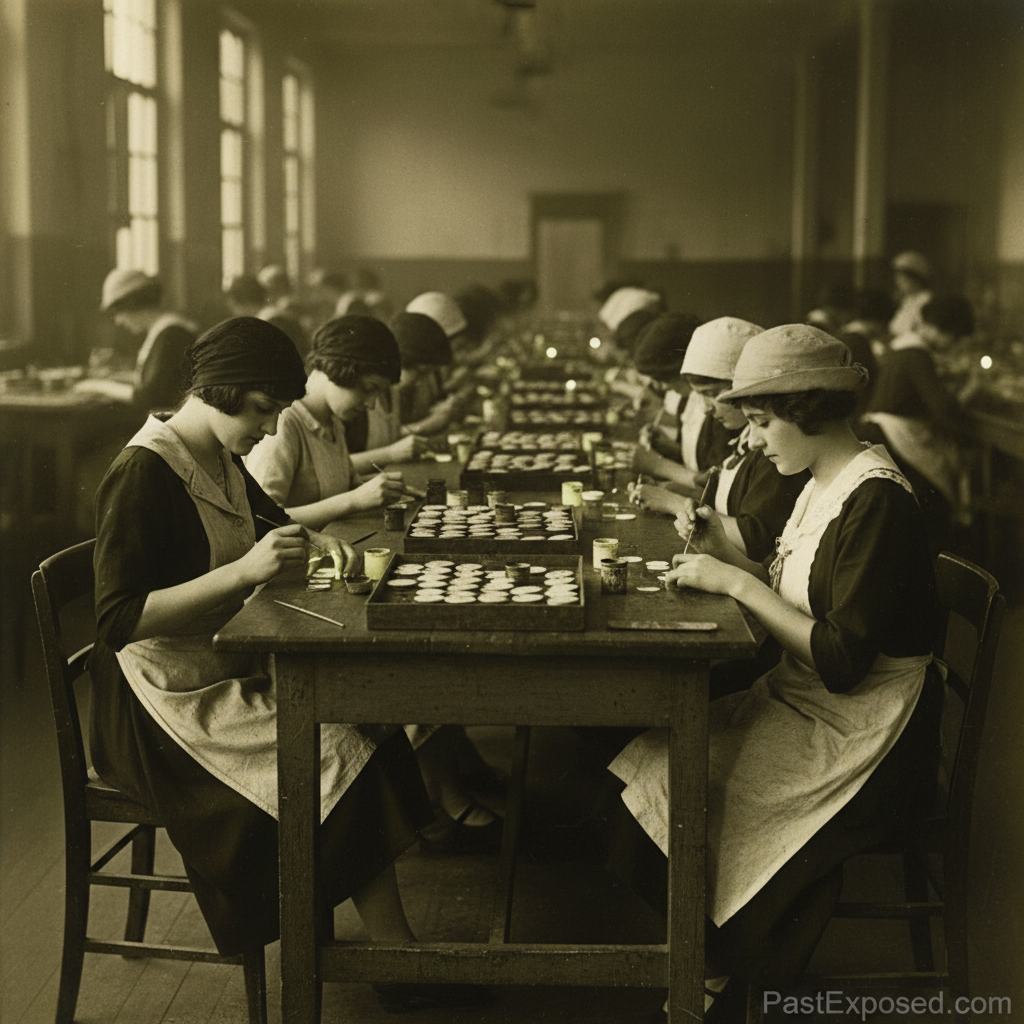
During World War I and into the 1920s, luminous watch dials became essential—soldiers needed to read their watches in dark trenches. Companies like the United States Radium Corporation and the Radium Dial Company hired hundreds of young women to hand-paint watch and clock dials with radium-laced paint.
The work was considered desirable, almost prestigious. The women, mostly teenagers and young adults from working-class families, earned more than factory workers or domestic servants. They wore their best dresses to work because the paint didn’t stain clothing. They worked in bright, clean studios—a far cry from the dark, dangerous factories where many of their mothers and sisters labored.
The paint, called “Undark,” contained radium-226, mixed with glue and phosphorus. Each tiny dial required painstaking precision. To achieve the finest point on their brushes, the women were instructed to use a technique called “lip-pointing”—placing the brush tip between their lips and drawing it to a point with their mouths.
“Lip, dip, paint,” they were told. Put the brush in your mouth, dip it in the radium paint, then paint the dial. Repeat. All day. Every day.
The women ingested radium with every brush stroke.
The Glamorous Ghost Girls
At first, the work seemed almost magical. The women’s clothes, hair, and skin would glow faintly in the dark after their shifts. They became celebrities at social gatherings, called the “ghost girls” or “shining girls.” Some painted their teeth and fingernails with the luminous paint to surprise their dates. Others wore their most radium-dusted dresses to dances, glowing like ethereal spirits under dim lights.
Grace Fryer, who would later become one of the most famous Radium Girls, remembered those days with a mixture of nostalgia and horror: “We were told that it wasn’t dangerous, that we needn’t be afraid… We painted our nails and our teeth with it to surprise our beaus when we turned out the lights.”
Meanwhile, the factory owners and scientists handling radium took extensive precautions. They used lead screens, tongs, and masks. They understood the danger—but they never warned the young women painting dials just feet away.
The First Deaths
In 1922, Mollie Maggia, a dial painter at the United States Radium Corporation in New Jersey, began to suffer from severe tooth pain. Her dentist removed one tooth, then another. The extractions wouldn’t heal. Her jaw began to swell, then decay. When her dentist tried to remove more infected tissue, her entire jawbone came away in his hands—crumbling like ash.
Mollie died on September 12, 1922, at age 24. The official cause of death was listed as syphilis—a diagnosis that ruined her reputation and devastated her family. The company never admitted radium poisoning.
But Mollie wasn’t alone. Other dial painters began experiencing similar symptoms: tooth loss, jaw necrosis (dubbed “radium jaw”), extreme fatigue, spontaneous bone fractures, and anemia. Young women in their twenties were dying horrible, inexplicable deaths.
Sarah Maillefer’s vertebrae collapsed, compressing her spine until she was nearly doubled over. Marguerite Carlough’s jaw disintegrated entirely. Helen Quinlan’s body became so radioactive that, years after her death, her preserved organs were still emitting measurable radiation.
The Corporate Denial
When the women began to sicken, the United States Radium Corporation launched a campaign of deception and denial that would last years:
- They blamed the victims: The company claimed the women suffered from syphilis or other sexually transmitted diseases, destroying their reputations
- They hired company doctors: Medical exams were conducted by doctors on the company payroll, who consistently found “no evidence” of radium poisoning
- They suppressed evidence: Internal company studies showing the dangers of radium were hidden from workers and regulators
- They intimidated workers: Women who spoke out were threatened with job loss and blacklisting
- They hired investigators: Private detectives were hired to dig up dirt on sick workers and their families
Most cruelly, the company continued to assure healthy workers that radium was completely safe, even as they buried colleagues who had worked beside them.
The Five Who Fought Back
In 1927, five former dial painters filed suit against the United States Radium Corporation. They became known as the “Radium Girls.”
Grace Fryer led the group. By the time she found a lawyer willing to take her case, her spine was deteriorating, and she needed a back brace to walk. It had taken her two years to find legal representation—forty lawyers had refused her case, unwilling to take on such a powerful corporation.
Edna Hussman was confined to bed, her hip joint having disintegrated.
Katherine Schaub had lost most of her teeth and jaw, making speech difficult.
Quinta Maggia McDonald was Mollie Maggia’s sister, determined to prove the company had killed her sibling.
Albina Maggia Larice, another of Mollie’s sisters, rounded out the five. The Maggia family had been devastated by radium—three sisters worked as dial painters, and all would die from radium poisoning.
The legal battle would become a landmark case in occupational health law.
The Trial That Changed Everything
The case of the Radium Girls attracted national media attention. Newspapers portrayed them as helpless victims being crushed by corporate greed, while the company painted them as greedy opportunists trying to extract money from a respectable business.
The women faced extraordinary legal obstacles. New Jersey’s statute of limitations for workplace injury was two years—but radium poisoning took years to manifest. The company argued the cases should be dismissed because too much time had passed since the women had been employed.
Raymond Berry, the lawyer who finally agreed to represent the women (initially taking the case only because his own wife shamed him into it), had to prove that:
- Radium had caused the women’s illnesses
- The company knew or should have known radium was dangerous
- The statute of limitations should begin from when the disease became apparent, not when exposure occurred
The trial was set for 1928. By then, none of the five women could walk without assistance. Grace Fryer’s bones were so fragile that her back brace had to be carefully fitted to avoid causing new fractures.
On the first day of trial, the women had to be carried into the courtroom and could barely raise their hands to take the oath. The sight shocked the nation.
Scientific Evidence
Dr. Harrison Martland, a medical examiner, conducted extensive tests on the dying women and proved that radium had been deposited throughout their bone structures. When he placed a dental X-ray film in a darkroom alongside samples of the women’s bones, the bones exposed the film—they were that radioactive.
He also exhumed the bodies of dial painters who had already died, including Mollie Maggia. Her bones glowed in the dark cemetery. Five years after death, her remains were still highly radioactive.
The evidence was irrefutable: radium was killing the dial painters. But scientific proof wasn’t enough—the company continued to fight.
The Settlement
In June 1928, with the women literally dying in court (one had to testify lying on a stretcher), the company finally agreed to settle. The Radium Girls received:
- $10,000 each (about $175,000 in 2024 dollars)—far less than they had sued for
- $600 per year for life (about $10,500 today)
- All medical and legal expenses covered
It wasn’t a fortune, but it was more than any industrial victim had received before. More importantly, the case established legal precedents that would transform workplace safety laws:
- Companies have a responsibility to ensure workplace safety
- Workers can sue for occupational diseases
- Statute of limitations for occupational disease begins when the disease is diagnosed, not when exposure occurred
- The burden of proof regarding workplace safety shifted toward employers
The Illinois Case
While the New Jersey case garnered headlines, another group of dial painters in Ottawa, Illinois, was fighting a similar battle against the Radium Dial Company.
Catherine Wolfe Donohue led this group. By 1937, when her case finally went to trial, Catherine was bedridden, her jaw disintegrating, her bones shattering with almost no pressure. She had to testify from bed, her words barely intelligible.
The Illinois case was even more contentious. The company hired investigators to prove Catherine was faking her illness. They secretly filmed her to catch her “walking around” when she claimed to be bedridden—footage that showed a desperately ill woman struggling to use the bathroom, not someone malingering.
Catherine died in 1938, shortly after winning her case. She was 35 years old.
The Body Count
No one knows exactly how many dial painters died from radium poisoning. Estimates range from several dozen to several hundred. Many died before the connection to radium was understood. Others were misdiagnosed. Still others suffered but never sought legal action.
The women died in terrible ways. Radium-226, once ingested, mimics calcium in the body and is deposited in bones and teeth, where it continues emitting radiation for years. This internal radiation slowly destroys bone tissue, causes anemia, and dramatically increases cancer risk.
Some women’s bodies became so radioactive that decades after death, their remains still emit measurable radiation. Their graves are monitored by environmental agencies.
The Manhattan Project Connection
The research conducted on the Radium Girls proved invaluable during World War II. When scientists began working with radioactive materials for the Manhattan Project (the program that developed the atomic bomb), they used the extensive medical data from radium poisoning cases to establish safety protocols.
The Radium Girls’ suffering literally wrote the book on radiation safety. Their deaths taught scientists about exposure limits, decontamination procedures, and long-term health monitoring that protected workers on the atomic bomb project and continue to protect nuclear workers today.
Grace Fryer’s Last Years
Grace Fryer, the woman who led the fight, lived longer than many of her colleagues but suffered terribly. By 1928, when she won her settlement, her spine had already collapsed in multiple places. She spent much of the next decade in and out of hospitals, undergoing painful procedures to remove pieces of dead bone.
She used her settlement money and public platform to advocate for worker safety reforms. Despite being in constant pain and gradually losing the ability to walk, she gave interviews, wrote letters to congressmen, and lobbied for stronger occupational safety regulations.
Grace died in 1933, at age 34. She was buried in Orange, New Jersey. At her funeral, her bones were so brittle that her body had to be carefully supported in the casket. Even in death, she was still radioactive.
The Legacy
The Radium Girls’ legal victories helped establish the foundation for the Occupational Safety and Health Administration (OSHA), created in 1970. Their case is still cited in occupational health law and workplace safety regulations.
Their story also fundamentally changed how the public and regulators viewed corporate responsibility. Before the Radium Girls, worker safety was considered the worker’s problem. After them, companies could no longer claim ignorance about workplace hazards—they had a legal and moral duty to protect their employees.
The case also established important principles about medical ethics and informed consent. Workers had the right to know what they were exposed to and what the risks were.
Modern Recognition
For decades, the Radium Girls were largely forgotten outside legal and medical circles. But in recent years, their story has been rediscovered:
- In 2017, Kate Moore published The Radium Girls, a comprehensive history that became a bestseller
- Multiple plays and films have been based on their story
- Historical societies have placed markers at the factories where they worked
- The U.S. Labor Department inducted several Radium Girls into the Labor Hall of Fame
In 2021, the EPA began cleanup of radium contamination at the former U.S. Radium Corporation site in New Jersey. The factory closed in 1926, but the property—and the surrounding area—remain radioactive nearly a century later, a toxic memorial to the women who worked there.
The Women Behind the Glow
It’s important to remember that the Radium Girls weren’t victims waiting to be saved—they were fighters. These were young women, many barely out of their teens, who took on powerful corporations, fought through social stigma (being accused of having syphilis was devastating in the 1920s), and pursued justice even as their bodies literally crumbled.
They knew they were dying. They knew they probably wouldn’t live to see the final outcome of their legal battles. But they fought anyway, so that other workers—women and men they would never meet—would be protected.
Grace Fryer said it best in a 1928 interview: “We’re not after the money. We wanted to show that the company knew radium was dangerous, but they told us it was safe. We wanted to make sure no other girls would ever suffer the way we have.”
The Radium Girls glowed in the dark, but they also illuminated a path toward worker rights and corporate accountability that we still walk today. Every time a worker dons protective equipment, every time a company is held accountable for workplace safety violations, every time OSHA inspects a facility—that’s the legacy of young women who were told to put poisoned brushes in their mouths and died fighting to make sure no one else ever would. Their bones still glow in their graves, radioactive testaments to the price of corporate greed and the power of ordinary people who refuse to be silenced. They were promised glamour and gave us justice. They were fed lies and fought back with truth. They were just girls—until they weren’t. Until they became warriors, dying but defiant, whose victory would save countless lives they would never meet. That is the true glow of the Radium Girls—not the toxic luminescence that killed them, but the light of justice they kindled in the darkness, a flame that still burns bright a century later.