
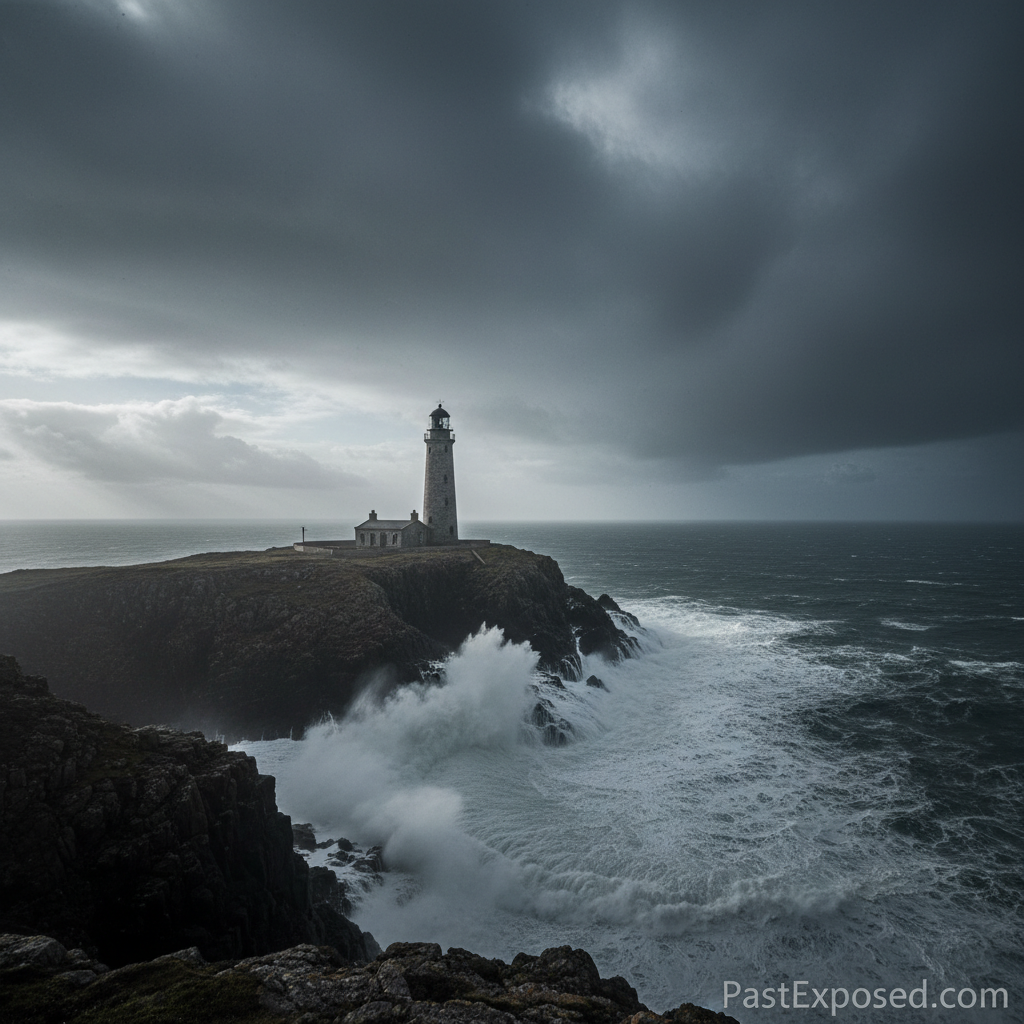
On Boxing Day 1900, a passing ship noticed something strange about the Flannan Isles lighthouse off the coast of Scotland: its light was dark. When a relief vessel finally reached the remote rock three days later, they found the lighthouse fully operational, the beds unmade, chairs overturned, and the gate to the compound swinging violently in the storm—but all three lighthouse keepers had vanished without a trace. No bodies were ever found. No explanation was ever confirmed. What happened on that desolate rock remains one of maritime history’s most chilling unsolved mysteries.
The Flannan Isles: Scotland’s Edge of the World
The Flannan Isles—also known as the Seven Hunters—are a cluster of uninhabited rocky islands about 20 miles west of the Isle of Lewis in Scotland’s Outer Hebrides. Exposed to the full fury of the Atlantic Ocean, these barren rocks have been feared by sailors for centuries. The islands were considered sacred in Celtic tradition, associated with Saint Flannan, and local shepherds would perform religious rituals before visiting them.
In December 1899, the Northern Lighthouse Board completed construction of a lighthouse on Eilean Mòr, the largest of the Flannan Isles. The 75-foot tower was designed to warn ships of the dangerous rocks and guide vessels through one of the most treacherous passages in British waters. The lighthouse was manned by three keepers who worked in rotation, with a fourth keeper remaining on shore at Breasclete on Lewis.
The work was isolating and demanding. The keepers lived in cramped quarters carved into the rock beneath the lighthouse, accessible only by a steep stairway of 160 steps from the landing platform. Supplies arrived every two weeks when weather permitted, but winter storms could leave the men stranded for weeks at a time.
The Three Keepers
In December 1900, the lighthouse was manned by three experienced keepers:
James Ducat was the Principal Keeper, 43 years old, married with four children. He had over 20 years of lighthouse experience and was known as a steady, reliable man. Colleagues described him as cautious and level-headed—not the type to take unnecessary risks.
Thomas Marshall was the Second Assistant, 28 years old, also married. He had been with the Northern Lighthouse Board for several years and was considered competent and professional.
Donald McArthur had been the Third Assistant, but he had taken ill just before the relief. He was replaced at the last minute by William MacArthur, an Occasional Keeper. Some sources confuse the names, but the man who disappeared was indeed William MacArthur, making his first assignment to Flannan Isles. He was young, inexperienced compared to the others, but eager to prove himself.
On December 7, 1900, the relief vessel Hesperus delivered these three men to the lighthouse, along with provisions for the coming weeks. The keepers waved goodbye as the ship departed. It was the last time anyone would see them alive.
The Light Goes Dark
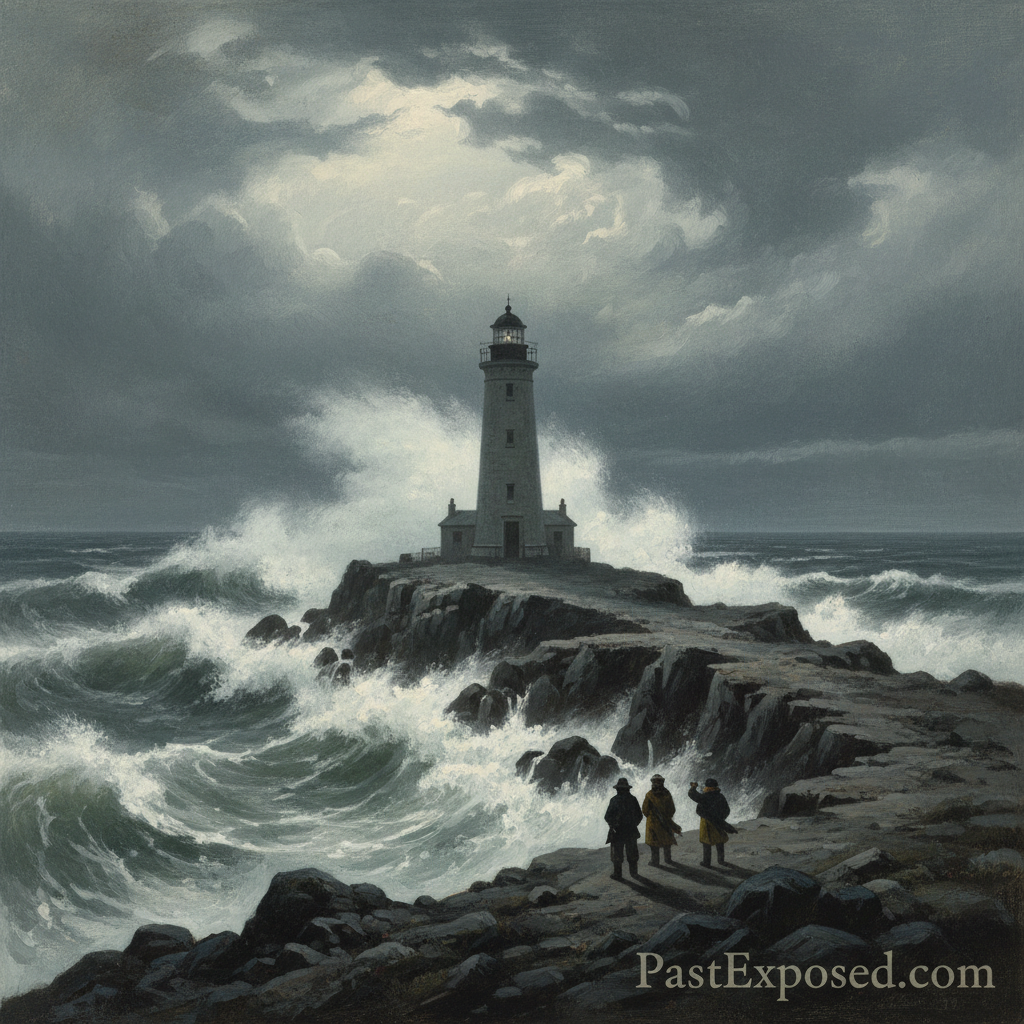
On December 15, 1900, the steamship Archtor passed the Flannan Isles during a violent storm. The captain noted in his log that the lighthouse—which should have been visible—was completely dark. He reported this to the authorities when he reached port, but the weather was so severe that no relief vessel could be sent immediately.
For eleven days, the lighthouse remained dark. Ships navigating the treacherous waters had no warning light to guide them. The Northern Lighthouse Board grew increasingly concerned, but the winter storms prevented any vessel from attempting the dangerous crossing to the exposed islands.
December 26: The Discovery
On Boxing Day, December 26, 1900, the relief vessel Hesperus, under Captain James Harvie, finally managed to approach Flannan Isles. As they drew closer, the crew could see that the lighthouse appeared intact—no visible damage, no signs of fire or destruction. But the light was still not operating.
A relief keeper named Joseph Moore was put ashore. He later described an overwhelming sense of dread as he climbed the steep steps toward the lighthouse. Everything was eerily silent. No one came to meet him. The usual flags signaling all was well were not flying.
Moore reached the lighthouse entrance and found the main door closed but unlocked. He called out. No answer. He entered the building and began searching.
What he found defied explanation.
The Scene Inside
Joseph Moore’s official report, along with subsequent investigation notes, documented the bizarre state of the lighthouse:
In the kitchen/living quarters:
- The kitchen clock had stopped
- The kitchen table was set for a meal, but the food had not been touched
- One chair was overturned on the floor
- All three oil-skin coats that keepers wore in bad weather were missing from their pegs—except one, which hung neatly in place
- The beds were unmade, suggesting the men had left suddenly
- Everything else was neat and orderly, exactly as lighthouse regulations required
In the lighthouse tower:
- The lamp was in perfect working order, with plenty of fuel
- The wicks had been trimmed and the light prepared for operation
- The logbook entries were up to date through December 15—the day the light was reported dark
- All equipment was properly maintained
Outside:
- The west landing (exposed to the Atlantic) showed evidence of severe storm damage: a box of ropes stored 70 feet above sea level had been washed away
- The iron railings near the landing were bent and twisted
- A life buoy was missing from its mounting
- However, the east landing (more sheltered) was undamaged
- The gate at the top of the stairs leading down to the west landing was closed and fastened
The Logbook Entries
When Superintendent Robert Muirhead arrived to investigate, he examined the lighthouse logbook. The final entries, written in Thomas Marshall’s handwriting, were dated December 15:
“December 12: Gale north by northwest. Sea lashed to fury. Never seen such a storm. Ducat irritable. [The third keeper’s name] crying.”
“December 13: Storm still raging, wind steady. Ducat quiet. [Third keeper’s name] still crying. God help us.”
“December 14: Noon. Grey daylight. Me, Ducat and [third keeper’s name] prayed.”
“December 15: 1pm. Storm ended. Sea calm. God is over all.”
These were the last words written in the log. But here’s where the mystery deepens: meteorological records from December 12-15 show that the weather was relatively calm during those days. The major storm that caused the damage to the west landing occurred after December 15. Some accounts claim these dramatic log entries are apocryphal—invented later by journalists—but they have become part of the legend regardless.
What the Investigation Found
Superintendent Muirhead conducted a thorough investigation. His official report noted:
- James Ducat and Thomas Marshall, experienced keepers, had both apparently left the lighthouse during severe weather—against all training and lighthouse regulations
- Both men had put on their oilskin coats (which were missing), suggesting they intended to go outside
- The third keeper, William MacArthur, had apparently stayed behind—his oilskin coat was still hanging in place
- The last entry in the logbook was dated December 15, but the exact time was unclear
- The clock had stopped, making it impossible to determine when the men disappeared
- The west landing had sustained massive storm damage consistent with waves over 100 feet high
Muirhead concluded that Ducat and Marshall had gone to secure equipment at the west landing during calm weather (after the storm mentioned in the log had passed). While they were outside, a massive rogue wave—a phenomenon known in these waters—had swept them into the sea. MacArthur, seeing his colleagues in danger, had rushed out without his coat to help and was also swept away.
This explanation became the official finding. But it raises more questions than it answers.
The Problems With the Official Explanation
Problem 1: The Gate
The gate at the top of the stairs to the west landing was found closed and securely fastened. If MacArthur had rushed out in panic to help his colleagues, would he have stopped to close and fasten the gate behind him?
Problem 2: Lighthouse Protocol
Lighthouse regulations explicitly forbade all three keepers from leaving the lighthouse at the same time under any circumstances. One keeper was always required to remain at the light. Ducat, with over 20 years of experience, would have known this rule intimately. Why would he break it?
Problem 3: The Overturned Chair
A chair was found knocked over in the living quarters. If the men left in an orderly fashion (two putting on coats, going outside to check equipment), why was there a knocked-over chair inside the building?
Problem 4: The Timeline
The Archtor reported the light dark on December 15. The logbook’s last entry was also December 15. Yet the major storm that damaged the west landing occurred after December 15—on December 17-18, according to meteorological records. How could the men have been swept away by a storm that hadn’t happened yet?
Problem 5: The Calm Day Theory
If the men went out during calm weather to inspect storm damage, why would they need their heavy oilskin coats? These were cumbersome garments worn only in the worst weather.
Alternative Theories
Theory 1: Rogue Wave During Inspection
Despite the problems, this remains the most widely accepted explanation. Perhaps two keepers went to inspect damage during a lull in the storm. While they were at the landing, a rogue wave—a single massive wave that can appear even in relatively calm seas—swept them away. The third keeper, hearing their cries or seeing the disaster, rushed out (closing the gate out of ingrained habit) and was also caught.
Theory 2: Accident at the Landing
Perhaps one keeper fell or was injured at the west landing. The other two went to help and all three were swept away while attempting a rescue. This would explain why all three left despite regulations.
Theory 3: Murder-Suicide
Some researchers have suggested that the isolation and stress led to violence. Perhaps one keeper killed the others and then himself, throwing the bodies into the sea. The overturned chair, the stressed tone of the (possibly apocryphal) log entries mentioning crying and praying, and the fact that MacArthur was young and inexperienced might support psychological strain. However, there was no evidence of violence, no blood, no signs of struggle beyond the single overturned chair.
Theory 4: Abduction or Foul Play
Could the men have been abducted? Could pirates or criminals have come to the island? This seems highly unlikely given the remote location, the storm conditions, and the lack of any motive or evidence of intrusion.
Theory 5: Supernatural Forces
The Flannan Isles’ association with Celtic mythology and their reputation as a place of supernatural power led to wild speculation. Local legends spoke of ghost ships, sea spirits, and cursed islands. Some claimed the keepers had disturbed ancient forces or been taken by the “Phantom of the Seven Hunters.” While these tales make for atmospheric storytelling, they offer no factual explanation.
The Logbook Mystery
The dramatic logbook entries describing storms, a crying keeper, and prayers have been central to the mystery’s appeal. However, historians have debated whether these entries are genuine or were fabricated by journalists seeking to sensationalize the story.
The Northern Lighthouse Board’s official records don’t contain these dramatic passages. Instead, the actual last entries appear to have been routine observations. However, some researchers point out that sensational log entries might have been suppressed by authorities to avoid panic or speculation.
The truth may never be known, as the original logbook—if it still exists—has never been publicly examined by independent historians.
The Poem That Made It Famous
The Flannan Isles disappearance might have remained an obscure maritime tragedy if not for poet Wilfrid Wilson Gibson. In 1912, he published “Flannan Isle,” a haunting ballad that captured the public imagination:
“Though three men dwell on Flannan Isle
To keep the lamp alight,
As we steered under the lee, we caught
No glimmer through the night…”
“We seemed to stand for an endless while,
Though still no word was said,
Three men alive on Flannan Isle,
Who thought on three men dead.”
Gibson’s poem, while taking significant liberties with the facts, brought the mystery into popular culture. The image of three men vanishing from a locked lighthouse in a storm has haunted readers for over a century.
Modern Investigations
In recent decades, researchers have reexamined the evidence using modern meteorological and oceanographic knowledge:
Wave Analysis: Studies of wave patterns in the area have confirmed that rogue waves exceeding 100 feet in height can occur near the Flannan Isles. These waves can appear with little warning, even in relatively calm conditions. Such a wave could easily sweep three men from an exposed landing platform.
Weather Records: Detailed analysis of December 1900 weather patterns shows that while December 12-15 was relatively calm, conditions deteriorated rapidly afterward. A severe storm hit on December 17-18. If the men disappeared on the evening of December 15 or morning of December 16 during a weather transition period, they might have been caught by the leading edge of the approaching storm.
Psychological Analysis: Modern understanding of the psychological effects of isolation suggests that even experienced lighthouse keepers could make irrational decisions under stress. However, three trained men simultaneously breaking protocol remains difficult to explain.
The Legacy
The Flannan Isles lighthouse continued to operate with rotating keepers until 1971, when it was automated. The automation process was reportedly difficult—keepers assigned to Flannan Isles often requested transfers, citing an oppressive atmosphere and feelings of unease. Some reported hearing unexplained sounds or feeling presences in the lighthouse, though these accounts are anecdotal and unverified.
In 1971, the lighthouse became fully automated. Today, it operates unmanned, its light still warning ships of the dangerous rocks below. But the mystery of what happened to James Ducat, Thomas Marshall, and William MacArthur on December 15, 1900, remains unsolved.
What Really Happened?
The most likely explanation remains some version of the official finding: the keepers were swept away by the sea during an attempt to secure equipment or inspect storm damage. The precise sequence of events will never be known with certainty, but the following scenario fits most of the evidence:
On December 15, after a period of rough weather, conditions improved slightly. Ducat and Marshall decided to inspect the west landing for damage. They put on their oilskins and went outside. MacArthur remained at the lighthouse. While the two men were at the exposed landing, a massive rogue wave—perhaps 100 feet high—appeared without warning and swept them into the sea.
MacArthur, either witnessing the disaster or responding to calls for help, rushed outside without stopping to put on his coat. In his panic or haste, he knocked over a chair. He secured the gate (possibly out of trained habit, or perhaps the wind closed it) and descended toward the landing. Before he could help, another wave swept him away as well.
The entire sequence could have taken less than a minute. Three men, gone in an instant, claimed by the Atlantic that had surrounded their isolated rock prison.
But this explanation, while plausible, cannot account for every detail. The closed gate, the timing discrepancies, the missing third oilskin coat—these small anomalies keep the mystery alive.
Over 120 years have passed since that December day when three lighthouse keepers vanished from a locked lighthouse on one of Scotland’s most remote and forbidding rocks. The Atlantic Ocean keeps its secrets well, and the men it claimed that day left almost no trace behind—only an unmade bed, an overturned chair, and a silence that still haunts those who study the case. The Flannan Isles lighthouse still stands, its automated light sweeping across the dark waters, watching over a mystery that may never be solved. Somewhere in those cold depths lie the answers, along with three men who went to work one day and never came home. The sea took them, as it has taken so many others. But the manner of their taking—the strange circumstances, the unanswered questions, the eerie precision with which all trace of them vanished—ensures they will never be forgotten. On winter nights when storms rage around the Seven Hunters, it’s easy to imagine three figures standing watch on that lonely rock, forever keeping a light that no longer needs them, forever searching for a way home through the endless dark.