In a locked vault at Yale University’s Beinecke Rare Book & Manuscript Library sits one of history’s most perplexing artifacts: a 240-page book filled with elegant script, bizarre botanical illustrations, and astronomical diagrams. For over 600 years, this medieval codex has defied every attempt at translation. Codebreakers who cracked Nazi Enigma machines have failed. Linguists fluent in dozens of ancient languages have been stumped. The world’s most powerful computers cannot decode it. Welcome to the enigma of the Voynich Manuscript—a book that may contain forgotten knowledge, an elaborate hoax, or secrets that were never meant to be revealed.
The Discovery: A Polish Bookseller’s Strange Find
The year was 1912. Wilfrid Voynich, a Polish book dealer and revolutionary-turned-antiquarian, was searching through a collection of manuscripts at the Villa Mondragone near Rome when he made a discovery that would consume the rest of his life. Hidden among religious texts was a peculiar volume bound in limp vellum, its pages covered in an undecipherable script and strange illustrations unlike anything he had ever seen.
Voynich was no stranger to rare books, but this was different. The manuscript appeared genuinely medieval in construction—carbon dating would later confirm the vellum was created between 1404 and 1438—yet its contents seemed almost alien. The text flowed in neat paragraphs and columns, suggesting it was meant to be read, but the language belonged to no known alphabet or linguistic family on Earth.
Even more bizarre were the illustrations. The manuscript was divided into apparent sections: botanical drawings of plants that don’t exist, naked women bathing in interconnected pools filled with green liquid, astronomical charts with unfamiliar zodiac symbols, and page after page of pharmaceutical recipes featuring impossible herbs.
Voynich knew he held something extraordinary. He also found a letter tucked inside, dated 1666, from Johannes Marcus Marci, a rector of Charles University in Prague, addressed to the famous Jesuit scholar Athanasius Kircher. The letter stated that the manuscript had once belonged to Emperor Rudolf II of the Holy Roman Empire, who believed it was written by the legendary Roger Bacon, a 13th-century friar, philosopher, and proto-scientist.
If true, this would make the manuscript a priceless scientific artifact from one of history’s greatest minds. But was it?
The Strange Language: A Cipher or Something Else?
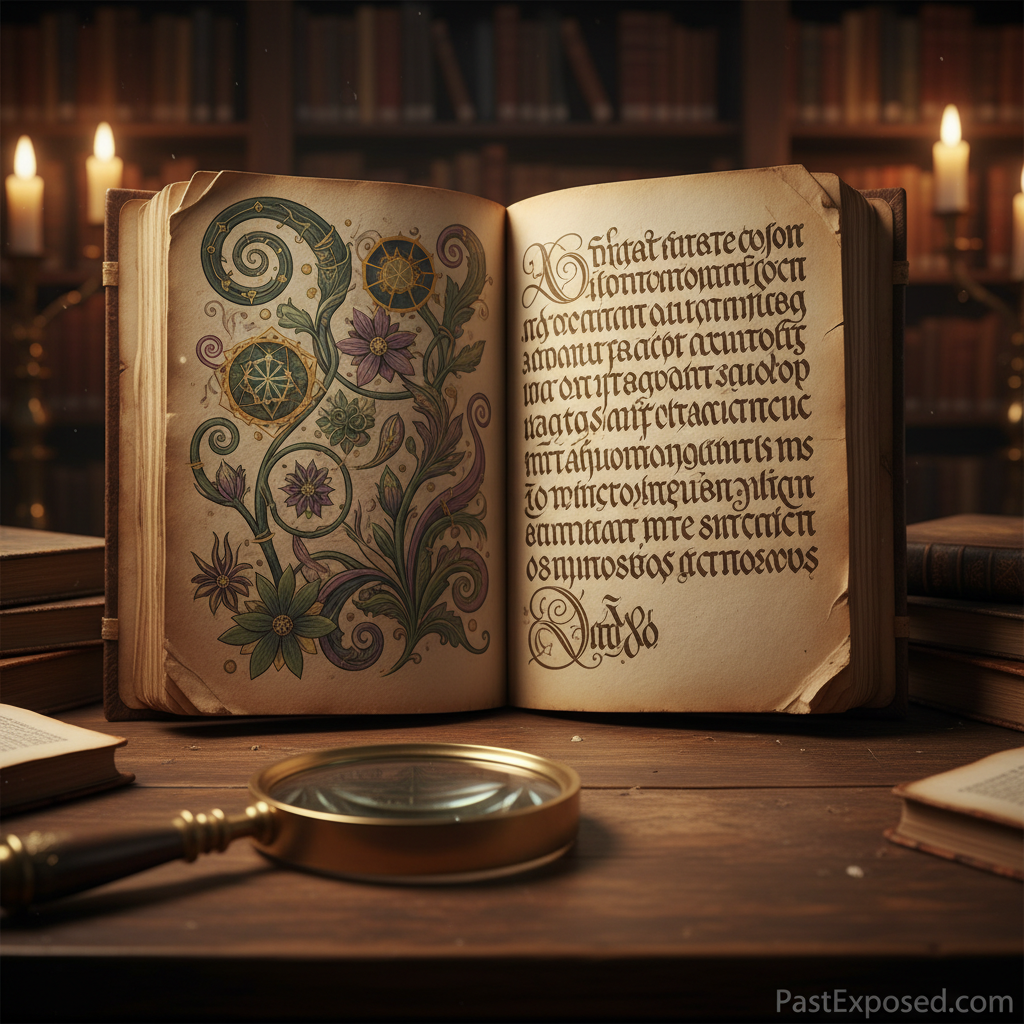
The Voynich Manuscript contains approximately 170,000 characters written in what appears to be a flowing, consistent script. Researchers have identified around 20-30 distinct letter-like symbols, which combine to form approximately 35,000 “words.”
But here’s where it gets truly strange: the linguistic properties of the text are both familiar and impossible.
What Makes It Look Like Language:
- Statistical consistency: The “words” follow patterns similar to natural languages, with certain characters appearing frequently at the beginning of words, others in the middle, and others at the end.
- Zipf’s Law: The manuscript follows this linguistic principle where a small number of words appear very frequently, while most words appear rarely—just like in English or any natural language.
- Organized structure: The text is broken into clear paragraphs, some with bullet points or numbered lists. There are what appear to be chapter divisions.
- Internal consistency: The same “words” recur throughout the manuscript in contextually appropriate places.
What Makes It Impossible:
- No language matches: Despite comparisons to Latin, medieval German, Arabic, Hebrew, Sanskrit, and hundreds of other languages, no connection has ever been confirmed.
- Too simple for a cipher: Traditional substitution ciphers from the medieval period have been cracked. The Voynich text shows characteristics that make it resistant to every known cryptographic analysis.
- Strange word patterns: Words repeat in unusual ways. Some pages have the same word appearing three or four times in a row—something that rarely happens in natural language or meaningful ciphers.
- No obvious errors: There are almost no crossed-out words or corrections, which is extremely unusual for any medieval manuscript, whether written in code or plain text.
The Illustrations: A Window Into Another World?
If the text is impenetrable, perhaps the images hold clues. The manuscript appears to be divided into six main sections based on its illustrations:
1. The Botanical Section
Over 100 pages feature detailed drawings of plants. They’re drawn with careful attention to roots, stems, flowers, and leaves—but none of them match any known species, living or extinct. Some researchers have attempted to identify them as stylized versions of real plants, perhaps Mediterranean or Middle Eastern herbs. Others believe they’re completely imaginary, products of either fantasy or deliberate obfuscation.
2. The Astronomical Section
This section contains circular diagrams featuring stars, moons, and suns. Some pages show twelve medallions that might represent zodiac signs, but they don’t match traditional Western, Islamic, or Eastern astronomical symbols. One diagram appears to show a cosmological system, but its structure doesn’t align with any known medieval understanding of the universe.
3. The Biological Section
Perhaps the most bizarre section shows dozens of small naked women, often with elaborate headdresses, bathing in pools of green or blue liquid. The pools are connected by an intricate system of tubes and channels. Some figures hold stars. One page shows what appears to be an embryo-like figure. The meaning is completely unclear—is this alchemy? Medicine? Reproduction? A metaphysical diagram?
4. The Cosmological Section
Several large fold-out pages contain complex circular diagrams with astronomical and astrological features. These are some of the most visually stunning pages but offer no additional clarity on the manuscript’s purpose or origin.
5. The Pharmaceutical Section
This section shows drawings of plant parts—roots, leaves, blossoms—placed in containers or jars, accompanied by text. It resembles medieval herbals or medical recipe books. If only anyone could read the recipes.
6. The Recipe Section
The final section contains only text, organized into short paragraphs, each marked with a star or bullet point. These could be recipes, instructions, or perhaps prayers and incantations.
The Codebreakers: A Century of Failure
After Voynich’s discovery, the manuscript became famous among cryptographers and scholars. Some of the greatest minds of the 20th century attempted to crack its code:
William Romaine Newbold (1921): A University of Pennsylvania professor claimed to have decoded the manuscript, revealing that Roger Bacon had invented the microscope and telescope centuries before their official discovery. His solution was later proven completely false—he had found patterns in meaningless pen scratches on the vellum.
Elizebeth Friedman and William Friedman (1940s-1950s): These legendary American codebreakers, who had cracked sophisticated German and Japanese codes during World War II, spent years studying the manuscript. Friedman created detailed statistical analyses and even enlisted a group of scholars called the “First Study Group.” They made no progress.
Robert Brumbaugh (1975): A Yale professor proposed that the manuscript was written in a constructed language or philosophical language. His theory went nowhere.
Leo Levitov (1987): Claimed the manuscript was written in a secret language by the Cathar heretics and contained descriptions of their death rituals. His translation was dismissed by linguists as completely unfounded.
Gordon Rugg (2004): Proposed that the manuscript might be a meaningless hoax created using a tool called a Cardan grille, which could generate text with statistical properties similar to language without actually meaning anything. This remains one of the more compelling skeptical theories.
In recent decades, computer scientists have applied machine learning and artificial intelligence to the problem. In 2017, researchers at the University of Alberta used AI to suggest the manuscript might be written in coded Hebrew. In 2019, a different team proposed it was an early form of Romance language. Neither theory has gained consensus.
The failure rate is 100%. No one has produced a translation that withstands scholarly scrutiny.
Theories: From the Brilliant to the Bizarre
Theory 1: It’s a Medieval Scientific Text in Code
Perhaps the manuscript contains medical or alchemical knowledge that needed to be hidden from religious authorities. Medieval scholars often encoded dangerous ideas. The problem: why would someone create a code that was this complex and then never teach anyone else how to read it?
Theory 2: It’s an Elaborate Hoax
Maybe someone in the 15th century created a nonsense manuscript to sell to a gullible collector—perhaps even the Emperor Rudolf II himself, who paid 600 gold ducats for it (equivalent to about $50,000 today). The sophisticated statistical properties that mimic language could have been achieved through clever but meaningless patterns. Gordon Rugg’s Cardan grille theory supports this.
Theory 3: It’s a Constructed Language
Perhaps a philosopher or linguist created an artificial language for philosophical purposes. The Renaissance saw experiments with “philosophical languages” designed to represent concepts more perfectly than natural languages. But why illustrate it with impossible plants and bizarre bathing scenes?
Theory 4: It’s Written in an Extinct Language
Some researchers propose the manuscript might record a lost language from a culture that left no other written records. But this seems unlikely given the manuscript’s medieval European origin and the sophisticated understanding of vellum preparation and bookmaking it displays.
Theory 5: It’s Glossolalia—Mystical Automatic Writing
Perhaps a mystic or visionary created the manuscript while in a trance state, producing text that has the appearance of meaning without actual linguistic content. This would explain the flowing consistency and the lack of corrections.
Theory 6: It’s Alien or Interdimensional (The Fringe Theory)
Some have speculated that the manuscript records knowledge from non-human intelligence or represents concepts impossible to express in human language. While this is almost certainly not the case, the manuscript’s persistent refusal to yield any secrets has driven some researchers to consider increasingly unconventional possibilities.
The Modern Mystery: What New Science Reveals
Carbon dating confirms the vellum dates to the early 15th century (1404-1438). Multispectral imaging has revealed no hidden text or corrections beneath the visible writing. Analysis of the ink shows it’s consistent with medieval iron-gall inks and was applied shortly after the vellum was prepared.
In other words, this is genuinely a 600-year-old mystery, not a modern forgery.
Statistical analysis has grown increasingly sophisticated. Some researchers believe they’ve identified different “hands” or scribes working on different sections, suggesting multiple authors or a copying process. Others argue the entire manuscript shows such consistent scribal habits that it must be the work of a single person.
One of the most intriguing recent discoveries involves the botanical illustrations. Botanist Arthur Tucker proposed in 2014 that the plants might be New World species, including soap plant, Mexican tomatillo, and extracts from Central American flora. If true, this would date the manuscript to after 1492—but carbon dating contradicts this, unless the manuscript was written on old vellum stored for decades, which was occasionally done but remains speculative.
The Enduring Questions
Why would someone invest enormous time and resources—vellum was expensive, creating a book was labor-intensive—into producing a manuscript that appears meaningful but cannot be read?
If it’s a cipher, why does it resist every cryptographic technique known to modern science?
If it’s a hoax, how did a 15th-century forger encode statistical properties of natural language that weren’t understood until the 20th century?
If it contains real knowledge, why did no one preserve the key to reading it?
The Manuscript Today: A Digital Mystery
In 2016, Yale University digitized the entire Voynich Manuscript and made it freely available online. Anyone can now download high-resolution images of every page. This democratization has brought thousands of amateur cryptographers, linguists, and curious minds to the problem.
New theories emerge regularly. Most are quickly debunked. A few show promise but ultimately fail to produce consistent, verifiable translations.
The manuscript has inspired novels, video games, and countless academic papers. It’s been called “the most mysterious manuscript in the world” and “the book that cannot be read.” It remains the ultimate cipher challenge.
The Final Secret
Perhaps the most unsettling possibility is that the Voynich Manuscript may never be decoded—not because we lack the tools, but because there might be nothing to decode. It may be the perfect embodiment of apparent meaning without substance, form without content, a mirror that reflects our desperate human need to find patterns and purpose in the universe. Or perhaps, locked within its pages, is knowledge so profound, so carefully hidden, that we simply haven’t evolved the right questions to unlock it. The manuscript sits in its climate-controlled vault, waiting, its secrets—if they exist at all—as secure as the day they were written six hundred years ago. What did its creator know? What were they trying to hide? Or were they simply laughing at the centuries of scholars who would waste their lives chasing a mystery with no solution? The manuscript offers no answers—only more questions, written in a language that might not exist at all.